• Responding to email notices you receive.
    **************************************************
    In short, DON'T! Email notices are to ONLY alert you of a reply to your private message or your ad on this site. Replying to the email just wastes your time as it goes NOWHERE, and probably pisses off the person you thought you replied to when they think you just ignored them. So instead of complaining to me about your messages not being replied to from this site via email, please READ that email notice that plainly states what you need to do in order to reply to who you are trying to converse with.

  • IMPORTANT! PLEASE READ!! About the Google Adsense ads being displayed

    =====================
    Posted 08/15/2025
    =====================


    Yeah, I know. They are a pain in the butt. But they pay the bills to keep my server running. Just a fact of life, I am afraid.

    Want to get rid of them? Simple. Just become a Contributor level member or above and they will be gone. -> Please click HERE."

    Is that too much for me to ask of you to keep this site running? Well, sorry about that. I too wish I could get everything for free. But alas.....

    =====================
    Addendum: 01/10/2026
    =====================


    Google Adsense ad revenue for December, 2025 was just $30 over the cost of the lease for the server running this site. So, in effect, the money providing the incentive for me to continue running this site is coming SOLELY from the paid memberships and sponsorships here. Which honestly ain't much....

savannah monitor sick

crossfire79

crossfire
Joined
Dec 18, 2016
Messages
36
Reaction score
1
Points
0
Age
40
Location
bluffton indiana
I have a 5 1/2 year old savannah monitor that for the first time ever in his life has stopped eating, I have been having to force feed him food and now water all weekend, last week he would still drink water on his own if i offered it. His tail is shrinking up like when they are dehydrated, all he wants to do is be very hot, he has never wanted to be this hot before and sleep this much.

For a couple of months now he has been going to the bathroom in his water dish every day instead of every few days, I have fed him med rat three times but on the 4th time he threw it up, after that he ate 3 large mice about 3 weeks ago and has stopped eating completely now. I need to know whether his is something that will go or away or if I have to put him down. On monday we are going back to the vet with a stool sample and to get him x rayed to make sure he didn't get away form me and eat something stupid. I do not have a wife or significant other, this lizard is what I look forward to coming home to see everyday after work and means a lot to me, he has been my best friend for the last 5 years and i owe it to him to try and save him if I can. I would appreciate any help in this matter, the vet i go to in not in any regards a reptile expert.
 
He is housed in a 55 gallon tank with crushed walnut shells as substrate, he has a 10.0 UVB bulb desert that is in an outlet use for kitchens not for animals cages. His hot spot is 95-100 degree, about 85 out of it, and about 90 above his heat mat under/inside his hiding area. Sometimes after I force feed him he will sit there for 30mins or so with his head held upwards. i switched his heat lamp from 100watt to 150watt since he wants to be hotter. Is this a problem that has been going on for a long time and I just never noticed or is it something that happened recently?
 
Could have possibly eaten some of the walnut shells and I'm not sure how bid he is but a 55 gallon is pretty small for a savana monitor


Sent from my iPhone using Tapatalk
 
he is getting better

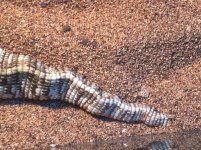
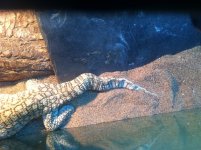
He started eating again and is going back to his original self except for his tail is kinked. even when I straighten it by hand I can feel tendons pulling it back to being crooked, I don't remember his tail every like this, and when he was sick it was worse. It seems like a more internal issue than just dehydrated. When they are dehydrated they shrink up evenly across the length of the tail. Here are some pics if anyone has any information I would really appreciate it.

What is flagyl and what is panacea? Is this something that I should have already treated him with? Should I treat him now? He was bought in a pet store 5 years ago.
 

Attachments

  • IMG_2554.jpg
    IMG_2554.jpg
    438.3 KB · Views: 357
  • IMG_2552.jpg
    IMG_2552.jpg
    390.6 KB · Views: 322
I'M IN THE same predicament,other than the fact that I am married.is yours a hatchling? It is common for hatchlings to have a slim chance of survival, considering the fact that a small percentage of hatchlings survive out of each batch. If this is the case, then, buy one no younger than a juvenile. The hatchling I currently bought, is behaving the same way, along with similar appearance. I got the best advice from, the eastbay vivarium in berkely, c.a. I recommend you Google them and get the same advice as I did, as far as 100 on warm side and 80 on cool side, along with proper humidity. Besides the advice they gave me, I have been force feeding,crickets dust with multivitamin and calcium powder, holding tail while submerged in water, to exercise it's limbs, and exposing it to uvb lighting. I suggest you call the eastbay vivarium in berkely c.a. to ask before doing anything else though.
 
He's had him for 5 years, so it's not a hatchling. The original post was a month ago, so I hope he's been to the vet now - how did it go?

Flagyl and panacea are anti-parasite medicines, so they would be used in case he had worms or some other sort of gut parasite.
 
Crossfire,

Your monitor isn't doing well because your husbandry is way off. There's so much info on-line that it always surprises me to see these types of posts. You need a MUCH larger enclosure filled with a few feet of dirt. Walnut bedding will kill your monitor. Do you measure the basking temps or are you just guessing? A 150 watt bulb in a 55 gallon tank is way overkill. I use 4'x 2' horse troughs with a plexi glass top for some of my hatchling lace monitors. It's an easy, efficient, and inexpensive design. In each of these I have a 75 watt megaray bulb. This 75 watt bulb is enough for 130F basking temps and ambient temps in the mid 80's. If it helps, I can post pics for you.

The tail is due to MBD. What are you feeding him? If you want your monitor to have any chance of survival you need to make changes right away. Good luck and let me know if you have any questions.
 
I'M IN THE same predicament,other than the fact that I am married.is yours a hatchling? It is common for hatchlings to have a slim chance of survival, considering the fact that a small percentage of hatchlings survive out of each batch. If this is the case, then, buy one no younger than a juvenile. The hatchling I currently bought, is behaving the same way, along with similar appearance. I got the best advice from, the eastbay vivarium in berkely, c.a. I recommend you Google them and get the same advice as I did, as far as 100 on warm side and 80 on cool side, along with proper humidity. Besides the advice they gave me, I have been force feeding,crickets dust with multivitamin and calcium powder, holding tail while submerged in water, to exercise it's limbs, and exposing it to uvb lighting. I suggest you call the eastbay vivarium in berkely c.a. to ask before doing anything else though.

Eric,

Only a small percentage of wild hatchling monitors survive because of predation and hardships. In captivity, the survival rate should be sky high but, due to poor husbandry, it's pitifully low. In the past two seasons I've hatched 15 lace monitors. All are alive and well because the people who bought them did their homework. I've raised many hatchlings, of different species, over the years and have lost very few.
 
Stephen, I'm aware the threads a bit old but how's your monitor doing?
 
I'M IN THE same predicament,other than the fact that I am married.is yours a hatchling? It is common for hatchlings to have a slim chance of survival, considering the fact that a small percentage of hatchlings survive out of each batch. If this is the case, then, buy one no younger than a juvenile. The hatchling I currently bought, is behaving the same way, along with similar appearance. I got the best advice from, the eastbay vivarium in berkely, c.a. I recommend you Google them and get the same advice as I did, as far as 100 on warm side and 80 on cool side, along with proper humidity. Besides the advice they gave me, I have been force feeding,crickets dust with multivitamin and calcium powder, holding tail while submerged in water, to exercise it's limbs, and exposing it to uvb lighting. I suggest you call the eastbay vivarium in berkely c.a. to ask before doing anything else though.
Feed him wax worms my hat chilling was doing the same thing he was skinny weak and not moving much started giving him upwards of 4 2
Wax works daily and he's still not eating on his own but he's doing much better ::)
 
monitor update

sues, my savannah monitor i had started this post about had pulled through this predicament, I had to force feed him once some carnival care the vet gave me. I think that gave him energy enough to pull through. I had to also offer water to him daily. by putting his nose up to warm tap water running in the sink, and waiting for him to stick his tongue out and seeing if he willingly started to drink. Most of the time he did start drinking water on his own and that made me realize that as long as he way drinking he'd be okay.

What I think had happened what I accidnelty broke his tail when he was fighting me while I was clipping his nails. Other than that I do not know.

No i didn't just guess at his temp, I tried to keep basking around 110, and watch where he sat under the lamp, directly of offset, and would change the bulb from 100watt to 150watt accordingly. In the summer time when the air is on he got the 150watt. The crushed walnut bedding he has never had a problem passing through his system. I believe it is a lot better than sand or dirt or cypress chips, and while they are young encourages natural behavior with foraging for insects i put in there.
But you guys were right about the cage size, I have said to myself for years I am going to build him something bigger and never got around to it.

That was then, keep in mind I posted this thread a long time ago.

About 6 months ago he started to get a cataract in one of this eyes, or at least something that caused his eye to cloud over, shortly after that he other eye did the same thing. After he lost his sight I really had to baby him to get him to find his food and help him swallow it. By picking him up and letting gravity work with him. And helping him find it when he couldn't see, or when he lost it. 2 months after he lost his eye sight, he start to loose him ability to balance himself and walk normally, eventually he lost the use of this back legs all together.
About that time he started to stop eating and would only take water when i offered it him by picking him up and putting up in the tub or to the running tap water. About a month after that he stopped drinking. I made sure to put a 75watt in that kept him good and warm all the time since he couldn't move. and checked him often.

So after I few tearful weekends I told myself if it was me I wouldn't want to live like that and have to be force feed and watered, so I had him put down. At the time this savannah monitor was had live 10 years out of his 12 year life cycle.
Forcing him to live in that 55gal aquarium his whole life is probably what cut his life short by two years. To anyone who wishes to attack my husbandry methods may do so at will, but keep in mind I am the one who has to live with the fact that this lizard has been my best friend for the last 10 years of my life, and my ignorance is probably what cut his life short.
As he began more dehydrated he had one of his hind legs that didn't shrink up like the rest of his body, he also had little to no reaction when you pinched this hind leg like he did with his other leg. So I suspect something more serious was going on, perhaps cancer. I don't know, I live in Indiana there are very few reptile vets, all of which have a wait list and cost a fortune.

Now is someone wants to help me correct my mistakes of the past last year I bought a black roughneck monitor and am preparing to build him a custom cage, I posted a thread in the cage forum for advice about sliding glass doors, custom rock walls etc.
I also need to know what else I can be feeding him, the more I learn about monitors the more I learn about what I am doing wrong. I have been feeding him mostly fuzzy rodents and realize now that, that shouldn't be so, and would like to know what else I can offer him. Keep in mind I do not have access to live squid, shrimp or anything from an ocean, but semi fresh fish.
 
I am very sorry to hear that you lost your monitor friend. I fully understand that you can become as attached to any reptile as much as you would be to a mammal.

I think that you realise that your husbandry could have been better, but you obviously put a lot of energy into trying to do the best for him that you could, and I hope that anyone responding with suggestions for your new monitor also realises this and does so with sensitivity not with the intent to attack you.

I have never kept a monitor, so I can't help with specifics, but as a starting point, I found a care sheet at Backwater Reptiles that might help; http://www.backwaterreptiles.com/reptile-care-sheets/black-roughneck-monitor-care-sheet.html


Enclosure: These are arboreal monitor lizards, which means they enjoy climbing. Sure, they spend some time on the ground, but more often than not, you'll find them perched on a branch or traversing other climbable surfaces. I have one wall inside the cage entirely covered with flat cork bark, and I'd estimate that my current "rudi" spends nearly 75% of his time on it. He even chooses to sleep vertically once in a while (albeit rarely).

There is no calculation for determining minimum cage dimensions for any lizard, so just use common sense. Give them enough room to walk and climb freely, which means a fairly large cage as they approach adult size. Vertical space tends to be more important to them than floor space. I've discovered that Black Roughneck monitors will actually burrow underneath the substrate at night if given the option. One of mine created a permanent tunnel under the dirt and moss flooring.

Heating & Humidity: A basking spot reaching graduated highs of 130F to 150F should give these lizards the temperature they need to efficiently digest their food and maintain a strong immune system. Use a temp gun to make sure. Make sure the cage has a gradient of temperatures, giving the monitor an opportunity to choose whether it wants to bask in hot temperatures, or cool itself down. Basically, this is a must for all lizards and will pay dividends.

Indonesia has an average relative humidity of between 72% and 86%. This gives you a general idea of how humid it can be within their natural habitat. Misting the cage regularly, along with a fairly substantial water bowl (and no full screen top), should get you into their preferred humidity range. I've found that even 60% humidity isn't quite enough for Black Roughneck monitors (note: if you see them soaking in their water dish, your cage is not humid enough). Substantial air flow is your enemy, as it dries out the enclosure. Tip: using a dirt substrate with some depth helps greatly in maintaining humidity. Adding some leaf litter to the top of the substrate will help maintain its moisture.

Lighting: 45W halogen basking bulbs. UV lighting is not, in my experience, necessary for these meat-eating lizards. But, if you're so inclined, feel free to utilize UV lighting as well.

Feeding: Black Roughneck monitors are not ruthless killing machines like the Argus monitor or bottomless pits like the Savannah monitor. If properly cared for, and given enough heat, they will have strong appetites, but not insatiable ones. Let them eat until they are full. They tend to use their front claws to tear apart food items, especially when the prey is too large to swallow whole. I personally think this also makes digestion somewhat easier.

As babies, they feast upon crickets and small roaches, but don't seem to appreciate superworms and waxworms with quite as much gusto. As they grow, they will readily accept mice, and eventually even chicks. Try to keep their diet somewhat varied, rather than an entirely rodent-based menu. If nothing else, it probably keeps things a little more interesting for the lizard. Large roaches are relished, as are crayfish. While not recommended due to the potential transfer of internal parasites, they will absolutely devour small lizards. One of mine essentially inhaled two live House geckos that I put into the cage.

Copyright 2011 - BackwaterReptiles.com
 
Thx for you reply, i went through all the sites google brought up for black rough neck monitor, care sheet, feeding. This one I did find, and led me to believe it was okay to feed him a whole baby chicken today that i got from the tractor store. It was really small and he ate it like a boss, but am not sure what effect all the feathers will have on his digestive system, and am not sure if its okay to keep feeding these to him. If it is okay, how often? Yes, I did post these same questions under a different black roughneck monitor thread.
I don't mind feeding live animals to my monitors, but I become hesitant to take a pair of scissors to a live baby chick, in order to remove his wings. Next I am gonna try frozen silversides, and maybe tilapia fillet, and also order some dubia roaches.
 
As I said, I don't know anything about monitors, but as it happens, my snakes live 100% on chickens, (from newborns to about 10 days old), and they have absolutely no difficulty with the feathers - it's all pretty much fluffy down at that age anyway.

I do find that keeping the chicks for a few days helps with the droppings though - when I fed them at the first day of hatching, the droppings were loose and very smelly (I suppose a newly hatched chick is still really just an egg-on-legs), but if I keep them even 2 or 3 days and feed them up on chicken feed (which I imagine would be available from the place you get the chicks), they are much firmer and less smelly.

Now, as my snakes are bigger, I raise them for about a week, and I feel that they are probably nutritionally more complete at that stage. I also follow the chicks up with a chicken wing portion once in a while to supply more skin, muscle and bone than might be available on a chick.

So, presuming that what a snake can eat, a monitor can deal with, I'd just feed the whole animal, no need to cut off wings.
 
Thx for you reply, i went through all the sites google brought up for black rough neck monitor, care sheet, feeding. This one I did find, and led me to believe it was okay to feed him a whole baby chicken today that i got from the tractor store. It was really small and he ate it like a boss, but am not sure what effect all the feathers will have on his digestive system, and am not sure if its okay to keep feeding these to him. If it is okay, how often? Yes, I did post these same questions under a different black roughneck monitor thread.
I don't mind feeding live animals to my monitors, but I become hesitant to take a pair of scissors to a live baby chick, in order to remove his wings. Next I am gonna try frozen silversides, and maybe tilapia fillet, and also order some dubia roaches.

When they're young they should be fed everyday. The digestive system of a monitor has no problem handling bones, feathers, and fur. I feed all of my monitors mice, quail, and chicks. There's no reason to feed live and you're best bet is to order frozen feeders online.
 
Back
Top