• Responding to email notices you receive.
    **************************************************
    In short, DON'T! Email notices are to ONLY alert you of a reply to your private message or your ad on this site. Replying to the email just wastes your time as it goes NOWHERE, and probably pisses off the person you thought you replied to when they think you just ignored them. So instead of complaining to me about your messages not being replied to from this site via email, please READ that email notice that plainly states what you need to do in order to reply to who you are trying to converse with.

  • IMPORTANT! PLEASE READ!! About the Google Adsense ads being displayed

    =====================
    Posted 08/15/2025
    =====================


    Yeah, I know. They are a pain in the butt. But they pay the bills to keep my server running. Just a fact of life, I am afraid.

    Want to get rid of them? Simple. Just become a Contributor level member or above and they will be gone. -> Please click HERE."

    Is that too much for me to ask of you to keep this site running? Well, sorry about that. I too wish I could get everything for free. But alas.....

    =====================
    Addendum: 01/10/2026
    =====================


    Google Adsense ad revenue for December, 2025 was just $30 over the cost of the lease for the server running this site. So, in effect, the money providing the incentive for me to continue running this site is coming SOLELY from the paid memberships and sponsorships here. Which honestly ain't much....

Sexing Prehensile Tailed Skinks

ErnieM

New member
Joined
Apr 7, 2006
Messages
23
Reaction score
0
Points
0
Age
67
Location
Nashville, TN
I am currently evaluating the purchase of a couple of PTS that have been housed together for a couple of years with no breeding observed. Before I plunk down the cash, I wanted to be as sure as I could be of the sexes of these little guys.

I note in Vosjoli's PTS book, he says that adult lizards can be sexed by everting the Hemipenis. Before I have anyone do this to the potential detriment of the subject, I wanted to get some feedback from y'all as to any experience with "popping" adult PTS's.

Anyone have any thought on this?
 
Sexing Corucia

LEEWAY CORUCIA RESEARCH CENTER (LCRC)


Hello,


Probing Corucia zebrata (underlined) has always proven indeterminate. It accomplishes nothing but one having a very angry skink. The jaw strength of these guys is incredible and you want to avoid being bitten at all costs.

Behavior observations can be a determinate factor although variations do occur. two males will almost (but not always) fight. Males, usually to express dominance, will twitch their tail similar to that of a cat. Females can occasionally attach each other as well.

A gentleman by the name of Justin once suggested using the shedded skin of a known male in an enclosure of a new skink. if the newcomer reacted to the skin in a hostile fashion, it would denote a male. However, in practice, this has proven indeterminate as well.

Generally males have a 'blockier' head in width and females a narrower , shorter head IN APPEARANCE. actually, the head size can be similar. It appears different more when compared to body width. A biometric formula designed at the former South Florida Corucia Research Center, can give a guide to sex by measuring the width of the head and dividing by the width of the girth of the midsection. If the results are less than about .73, the Corucia may be female. If above, then a male is likely. This method also is not absolute. Of course, a gravid female will have significant girth to give one a good idea of sex.

In short, there is no clear - cut answer but to combine a variety of methods and hope for the best. If the Corucia is not malnurished, a thin build Corucia give a better chance of being a male.

Sincerely,
Brian - LCRC
 
Thanks, Brian. These two are very happy in the same enclosure, and have been for a couple of years. I will try the formula method, and see what I get. If the measurements are close to each other, then at least I can have some assurance that they are the same sex...whatever that is!

Ernie
 
Additional info on sexing Corucia

Hi Ernie,

Another popular idea that has come in to play lately is ultrasound for sexing Corucia. In my experience, as well as other experienced Corucia caretakers, is that ultrasound is fairly expensive & the results often clouded, literally. Corucia, if you haven't noticed, are very 'gassy' lizards in which many times an ultrasound will prove inconclusive because of this. Brian was right with the above advice but, I might also add, male Corucia tend to do a little dance when interested in mating. I've seen this many times. It's a dance in which they have a tendency to do a bobbing & weaving motion with their head. Bump the humidity up & do alot of misting .... There really is no set time in the day or evening that one can witness this. Even though Corucia are known to be crepuscular, when it comes to mating & the ritual beforehand, they don't really care what time of day it is!! In the wild, mating may commense and spike with the start of the rainy season. With Corucia kept outdoors in Southern Florida, mating occurred with more intensity and frequency during rainshowers and thunderstorms. By the way, the ratio method, if you use it, is called the C/A biometric ratio (Latin: C= Caput (head) A = amplus (width) ). You may post pictures if you wish us to try to sex them with this method. The picture needs a clear shot of the head and abdomen as seen from above. Positioned vertically really helps too with the body as straight as possible. Sexing Corucia is not easy. The C/A has worked for us about 75-80% of the time. The rest of the time, it's just observations, personality, shape of head &/ or body etc. It would, in fact, be interesting to know that if you happened to have 2 male Corucia living together harmoniously, whether this occurs because lacking a female would make them non-territorial. Good luck to you & I hope you can try to post pics.

Sherri & Brian
LCRC

 
Thanks again. I will work on getting pix for this purpose.

Another bit of information on these two...they were long term at a local herp shop together, and when an older C. zebrata was put in with them in an attempt to get something going, the older one tried to rough up the other two. So, whether they were all males, or all females, or just cranky...who knows?!?

I will get pix when I can...

Ernie
 
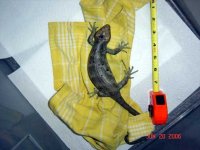
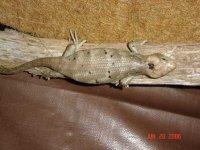
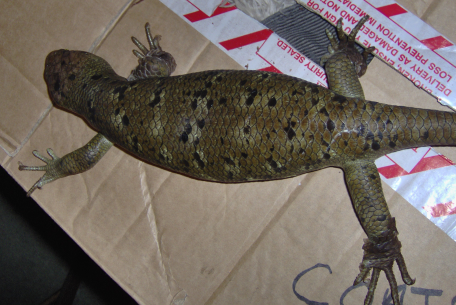
Hello All- I decided to put some more pictures up for evaluation. This is my 2nd baby PTS- about 3months old. I think female, but what do you all think? Also, Sherri, I noticed that you referred to one of my other pics by a sub-species name. I didn't know we were doing that now, maybe you could start another thread about that, too if your not too busy. Geez its good to be back, I didn't realize I missed this so much!

Kisha
 

Attachments

  • 2nd  Baby Female2.web.jpg
    2nd Baby Female2.web.jpg
    22.3 KB · Views: 421
  • 2nd Baby Female.web.jpg
    2nd Baby Female.web.jpg
    28 KB · Views: 439
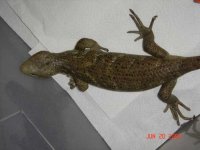
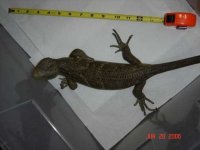
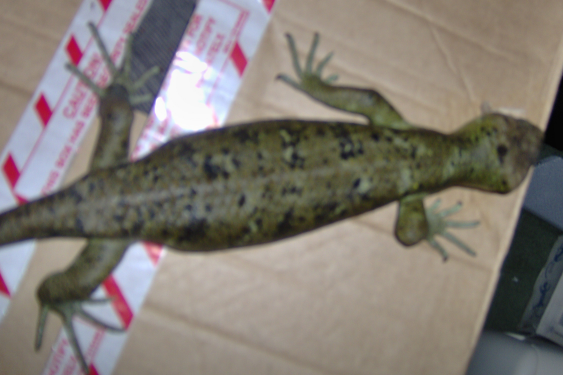
Here is my other (not sick) twin. Better shots for sexing, any ideas? I don't have any about this one.

Kisha
 

Attachments

  • Good Twin Sex Unknown2.web.jpg
    Good Twin Sex Unknown2.web.jpg
    15.6 KB · Views: 491
  • Good Twin Sex Unknown.web.jpg
    Good Twin Sex Unknown.web.jpg
    13.5 KB · Views: 424
Picture # 1- probably a female; very cute

Picture # 2- also a probable female; she is a beauty!

Pictures 3 & 4- 90% sure male; 95% sure alfredschmidti; Congratulations!

Sorry that I switched subjects on you like that in the last post. I just got so excited when I saw the twins & whether you knew what you may have. Alfreds are pretty rare. Out of my 57 Corucia, 8 are alfredschmidti. I won't go into anymore of that until we start a new thread.
 
So it looks like the twins are both male, that may well be part of the problem. Picture #1+2 were the same skink, btw, the different lighting changed her coloring dramatically. So now I have too many males! Looks like I'm back in the market for a sale or trade :) I can't wait to read about the alfredschmidti, eventhough I have no idea what that means.
Kisha
 
I have a shortage of males, LOL! Maybe we can talk about this..... On alfredschmidti, Out of the 8 (with baby included), I only have one male! He's been very busy lately... Actually, I only paired him with 3 other females & I hate that ratio. My favorite is a 1:2 but as you'll find out, CZA's are extremely difficult to come by. I do have 3 single females (hint, hint!). Maybe we can work out a trade because, all joking aside, they need to be in a breeding situation. Keeping the line pure is preferable too for obvious reasons.
 
Wow, how did you get so lucky! A trade is absolutely something I would want to pursue. The big twin could be ready to go anytime, but the other will need a bit of time to put some weight back on before I stress him out with new cage mates. I agree absolutely about keeping them in breeding groups. Lets talk more about this.
What you have said about alfredschmidti in the other post would certainly explain a few things about these 2. Not just the skin problems with the one, but the other is horribly aggressive compared to my others- he lunges and comes after you if you go into his cage and will climb out after you if you don't get the door shut in time! Thanks for your opinions about the sexes, I think I might be getting better. I'm also glad we can discuss these things in a public forum, more info for everyone else who may have the same questions.
 
I'm so glad about discussing this too & really happy that you came on the scene when you did. It's breathing new life into things & hopefully we all can learn on behalf of our animals. We owe them that! Yes, we can talk trades but maybe privately. First & foremost, we need to get your boy up & going but i'm with you.. all of what we've discussed might be the answer to why he has not been thriving. I really, really am thrilled for you about the twins being alfredschmidti because they are soooo very rare & this has been an excellent way to bring this topic to everyones attention.

Thanks again,

Sherri
 
Sorry to drag up an old thread, but please could someone post pictures of a "typical" body build for male/female? The pics in the thread dont seem to be working any more. :(
 
Or how about this - Please could someone give me an educated guess as to what sex these two are?
Skinksex1.png


Skinksex2.png
 
The first picture looks like a female by the heavy build of its body. I would like to use something called the C/A Biometric ratio to determine the sex, but it is a little difficult to determine as the picture is at a bad angle. This ratio is of the width of the head divided by the widest girth of the body. It is not 100% accurate, but it is good as a general guide. A picture like to second skink is much easier to determine sex from. The second appears female. It does look somewhat skinny in the pelvic/lower abdomen region, so you might want to have that checked out. jrbl
 
Thanks for the reply.

The first is the aggressive one, so it was harder to keep her out for a photo :) I will try again, although I too would have guessed female. The second was a little harder for me to determine, but I guess it looks like I have 2 females. Great. Guess Id better start looking for a male...

The second one is a bit thin on the hips and tail, and this is a concern to me so she will be going to the vet. Over the week I have had her though she has been eating like a pig so hopefully thats all she needed, but a check over should clear things up. Is it possible also to have them DNA tested? Or do you think its not worth it?
 
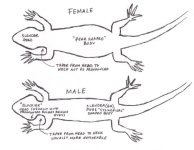
If you have several and can compare them (and know what to look for...) the males generally have larger, "blockier" or "chunkier" heads than the females. Whereas the females sometimes look a bit "pinheaded" in comparison. Also, the females almost always have a "pear-shaped" body (when viewed from the top): narrower just behind the front legs, and bulging out toward the back legs, while the males are usually "straighter" (more uniformly cylindrical their entire length). But sometimes it's hard to tell -- I have one juvenile that I think is about 3 or 4 years old that I *still* am not sure about ('though I'm starting to lean toward "female")...

-- C
 
Here is my crude attempt to illustrate the differences between a male and female Corucia. This picture shows the outline of an adult female and male, as viewed from the top. Note that the differences are exaggerated in this illustration, and that individual Corucia may vary.

This doesn't apply to juveniles, although some of us who have kept a lot of Corucia *think* we can tell (with some reliability) based on head shape, but it's far from foolproof.

From what I've observed, there is no apparent difference in tail taper (which is usually helpful in sexing snakes). However, I am working on a theory that there *may* be some discernable difference in vent "contour" (i.e., the shape of the vent area fore and aft of the opening, as viewed from the side). Will let you know if I figure anything out in this "area".

I hope this helps some people.

-- Celeste
 

Attachments

  • Female vs Male smallest.jpg
    Female vs Male smallest.jpg
    45 KB · Views: 340
Thanks Celeste. Im getting really confused with some I see still - for example, one of my females has a big bulky head with large bulges behind eyes, but she has a pear shaped body..! I spoke to someone else that said hemipenal bulges may be visible at times, can anyone clarify this?
 
That "hemipenal bulge" may be the "vent area contour" I was referring to. It *seems* to me that (again, sometimes), the male vent area has a recognizable bulge aft of the vent opening, while the female vent area tapers more immediately aft of the vent opening (sort of like in snakes). But I haven't been able to observe enough to be sure, which is why I say it's just a "theory" right now.

Also, the head bulges seem to be more pronounced in Cza's, so female Cza's can resemble male Czz's... (While a male Cza is unmistakeably male!)

Sherri says it's not safe to probe these guys. Philippe de Vosjoli's book show a technique for everting the male hemipenes. But if done improperly it can cause serious crushing trauma... :-L

So far, I've had a high enough success rate with the head/body shape comparison shown in the picture that I haven't messed with any other techniques (I've sexed 15 out of 17 definitively, and have 4 established breeding groups to prove it). But I still have one adult Czz that I haven't been able to sex for sure yet (he or she is housed with three definite females), and one baby I think is female but I'm not *positive* about yet (and that one I don't really have to worry about for a couple more years).

-- Celeste
 
Back
Top