• Responding to email notices you receive.
    **************************************************
    In short, DON'T! Email notices are to ONLY alert you of a reply to your private message or your ad on this site. Replying to the email just wastes your time as it goes NOWHERE, and probably pisses off the person you thought you replied to when they think you just ignored them. So instead of complaining to me about your messages not being replied to from this site via email, please READ that email notice that plainly states what you need to do in order to reply to who you are trying to converse with.

  • IMPORTANT! PLEASE READ!! About the Google Adsense ads being displayed

    =====================
    Posted 08/15/2025
    =====================


    Yeah, I know. They are a pain in the butt. But they pay the bills to keep my server running. Just a fact of life, I am afraid.

    Want to get rid of them? Simple. Just become a Contributor level member or above and they will be gone. -> Please click HERE."

    Is that too much for me to ask of you to keep this site running? Well, sorry about that. I too wish I could get everything for free. But alas.....

    =====================
    Addendum: 01/10/2026
    =====================


    Google Adsense ad revenue for December, 2025 was just $30 over the cost of the lease for the server running this site. So, in effect, the money providing the incentive for me to continue running this site is coming SOLELY from the paid memberships and sponsorships here. Which honestly ain't much....

Snakes That Don't need Heating

herps420

New member
Joined
Apr 24, 2020
Messages
26
Reaction score
0
Points
0
Location
Mountain View, CA
I was wondering what snakes (if any) don't require any heating to do well? I don't want a hot snake, I know most vipers don't need heating. I was thinking a rat snake maybe?

 
Well, that depends on the temp in the room. If ambient is 85F, lots of snakes wouldn't need supplemental heat. If 60F, most would. Heck, if you run your room on the warm side, some would benefit from cooling (and many do need winter cooling to breed).

Even those that are often kept at 'room temp' can benefit from opportunities to thermoregulate, even a couple degrees. I give my black milks a 75F hot spot, simply for choice, and they do use it occasionally.

Since providing heat to a snake is so cheap, and so simple, I'd not recommend that this be any part of a choice of which snake to keep. There are literally scores of more important criteria.
 
Well, that depends on the temp in the room. If ambient is 85F, lots of snakes wouldn't need supplemental heat. If 60F, most would. Heck, if you run your room on the warm side, some would benefit from cooling (and many do need winter cooling to breed).

Even those that are often kept at 'room temp' can benefit from opportunities to thermoregulate, even a couple degrees. I give my black milks a 75F hot spot, simply for choice, and they do use it occasionally.

Since providing heat to a snake is so cheap, and so simple, I'd not recommend that this be any part of a choice of which snake to keep. There are literally scores of more important criteria.

at 72-75 degrees room temperature. By the way, not all black milk snakes are black, right? I want one with the red black and white stripes, kind of like a coral snake. (yes I know they are in a different order).
 
The black milk snake (which matures to solid black) is Lampropeltis micropholis. All other species in the former Lampropeltis triangulum complex are tricolors.
 
The black milk snake (which matures to solid black) is Lampropeltis micropholis. All other species in the former Lampropeltis triangulum complex are tricolors.


I believe you are thinking of Lampropeltis triangulum gaigeae which is the Black Milksnake. Lampropeltis micropholis is the Andean (or Ecuadorian) Milksnake that gets darker, but not solid black like gaigeae.

More snakes that don't require supplemental heating:

Rhino Ratsnakes
Rein Snakes
Sumatran Short Tails (perfectly happy in the high 70's low 80's)
Russian Ratsnakes
 
I believe you are thinking of Lampropeltis triangulum gaigeae which is the Black Milksnake. Lampropeltis micropholis is the Andean (or Ecuadorian) Milksnake that gets darker, but not solid black like gaigeae.

More snakes that don't require supplemental heating:

Rhino Ratsnakes
Rein Snakes
Sumatran Short Tails (perfectly happy in the high 70's low 80's)
Russian Ratsnakes

I was thinking a rein snake, i think that they look really nice in blue.
The only thing is, i don't know where I could find one? They are also rare snakes, so there are no care sheets on them. Is there a specific place you know of that sells them?

As for milksnakes, why do some milk snakes of the same species (unless they were wrongly listed as the same species) have the three bands that are blurred? I don't really like the look of that, I would like one that has the three colors bright and seperate. (sorry if I'm being picky)
For example:
This:

search


not this:

search


I don't know if it varies snake to snake, or if they are different species labeled as the same.

Thanks for you guys' help!
 
Hi Terry -- I got my black milks from you in 2016 or so, and they're doing great!

I believe you are thinking of Lampropeltis triangulum gaigeae which is the Black Milksnake. Lampropeltis micropholis is the Andean (or Ecuadorian) Milksnake that gets darker, but not solid black like gaigeae.

the former Lampropeltis triangulum complex

Subspecies of Lampropeltis triangulum were dropped, and L.t. gaigeae, L.t.andesiana, and L.t.micropholis are now all Lampropeltis micropholis. What we call the 'Costa Rican Black Milk Snake' are a couple montane locales of micropholis from Costa Rica. Per this paper:

Sara Ruane, Robert W. Bryson, Jr., R. Alexander Pyron, Frank T. Burbrink, Coalescent Species Delimitation in Milksnakes (Genus Lampropeltis) and Impacts on Phylogenetic Comparative Analyses, Systematic Biology, Volume 63, Issue 2, March 2014, Pages 231–250, https://doi.org/10.1093/sysbio/syt099

http://www.kingsnake.nl/lampropeltis-micropholis/

http://reptile-database.reptarium.cz/species?genus=Lampropeltis&species=micropholis

http://www.catalogueoflife.org/col/...5a3a/synonym/3e8c33ed22c99b2230730ac91bc05288
 
As for milksnakes, why do some milk snakes of the same species (unless they were wrongly listed as the same species) have the three bands that are blurred? I don't really like the look of that, I would like one that has the three colors bright and seperate. (sorry if I'm being picky)

A lot of this has to do with selective breeding. Wild (or 'wild type') snakes will typically be not so clean looking as nice captive bred snakes (the latter is what you'd be buying, with most milk species). If you find a snake for sale (so, look at ads) that you like the look of, then you can go back and learn about the species and see if it is interesting to you.

I'd strongly advise handling a couple milks before you buy. I bred pueblans and nelsons, and owned a honduran, and over time I found that other than being really pretty, and easy to care for, and easy to breed, their general attitude wasn't rewarding.
 
I have Black Milks, Russian Rats, and Korean Rat .. all do well at lower temps than most .. but like a little basking area .. of these .. my Russians and Black Milks are my favorites!
 
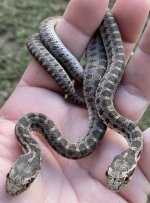
Elaphe davidi do not need heat.
 

Attachments

  • 3AACD896-543B-4677-ADA0-0E6FF36696BA.jpg
    3AACD896-543B-4677-ADA0-0E6FF36696BA.jpg
    301.3 KB · Views: 117
Back
Top