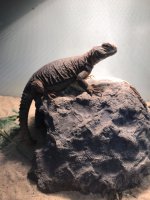
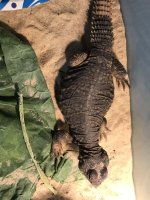
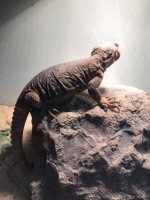
I do not know if it is Uromastyx shobraki. But, this is all I could find on the particular species.
Uromastyx shobraki WILMS & SCHMITZ, 2007
– /
IUCN Red List - Uromastyx shobraki - Near Threatened, NT
iNaturalist logo
Add your own observation of
Uromastyx shobraki »
We have no photos, try to find some by Google images search: Google images
Higher Taxa Agamidae (Uromastycinae), Sauria, Iguania, Squamata (lizards)
Subspecies
Common Names G: Südarabische Dornschwanzagame
Synonym Uromastyx yemenensis shobraki WILMS & SCHMITZ 2007
Uromastyx shobraki WILMS et al. 2009
Uromastyx yemenensis shobraki — SINDACO et al. 2014
Uromastyx shobraki — TAMAR et al. 2017
Distribution W Yemen
Type locality: Mafraq Mocca (Mafraq al-Mukha), km 13.5, Republic of Yemen.
Reproduction
Types Holotype: ZFMK 48681, adult male, leg. B. Schätti, 5.–6.IV.1988; Paratypes: ZFMK 48680, adult male, same data as holotype; MHNG 2496.55-56, MHNG 2553.56 and MHNG 2455.100.
Diagnosis Differential diagnosis: Uromastyx shobraki is distinguished from U. thomasi and U. princeps by the significantly longer tail. From all remaining species of the genus (with the exception of the U. ocellata group) by the arrangement of the annuli of the tail: last 8–21 forming a continuous scale row each (U. ocellata group) vs. 2–5 whorls forming a continuous scale row (all other Uromastyx species). From U. ocellata, U. ornata and U. macfadyenithe species differs in lacking femoral- and preanal pores.
Comment
Uromastyx shobraki differs from U. benti in having smaler scales around midbody (188.92 +/- 13.22 in U. shobraki vs. 160.05 +/- 8.98 in U. benti) and smaller ventrals (86.64 +/-4.88 in U. shobraki vs. 74 +/-4.02 in U. benti). U. shobraki is differentiated from U. yemenensis not only by its larger maximum size (393 mm in U. shobrakivs. 337 mm in U. yemenensis) but also in different colour pattern and in significant genetic differences.
Etymology U. shobraki is named in honour of Dr. Mohammed Shobrak, Director of the “National Wildlife Research Centre, NWRC” in Taif, Saudi Arabia, for his outstanding achievements regarding the conservation of Arabian Wildlife.
References
Sindaco, Roberto; Riccardo Nincheri, Benedetto Lanza 2014. Catalogue of Arabian reptiles in the collections of the “La Specola” Museum, Florence. Scripta Herpetologica. Studies on Amphibians and Reptiles in honour of Benedetto Lanza: pp. 137-164 - get paper here
Tamar, Karin; Margarita Metallinou , Thomas Wilms , Andreas Schmitz , Pierre‐André Crochet , Philippe Geniez , Salvador Carranza 2017. Evolutionary history of spiny-tailed lizards (Agamidae: Uromastyx) from the Saharo-Arabian region. Zool Scripta 2017;00:1–15 - get paper here
Wilms, T. 2007. Dornschwanzagamen der Gattung Uromastyx - Einführung in Taxonomie und Ökologie einer auf Wüsten spezialisierten Echsengruppe. Draco 8 (31): 4-19 - get paper here
WILMS, T.M. & A. SCHMITZ 2007. A new polytypic species of the genus Uromastyx Merrem 1820 (Reptilia: Squamata: Agamidae: Leiolepidinae) from southwestern Arabia. Zootaxa 1394: 1-23 - get paper here
Wilms, Thomas; Böhme, Wolfgang; Wagner, Philipp; Lutzmann, Nicolà; Andreas Schmitz 2009. On the Phylogeny and Taxonomy of the Genus Uromastyx Merrem, 1820 (Reptilia: Squamata: Agamidae: Uromastycinae) – Resurrection of the Genus Saara Gray, 1845. Bonner zoologische Beiträge 56: 55-99 - get paper here
External links
IUCN Red List - Uromastyx shobraki - Near Threatened, NT
National Center for Biotechnology Information
Google images