

• Responding to email notices you receive.
    **************************************************
    In short, DON'T! Email notices are to ONLY alert you of a reply to your private message or your ad on this site. Replying to the email just wastes your time as it goes NOWHERE, and probably pisses off the person you thought you replied to when they think you just ignored them. So instead of complaining to me about your messages not being replied to from this site via email, please READ that email notice that plainly states what you need to do in order to reply to who you are trying to converse with.

  • IMPORTANT! PLEASE READ!! About the Google Adsense ads being displayed

    =====================
    Posted 08/15/2025
    =====================


    Yeah, I know. They are a pain in the butt. But they pay the bills to keep my server running. Just a fact of life, I am afraid.

    Want to get rid of them? Simple. Just become a Contributor level member or above and they will be gone. -> Please click HERE."

    Is that too much for me to ask of you to keep this site running? Well, sorry about that. I too wish I could get everything for free. But alas.....

    =====================
    Addendum: 01/10/2026
    =====================


    Google Adsense ad revenue for December, 2025 was just $30 over the cost of the lease for the server running this site. So, in effect, the money providing the incentive for me to continue running this site is coming SOLELY from the paid memberships and sponsorships here. Which honestly ain't much....

US Outbreak of Human Salmonella Infections Associated With Aquatic Frogs

wcreptiles

New member
Joined
Nov 15, 2003
Messages
557
Reaction score
4
Points
0
Location
Cincinnati, Ohio, USA
Sorry the complete article requires a subscription, following is the abstract.

US Outbreak of Human Salmonella Infections Associated With Aquatic Frogs, 2008–2011
Shauna L. Mettee Zarecki, RN, MSN, MPHa,b,c,d, Sarah D. Bennett, MD, MPHa,b,d, Julia Hall, MPHe, Jill Yaeger, BSf, Kate Lujan, RN MPHg, Marguerite Adams-Cameron, MPHh, Kim Winpisinger Quinn, MSi, Rita Brenden, PhDj, Gwen Biggerstaff, MSPHb, Vincent R. Hill, PhD, PEb, Kari Sholtes, MSEEk, Nancy Marie Garrett, BSb, Patti C. Lafon, MSb, Casey Barton Behravesh, MS, DVM, DrPHb,d, Samir V. Sodha, MD, MPHb,d,l, on behalf of the Salmonella Typhimurium Outbreak Investigation Team
+ Author Affiliations

aEpidemic Intelligence Service,
bDivision of Foodborne, Waterborne, and Environmental Diseases, National Center for Emerging Zoonotic and Infectious Diseases,
cPreventive Medicine Residency and Fellowship,
kDivision of Emergency and Environmental Health Services, National Center for Environmental Health, and
lGlobal Immunization Division, National Center for Immunization and Respiratory Diseases, Centers for Disease Control and Prevention, Atlanta, Georgia;
dUnited States Public Health Service Commissioned Corps
eUtah Department of Health, Salt Lake City, Utah;
fMadera County Environmental Health Department, Madera, California;
gDisease Control Environmental Epidemiology Division, Public Health Nurse Consultant Office of Planning and Partnership, Colorado Department of Public Health and Environment, Grand Junction, Colorado;
hEpidemiology and Response Division, New Mexico Department of Health, Albuquerque, New Mexico;
iOutbreak Response and BT Investigation Team, Ohio Department of Health, Columbus, Ohio; and
jMicrobial Diseases Laboratory Branch, Division of Communicable Disease Control, Center for Infectious Disease, California Department of Public Health, Richmond, California


Abstract
OBJECTIVE: Although amphibians are known Salmonella carriers, no such outbreaks have been reported. We investigated a nationwide outbreak of human Salmonella Typhimurium infections occurring predominantly among children from 2008 to 2011.

METHODS: We conducted a matched case-control study. Cases were defined as persons with Salmonella Typhimurium infection yielding an isolate indistinguishable from the outbreak strain. Controls were persons with recent infection with Salmonella strains other than the outbreak strain and matched to cases by age and geography. Environmental samples were obtained from patients’ homes; traceback investigations were conducted.

RESULTS: We identified 376 cases from 44 states from January 1, 2008, to December 31, 2011; 29% (56/193) of patients were hospitalized and none died. Median patient age was 5 years (range <1–86 years); 69% were children <10 years old (253/367). Among 114 patients interviewed, 69 (61%) reported frog exposure. Of patients who knew frog type, 79% (44/56) reported African dwarf frogs (ADF), a type of aquatic frog. Among 18 cases and 29 controls, illness was significantly associated with frog exposure (67% cases versus 3% controls, matched odds ratio 12.4, 95% confidence interval 1.9–infinity). Environmental samples from aquariums containing ADFs in 8 patients’ homes, 2 ADF distributors, and a day care center yielded isolates indistinguishable from the outbreak strain. Traceback investigations of ADFs from patient purchases converged to a common ADF breeding facility. Environmental samples from the breeding facility yielded the outbreak strain.

CONCLUSIONS: ADFs were the source of this nationwide pediatric predominant outbreak. Pediatricians should routinely inquire about pet ownership and advise families about illness risks associated with animals.

ownership and advise families about illness risks associated with animals.

Key Words:childrenpediatricSalmonellaoutbreakzoonosesamphibiansfrogspets•Abbreviations:
ADF — African dwarf frog
CDC — Centers for Disease Control and Prevention
CI — confidence interval
CDPH — California Department of Public Health
MLVA — multiple-locus variable number tandem repeat analysism
OR — matched odds ratio
PFGE — pulsed-field gel electrophoresis
Accepted November 29, 2012.
Copyright © 2013 by the American Academy of Pediatrics

Original article here.
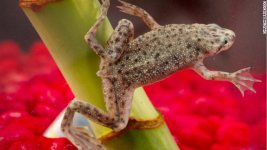
 
Pet frogs carrying Salmonella make kids sick

Pet frogs carrying Salmonella make kids sick

Raw meat is a notorious Salmonella carrier. It can also be found on unclean kitchen counters. An investigation published this week in the journal of Pediatrics suggests we should also look for the deadly bacteria in pet frogs.

Investigators from public health agencies across the United States found that African dwarf frogs are causing a nationwide outbreak of a specific Salmonella strain in children.

A group of health professionals make up the Salmonella Typhimurium Outbreak Investigation Team, which is part of the Centers for Disease Control and Prevention. Recently, the team has been examining the effects of African dwarf frogs on people’s health.

“Amphibians and reptiles should never be kept in homes with children less than 5 years old or with people who have immune deficiencies,” said lead author and CDC public health advisor Shauna Mettee Zarecki. This includes day care settings and nursing homes, she said.

This investigation is the first to report a nationwide Salmonella outbreak associated with amphibians.

The team examined an outbreak of that strain from 2008 to 2011 and identified 376 cases of Salmonella in 44 states to use in a matched case-control study. The control group was made up of people with recent Salmonella infections other than the outbreak strain, and the cases group included people with the outbreak strain infection. About 70% of those infected were children younger than 10 years old.

Here’s where it gets more complicated. Investigators interviewed 114 of those patients and about 60% of them reported frog exposure. Out of the patients who knew the type of frog, about 80% reported coming in contact with ADFs. In other words, salmonella infection was significantly associated with frog exposure in the study.

The investigators concluded the majority of children got sick from indirect exposure to these animals, such as handling aquarium water. Mettee Zarecki stressed that parents and/or children should wash animal habitats outside to avoid contaminating their kitchen sink or bathtub. Investigators said aquarium water can become more contaminated over time, increasing infection risk.

Mettee Zarecki said 29% of patients - mostly children - were hospitalized in this investigation.

Investigators tested samples from the frogs’ aquariums in patients’ homes, pet stores and a day care center that all matched the outbreak strain. According to the CDC’s website, patient purchases led investigators to one ADF breeding facility at Blue Lobster Farms in Madera County, California.

What’s troubling is frogs carrying the outbreak strain from this facility could still be in households, continuing to spread the infection. Surprisingly, pet frogs can live to up 18 years, more akin to a pet dog than a goldfish.

The investigators want pediatricians to warn patients of the risk associated with pet frogs. If you do come in contact with an amphibian or reptile, investigators recommend precautions like washing your hands with soap and warm water and using hand sanitizer.

Original article here.
 

Attachments

  • african-dwarf-frog-salmonella.jpg
    african-dwarf-frog-salmonella.jpg
    75.9 KB · Views: 89
Back
Top