• Responding to email notices you receive.
    **************************************************
    In short, DON'T! Email notices are to ONLY alert you of a reply to your private message or your ad on this site. Replying to the email just wastes your time as it goes NOWHERE, and probably pisses off the person you thought you replied to when they think you just ignored them. So instead of complaining to me about your messages not being replied to from this site via email, please READ that email notice that plainly states what you need to do in order to reply to who you are trying to converse with.

  • IMPORTANT! PLEASE READ!! About the Google Adsense ads being displayed

    =====================
    Posted 08/15/2025
    =====================


    Yeah, I know. They are a pain in the butt. But they pay the bills to keep my server running. Just a fact of life, I am afraid.

    Want to get rid of them? Simple. Just become a Contributor level member or above and they will be gone. -> Please click HERE."

    Is that too much for me to ask of you to keep this site running? Well, sorry about that. I too wish I could get everything for free. But alas.....

    =====================
    Addendum: 01/10/2026
    =====================


    Google Adsense ad revenue for December, 2025 was just $30 over the cost of the lease for the server running this site. So, in effect, the money providing the incentive for me to continue running this site is coming SOLELY from the paid memberships and sponsorships here. Which honestly ain't much....

What are these red marks on my albino pied?

leocrespo

New member
Joined
Jun 1, 2017
Messages
21
Reaction score
1
Points
0
Location
Las Vegas - NV
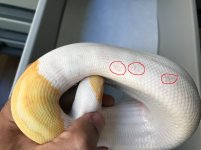
She was on reptichip, I moved her to plain paper now. These spots don’t look like scale rot to me, any idea what they are?
acce77fb8322bbb01fad8826d76b6bae.heic
6725207a466d10080bb16493ad920fe0.heic


Thank you
 
Yes live rodents as she doesn’t eat ft, I have an ARS Rack. All the other snakes in the rack are fine, except for her. I took her out of reptichip and put her on paper towel. Does it look like scale rot to you? Scale rot is usually pretty nasty, I’ve never seen just this pinkish thing on the scales.
 
In my experience, white ball pythons can show "pink" for a variety of reasons.
1. Live Feeding - rat bites, claws, pink like bruising for lack of a more scientific explanation.
2. Ready to shed. More of a universal pink all over.
3. Too cold, in regard to temperature.
4. Young ball python, 1.5 year old or younger.

If all your snakes are housed the same, I would guess temp. is probably not the issue. I would most likely guess "live" feeding in the case of the pictures you showed, especially if the rodent is left in the cage for an extended time period vs. immediately killed.

I'll post some pics in a moment. Long story short, not scale rot in my opinion, simply a result of being white and being able to see the "red" blood closer to the surface thus appearing "pink".
 
If a darker pigmented snake was a live feeder and sustained the same interaction with it's prey as the white snake, it simply would not be as easy to see as it is on a white snake.

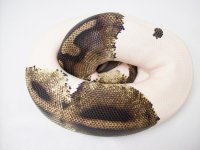
This picture, you can see the belly becomes pink as it approaches shed time.
 

Attachments

  • 005.jpg
    005.jpg
    243.7 KB · Views: 1,462
Thank you for the detailed reply. You’re definitely right on 1 and 4, and got me worried about temps. I set the thermostat to 100, so that the tub is at 96, but the upper layer of reptichip is always at 85sh.

I was told that the temperature of the tub itself is the important one, not on the top of the substrate. Should I bump up the heat?

Top of substrate
2dd21be159dc881603cf5e629f9874e6.heic


Tub temperature
f87ea0e86177736561309bfc080962ab.heic


Where I have the thermostat sensor. It’s directly on top of the heat panel
1fdb1f14cec61b81dfc3aa8c66067edf.heic
 
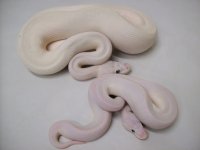
Two BELs, a 2 year old next to a 5-6 month old, if I recall correctly. Pink in both. less with age.
 

Attachments

  • Bel.jpg
    Bel.jpg
    177.6 KB · Views: 1,495
Alright, thanks again Robert! [emoji106]
No problem.
FYI: These three marks are most likely a direct result of live feeding.
Good luck Leonardo
 

Attachments

  • acce77fb8322bbb01fad8826d76b6bae.heic.jpg
    acce77fb8322bbb01fad8826d76b6bae.heic.jpg
    179.2 KB · Views: 1,721
I agree with all that Robert has said.
I'll add that scale rot is usually more of a brown coloration than pink as well. Does not look like scale rot.
 
I'm also seeing similar red spotting towards the white tail end of my 1 y/o pinstripe pied, and I also feed him live. But I always watch him strike and hold the rats (I leave before the rat actually dies and he swallows); so there's no chance for the rat to hurt him. I will try to stop feeding live if I have to, but he refuses frozen/thawed, although admittedly I wasn't too persistent.
 
I'm just curious - from what you say, Robert, do you mean that this might be how bruising can show up?

In my experience, white ball pythons can show "pink" for a variety of reasons.
1. Live Feeding - rat bites, claws, pink like bruising for lack of a more scientific explanation.
"Pink like bruising" is my layman's term Helen. Is it an actual bruise, not 100% sure, but whatever it is, it manifests itself repeatedly after live animal bite and claw attacks.

But I always watch him strike and hold the rats (I leave before the rat actually dies and he swallows); so there's no chance for the rat to hurt him.
I unfortunately think you may be mistaken in your conclusion. A rat only becomes harmless after death. A snake simply holding a rat is not even half the battle. Once you leave the room, what can happen:
1. The snake loses interest, lets go and prey revives. It then goes on to attack the snake through out the night. The snake finally eats it and you return in the morning none the wiser.
2. The snake and rat struggle longer than you think, the rats whips around and catches the snake's tail gnawing on it.
3. The rat is not dead and convulsing nerves in it's legs repeatedly scratch the snake with it's hind legs.
4. Etc.
I would not leave the snake alone until you know the rat is 100% "dead".

I often would allow the snake to strike and wrap the rat, then with tongs I would subdue whatever part of the rat was left to struggle. If it was the head I would pinch the rats mouth so it could not bite. If it was the hind legs I would pinch the legs so they could not kick. Either way, the rat is not dead until it is dead - period.
 
Back
Top