• Responding to email notices you receive.
    **************************************************
    In short, DON'T! Email notices are to ONLY alert you of a reply to your private message or your ad on this site. Replying to the email just wastes your time as it goes NOWHERE, and probably pisses off the person you thought you replied to when they think you just ignored them. So instead of complaining to me about your messages not being replied to from this site via email, please READ that email notice that plainly states what you need to do in order to reply to who you are trying to converse with.

  • IMPORTANT! PLEASE READ!! About the Google Adsense ads being displayed

    =====================
    Posted 08/15/2025
    =====================


    Yeah, I know. They are a pain in the butt. But they pay the bills to keep my server running. Just a fact of life, I am afraid.

    Want to get rid of them? Simple. Just become a Contributor level member or above and they will be gone. -> Please click HERE."

    Is that too much for me to ask of you to keep this site running? Well, sorry about that. I too wish I could get everything for free. But alas.....

    =====================
    Addendum: 01/10/2026
    =====================


    Google Adsense ad revenue for December, 2025 was just $30 over the cost of the lease for the server running this site. So, in effect, the money providing the incentive for me to continue running this site is coming SOLELY from the paid memberships and sponsorships here. Which honestly ain't much....

What kind of Pueblan is this???

ryant-182

New member
Joined
Oct 6, 2011
Messages
16
Reaction score
0
Points
0
Location
Spring Hill, Florida
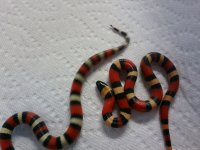
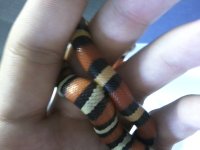
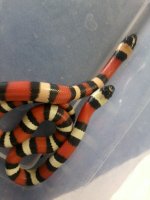
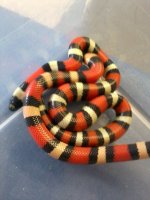
I bred two apricot pueblans early this year and the eggs are just now hatching. Ive had 5 out of 7 hatch so far, the first 3 look like apricots, the other 2 look like normals! one has a tiny bit of yellowish-apricot coloring on the tail but the other looks completely normal. Can someone help me out n tell me if their color will come in, or they are just normals somehow, or if there somehow a different morph possibly the parents were het for something.
Here is one apricot baby next to the weird one i am talking about.
 

Attachments

  • 120717_0000.jpg
    120717_0000.jpg
    151 KB · Views: 239
  • 120717_0002.jpg
    120717_0002.jpg
    98.4 KB · Views: 259
  • 120717_0003.jpg
    120717_0003.jpg
    236.6 KB · Views: 255
  • 120717_0004.jpg
    120717_0004.jpg
    246.5 KB · Views: 256
Nice looking hatchlings!

Those look to be really nice textbook representations of L.t.campbelli too! :yesnod:

Those are all very normal looking, and they can indeed vary with different bloodlines and even within the same clutch, as your do. Their inner light rings can be anything from a pure white/beige, to very yellow, or apricot or tangerine.

They will all develop some darker "newsprinting" in their light inner triad rings as they mature too, but some lines have much more of a predisposition for staying much "cleaner" than others.

Anyway, those are some sweet looking genuine Pueblan's you got there, so congratulations on those guys! :yesnod:


~Doug
 
Okay thankyou I just have heard mixed answers about how the coloration of apricot offspring works, some said they act like hets so you can breed them and get apricot colored offspring, and others have said they are just normals.
 
Okay thankyou I just have heard mixed answers about how the coloration of apricot offspring works, some said they act like hets so you can breed them and get apricot colored offspring, and others have said they are just normals.


Okay, let me clarify this better for you. Yes, "apricot" is basically a color morph, but it is simply a normal line-bred color phase that started showing up in them in the early to mid 1990's. The white and yellow inner triad rings are a more typical coloration. This is VERY similar to tangerine Hondurans and tricolor Hondurans, both are normal color phases but not a recessive trait either. You can get both types and anything in between depending on what you breed it to and what THEIR parental lineages consisted of. The different color phases are not a recessive (heterozygous) trait and will be one type or the other, with gene carriers that are 100% "het" for apricot.

The reason you get mixed colors is because they have mixed lineages of either types of color phase. If you breed a very orange apricot to another very orange apricot, and the past parental lineages of those parents were all from apricots, your chances of producing apricots will be much greater, and vise-versa as well. There was some more recent normal, lighter colored animals involved with your parental stock, so that is why you are getting somewhat more of a mixed phenotype clutch there. It's the exact same thing with tangerine Hondurans and tricolor Hondurans, apricot Mexican milks, etc.... in other words, you wont label the tricolors you produce as "het" for apricot, but it would be accurate to mention them being "from apricot lineage".


Anyway, your apricots are a color phase "morph", and not a recessive morph.

Hope this helps some......... :thumbsup:


And all of yours are very nice looking as well. I am guessing they came from some pretty "clean" parents that didn't have a whole bunch of dark pigment (melanin) in their inner light rings known in the hobby as "newsprint". Instead of very distinct dark scale tipping (as with many Latin milksnake subspecies), Pueblan's and many other North American milks get a sort of "over-spray" look in their light rings like they were lightly sprayed with a paint can of dark paint. This is very typical of older Pueblans as they mature.


cheers, ~Doug

 
Thank you very much! I had many different views and opinion on how this sort of thing happen. One quick question, Is it possible to get an apricot out of these types of "apricot lineage" babies? So I guess the longer line of apricots you have without being broken by a normal coloration will give you a better change or apricots! Thank you very much!
 
Thank you very much! I had many different views and opinion on how this sort of thing happen. One quick question, Is it possible to get an apricot out of these types of "apricot lineage" babies? So I guess the longer line of apricots you have without being broken by a normal coloration will give you a better change or apricots! Thank you very much!

Yes, that is basically it. it is possible to get some, but you will definitely get a mixed grab-bag of more lighter ones as well if they aren't richly colored apricots themselves. It really depends. The more orange/apricot involved, the better for producing more of the same.

What do the parents of those look like anyway??? as that is a huge factor!. The shades and intensities of the apricot color can vary considerably, so that will obviously contribute immensely to what their offspring will tend to look like.


~Doug
 
Wow! Thats really nice looking! Im having a hard time having people interested in getting my pueblans, have any tips for selling them?

Well, all I can say is take good photos and advertise them as best you can for maximum exposure. Also, proof-read any ads you make for mistakes. I see so many ads where almost every other word is misspelled, and that is not a good thing for customers to see. As you already know, there are LOTS of Pueblans in the hobby mainstream, just as there are many other types. It certainly helps to be pretty well-known and develop a good reputation too, but you have to start somewhere to get the ball rolling. You can't sell them if people don't know you have them... :D


~Doug
 
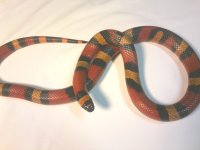
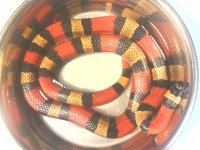
That's true, here are the parents of the hatchlings, I'm hoping I can get these babies sold! The male is the first pic, and the female is the second.
 

Attachments

  • 120618_0039.jpg
    120618_0039.jpg
    108.4 KB · Views: 219
  • 120618_0035.jpg
    120618_0035.jpg
    178.4 KB · Views: 199
Ryan, Very nice looking pueblans. Do you remember where you got your adults from? The babies are not all that popular but there are a few select people that will be interested in very nice hatchlings. If not, donate them to a herp society, USARK, or any foundation that supports our hobby. If you have a hard time selling them why have a second clutch? I think of it this way, if I can't feed 200 babies I don't produce 200 babies. Just a thought, I do know pueblans will lay a fertile second clutch with only one breeding. Again though very nice apricots!
 
I wont have any issue keeping the babies, I would just like to sell them. My second clutch was already about to be laid while the first clutch was hatching. I have no problem donating them if Im not able to keep them but i would much rather sell them to get back what I put into them.
 
ryan, there's aways wholesaling. you're only going to get a fraction of what you would get if you sold direct to the customer, but you're always guaranteed sales when you wholesale.
 
Back
Top