Seamus,
I'll assume for the moment you grew up in Russia.
Now, here in America, one must actually commit the crime before being convicted of it. Please show me where you've seen me selling ANY Ball Python as Het for anything.
Now, for our next lesson in capitalism. Here in America people (often called consumers) will often spend more for animals which look different from the "norm." Because we live in a capitalistic society charging more for "special" animals is ok. The down side to this is that not everyone agrees as to what special animals are. Many people feel that only thier animals are special enough to garner any extra money, and because they themselves have invested heavily in thier animals, they often try to down-play the "specialness" of other people's animals. The truth of the matter is, that no matter what a ball python looks like it is still just a Python regius, a small python.
My argument about the "pastel" ball python was about the use of the word pastel. Pastel is an adjective in the English language and as such can not/should not be used to trademark a phenotype. Pastel is not specific enough, "Pastel Jungle" may be.
To give you an example, one of my students refers to her 4-cylinder Chevy Cavalier as a "sports car." Now many people, (myself included), would not consider a Cavalier a "sports car." If she walked into a convention for sports car enthusists and said, "Yeah, I drive a sports car", she would probably get laughed at when she told them what she considered a sports car. However, if she were to place an ad in the local paper selling her sports car, and someone were to purchase it, she would not be in violation of ANY law. As there is no universally accepted definition as the term "sports car" she can not be held liable for fraud. I still think many, many people call many, many light colored snakes "pastels" every single day. Now at the Brotherhood of the Ball annual convention "pastel" may very well have a set definition, but outside the "Ballcave" Ballman, it won't hold-up. And watch out, the Mite-ler might be after you!
Has anyone done some looking for what percent of known hets show this trait compared to what percent of 'normals' do?
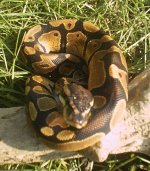
This is what I'm trying to do here. I am guessing there are probably less than 200 PROVEN hets out there. If, out of those PROVEN hets, there is striping present on all of them, I think that would signal some linkage between the two traits. Perhaps it could be even more complicated than that, it could be sex-linked as well, perhaps the striping only shows up on the females. I am trying to look into the percentages, I AM NOT SELLING THE SNAKE SEAMUS!