• Responding to email notices you receive.
    **************************************************
    In short, DON'T! Email notices are to ONLY alert you of a reply to your private message or your ad on this site. Replying to the email just wastes your time as it goes NOWHERE, and probably pisses off the person you thought you replied to when they think you just ignored them. So instead of complaining to me about your messages not being replied to from this site via email, please READ that email notice that plainly states what you need to do in order to reply to who you are trying to converse with.

  • IMPORTANT! PLEASE READ!! About the Google Adsense ads being displayed

    =====================
    Posted 08/15/2025
    =====================


    Yeah, I know. They are a pain in the butt. But they pay the bills to keep my server running. Just a fact of life, I am afraid.

    Want to get rid of them? Simple. Just become a Contributor level member or above and they will be gone. -> Please click HERE."

    Is that too much for me to ask of you to keep this site running? Well, sorry about that. I too wish I could get everything for free. But alas.....

    =====================
    Addendum: 01/10/2026
    =====================


    Google Adsense ad revenue for December, 2025 was just $30 over the cost of the lease for the server running this site. So, in effect, the money providing the incentive for me to continue running this site is coming SOLELY from the paid memberships and sponsorships here. Which honestly ain't much....

incubation temps.,/accuracy/equipment

thesnakeman

thesnakeman
Joined
Aug 5, 2004
Messages
505
Reaction score
0
Points
0
Location
Missouri, U.S.A.
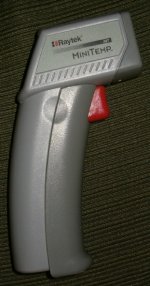
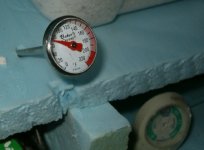
I use two of these meat thermometers, one high, one low, within the incubator. They seem to be very accurate for measuring ambient air temps, but they're small, and difficult for me to see without my specs. Then I spot check surface temps with this laser gun. I really like it,{so does the cat}, and it also seems fairly accurate. Surface temps of eggs seem to be 1 or 2 degrees higher than surrounding substrate temps which is good. The digital proportional thermostat is set for about 76, up a degree from half time point. And the ambient air temp seems to be about that. Substrate surface is running about 74. And egg surfaces are at 75.5 to 76.5 I try to keep internal humidity around 75%. But who knows how accurate that little gizmo is.

So what I'm wondering, is what type of measuring devices do the rest of you utilize? And what type of readings do you get? And what types of results as far as incubation duration, mortality's, fungus, etc? Thanks,
T.
 

Attachments

  • HPIM1709.JPG
    HPIM1709.JPG
    63.1 KB · Views: 136
  • HPIM1707.JPG
    HPIM1707.JPG
    123.8 KB · Views: 125
My Indigo's are all kept in 6 ft vision cages. They have a separate 14/12 ft room which is heated for winter management. I try to cycle the temperature between 70-80 degrees summer and in the winter hit 55-70 degrees. They have light cycled at 8-8 during summer and 10-5 during winter. The room is well insulated and sealed so humidity is generally 70 plus.
The eggs are kept in expanded hovibators with a indoor outdoor walmart thermo. I had been told that these are good at 78 degrees on incubation. I am now at 75 degrees .
The eggs are lined 5 to a plastic shoe box on moist vermiculite. I had been told keeping these wet is important but with any excess moisture in the substrate have found the eggs seem to bubble out at the over wet area.
I am 105 days and no pips yet.

Can you see movement in these at the late stages of hatching, can a heart beat be auscultated, is there any way to tell they are still alive in there???
 
Ask Mr. Snodgres about signs of life,

I think if anyone would know, it would be him. Personally I don't know how to tell if an egg is good until it pips. Ive tried candling, but could not tell. My wife being a nurse, I have access to a stethascope, so maybe I could here a heartbeat. I'll try that if I can get her to bring it home for me.

I have been told that 78 is fine for inc temp, but last year I had a much higher incidence of mold, which continuously returned, in spite of my best efforts to eradicate it. This year I had some mold on the unicolor eggs, but so far none on the indigos. And last year the eggs only went 100 days. I think it better to have them go a bit longer for better development, so I lowered the temps just 2 degrees this year. We'll see how many days it takes this time.

But if your eggs do not smell bad, are not discolored, and have not totally caved in, it's a good bet they are fine. I have seen eggs that looked horrible hatch out a healthy baby. Hang in there, and keep us posted.
T.
T.
 
Incubation

I like to keep the incubation temperatures of all my Dry eggs between 73*F and 75*F, though I do not worry if the temps briefly drop slightly below 70*F or briefly increase to 80*F, but I believe the cooler the incubation temperatures, the larger and healthier the babies. As I have said many times, the energy expenditure required for embryonic development is quite high and energy expenditure creates heat. This means the core temperature of the egg is always going to be a minimum of 2-3* F above the ambient temperature of the incubation container, so I definitely try to avoid extended exposure of the eggs to temperatures over 75*F.
Bad eggs will almost always begin to discolor collapse and I have had many clutches go 120 days prior to pipping, while I have also lost eggs that survived the entire incubation period. The incubation period is but one reason Drys will try your patience and patience is one of the keys of success in keeping and breeding the genus.
There is a device available, developed for those involved in aviculture, that has shown good results in tracking the development of eggs and the device is known as the Egg Buddy. The company that developed it came out with a second model last year that has demonstrated increased efficacy in regards to reptile eggs. For more information regarding the device, you can check out the following URL:

http://www.avianbiotech.com/buddy.htm

Best regards,

Jeff
 
Thanks Jeff. Interesting,... Have you tried it? Do you know anyone who has used it for snake eggs? The price is a bit steep, but it might be a good investment if it works. I would rest easier just knowing for sure, one way or the other.

I tried to listen with my wife's stethescope, but I couldn't hear a bloody thing.
T.
 
Hi I am new to the forum, this is my first post! I have been looking at the forum for a long time however and was waiting until I got my first couperi before joining. Thanks for all the great info, I have always been fascinated by the species since I lived in the US as a kid, and it is really good to see such sharing of information.
The reason I have chosen this post to reply to is that I have been using the Buddy Dig Egg monitor for a couple of years at work with a mix of turtle, tortoise, lizard and snake eggs, in particular Casarea dussumieri, and have found it to be a useful tool. Detecting heart rates is fairly easy even with small eggs, Casarea eggs are usually between 3 and 5 gramms in weight, and the changes in heart rate through development are really interesting. Infertile eggs or DIS eggs usually go mouldy anyway but it can be useful especially before pipping as the animal inside seems to have a very fast irregular heart beat prior to hatching.
However, I use the monitor to detect fertility, but I never discard good looking eggs that I dont get a beat from, sometimes the sensors just dont pick up the beat, and moving the egg into a position that the montior will read can be hazardous to the embryo inside, so please take care.
I know of several herp keepers who also use it.
Hope this helps, I know the box is a bit expensive but it is a real joy to see the very first heart beat.
Thanks again for all the great info
 
Back
Top