• Responding to email notices you receive.
    **************************************************
    In short, DON'T! Email notices are to ONLY alert you of a reply to your private message or your ad on this site. Replying to the email just wastes your time as it goes NOWHERE, and probably pisses off the person you thought you replied to when they think you just ignored them. So instead of complaining to me about your messages not being replied to from this site via email, please READ that email notice that plainly states what you need to do in order to reply to who you are trying to converse with.

  • IMPORTANT! PLEASE READ!! About the Google Adsense ads being displayed

    =====================
    Posted 08/15/2025
    =====================


    Yeah, I know. They are a pain in the butt. But they pay the bills to keep my server running. Just a fact of life, I am afraid.

    Want to get rid of them? Simple. Just become a Contributor level member or above and they will be gone. -> Please click HERE."

    Is that too much for me to ask of you to keep this site running? Well, sorry about that. I too wish I could get everything for free. But alas.....

    =====================
    Addendum: 01/10/2026
    =====================


    Google Adsense ad revenue for December, 2025 was just $30 over the cost of the lease for the server running this site. So, in effect, the money providing the incentive for me to continue running this site is coming SOLELY from the paid memberships and sponsorships here. Which honestly ain't much....

Is High-White Genetic?

GreenTreePython13

New member
Joined
Jan 21, 2011
Messages
187
Reaction score
5
Points
0
Location
South Windsor, CT, USA
Is the high white trait in california kings genetic? I know that it is not for ball pythons. I heard that it wasn't for kings either, and that I'd get the same outcome if I bred a high white to another high white as I would if I bred a high white to a normal. Is that true?
 
So-called "high-white" Cal. kings are derived from years of line-breeding. It is NOT a simple recessive gene like amelanism, or hypomelanism in colubrids. Boa and python genetics can be worlds apart from the way culubrid genetic mutations are inherited.

"high-white's" originated years ago from breeding the naturally aberrant patterns of the Newport-Long Beach coastal locality kings that were more yellow and brown into the pure black & white 50-50 Desert phase type Cal. kings, then selectively and continually bred to the most reduced black patterned offspring over the years to create more patternless animals with more white background coloration as well. High-white x high-white can give you some very white offspring. This process was originally similar to how the "banana" Cal. kings became popular that also many times had the San Diego striped gene involved too, except they originally had less(or no) black and white influence and more extreme yellow influence from the coastal Newport-Long Beaches. Over time, alot of the "banana" kings today display far more white influence from the desert phase forms than they originally did, as they were VERY yellow. You can still find some very yellow individual too however.

Your odds for producing more higher-whites will surely be with breeding to another very high-white individual, but with so much variable influence that floats around in them today from all the different types that have gone into their composition, you can still get some surprises, just as you would MOST ANY types of Cal. king breedings. You can breed two banded types and get striped, aberrant, bandeds, or anything in between too.

Anyway, all the high-white, high-yellow kings in the market are all line-bred to display more of that particular color, and not an automatic and predictable simple recessive trait like if you bred a high-white to a normal stripe, or even a banded, and you would get normal looking "hets". It doesn't work that way with the Cal. kings you are referring to.


cheers, ~Doug

 
great info Doug!

I hope you don't mind me posing another question... a couple months ago I was given a baby (cbb) cal king at one of my local society meetings. She is a black and white baby and I've noticed over the last few weeks a slight yellow tint in the white areas... does the yellow come in over time? (I am assuming it does since that's how it works with other snakes)
 
great info Doug!

I hope you don't mind me posing another question... a couple months ago I was given a baby (cbb) cal king at one of my local society meetings. She is a black and white baby and I've noticed over the last few weeks a slight yellow tint in the white areas... does the yellow come in over time? (I am assuming it does since that's how it works with other snakes)

Hi April,.......

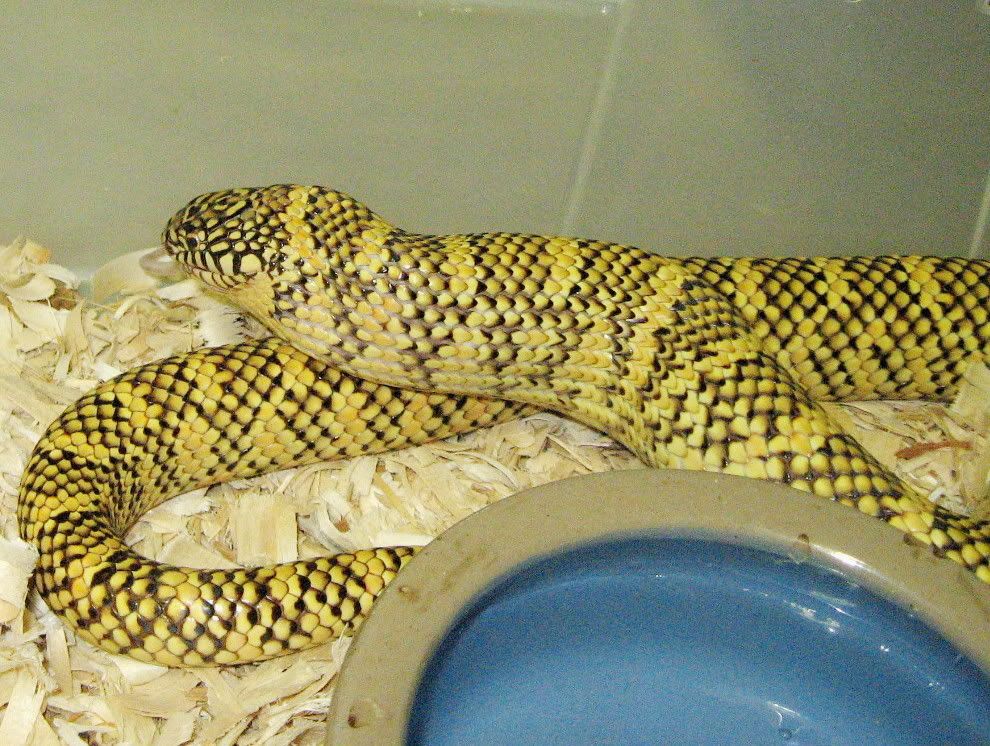
Yes, many snakes, including Cal. kings will develope more yellow pigment as they mature. This is VERY common in many types of snakes as you previously mentioned. Another reason that snakes can develope more yellow pigments(xanthines) over time as they mature is that there seems to be varying genetic pre-dispositions for many snakes to retain and store carotenoids in their pigment cells from their diet intake. These are stored in the pigment cells known as "xanthophores"..(xanthos meaning yellow in Greek). I would also imagine this is why some albino (amelanistic) Nelson's milksnake's are EXTREMELY yellow as they mature, while other bloodlines are more typical white. The young "high-yellow" nelsoni start out looking very typical, but develope very intense amounts of yellow later on.

Anyway, yes, colors, genetics in general, and what actually causes them in snakes have always been very interesting to me..LOL!.

Good luck with your recent Cal. king acquisition!


~Doug
 
thanks! Glad I decided not to name her Domino. haha! She's a great little snake, very angry and full of attitude, just like I like them.
 
thanks! Glad I decided not to name her Domino. haha! She's a great little snake, very angry and full of attitude, just like I like them.

LOL!!,.yeah, that can be fairly typical of some of the getula complex youngsters. Just feed it REAL WELL, and OFTEN when young and growing, and it will at least help curb any chewing on your fingers.............well, "most" of the time anyway..LOL!

As you might already know, many folks just don't feed their getula enough. They have an INSANE metabolism compared to many other types of snake, and they just don't do well on a mediocre diet once a week or so when young and growing. As long as they can digest their meals properly with a belly heat thermogradient on one side of the enclosure that is in the low-mid 80's, they will use all their caloric intake to grow like weeds..LOL!


~Doug
 
good to know! She's taking 1 f/t mouse fuzzy every week, they seemed too big for her but she takes them no problem and is actually a bit chunky (especially when compared to my corns!). I'll make sure to keep the feeding on the heavier side, maybe switch her to a little smaller size fuzzies but twice a week instead of once.
Thanks!
 
good to know! She's taking 1 f/t mouse fuzzy every week, they seemed too big for her but she takes them no problem and is actually a bit chunky (especially when compared to my corns!). I'll make sure to keep the feeding on the heavier side, maybe switch her to a little smaller size fuzzies but twice a week instead of once.
Thanks!

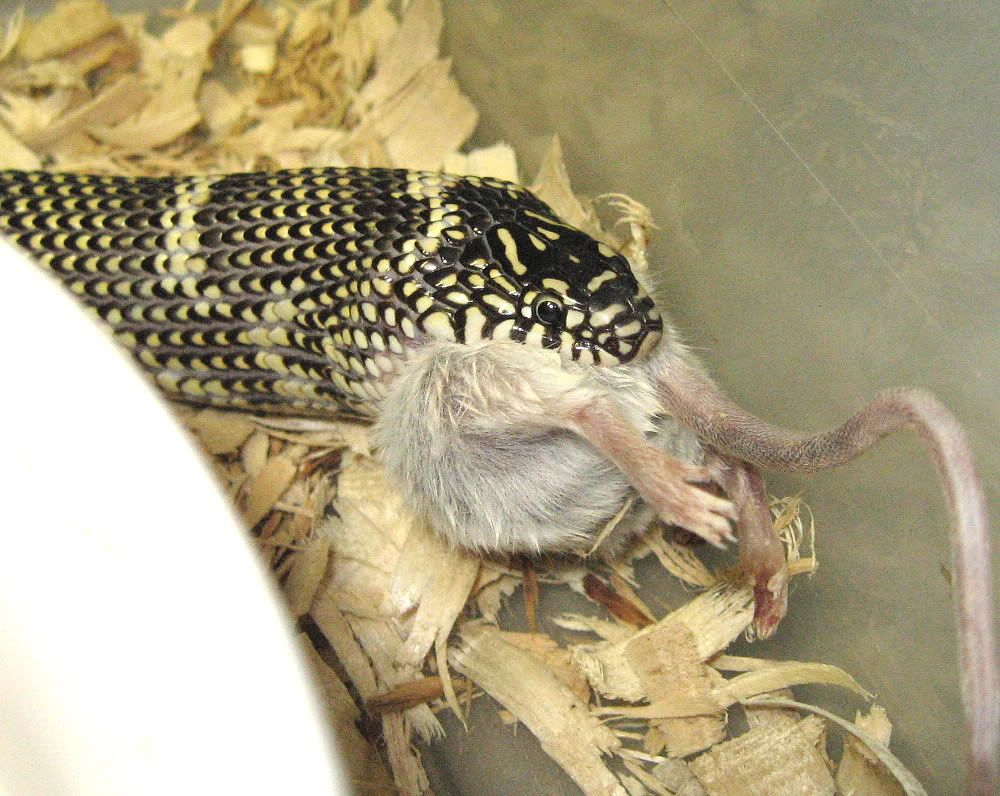
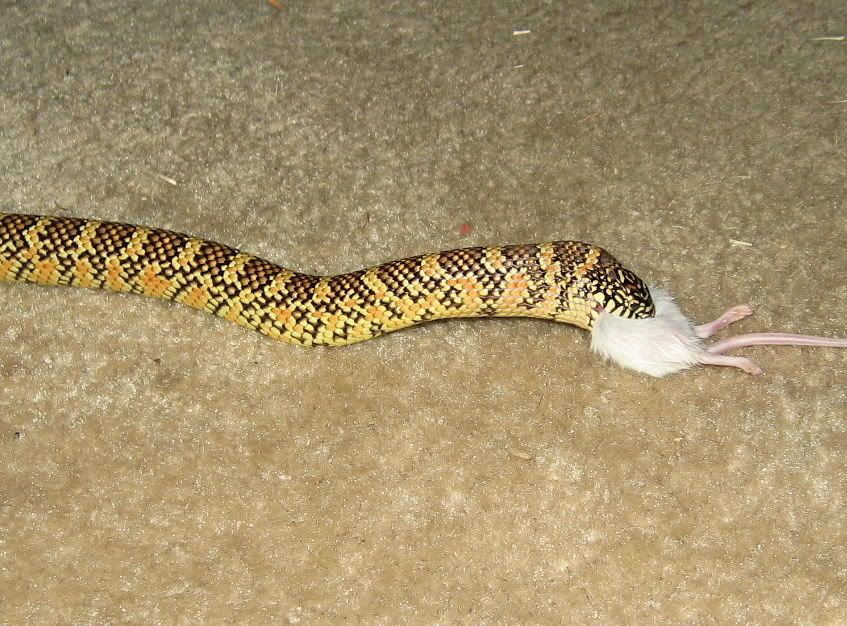
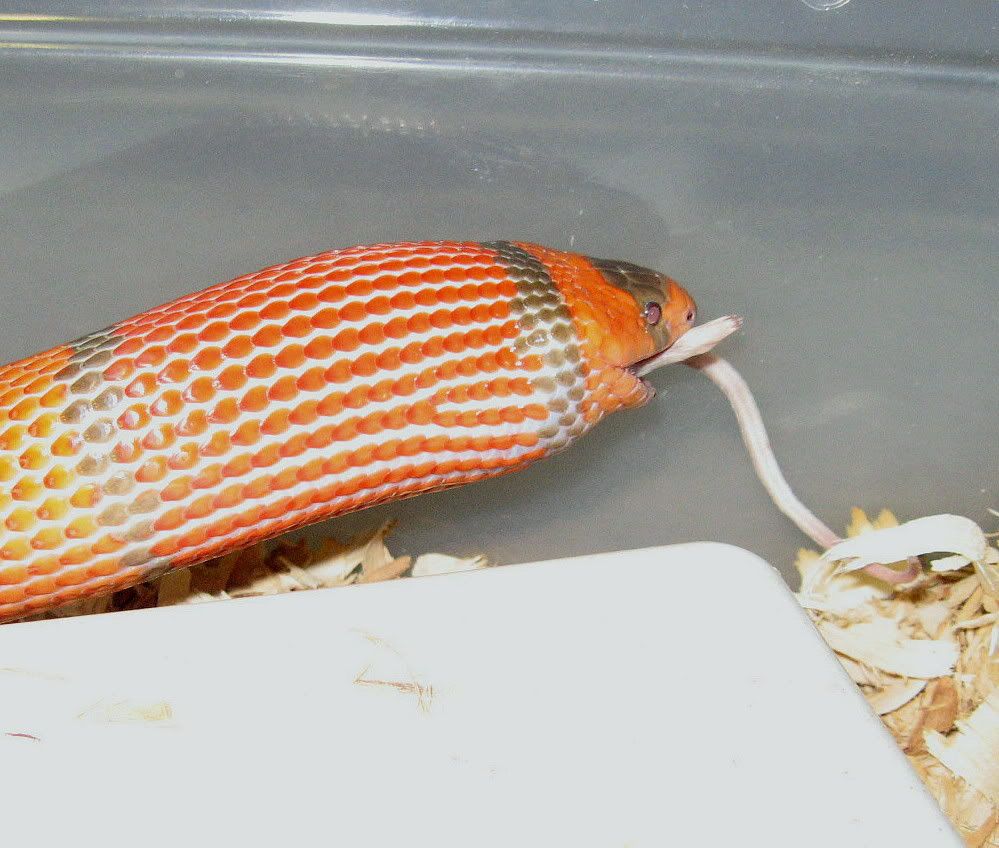
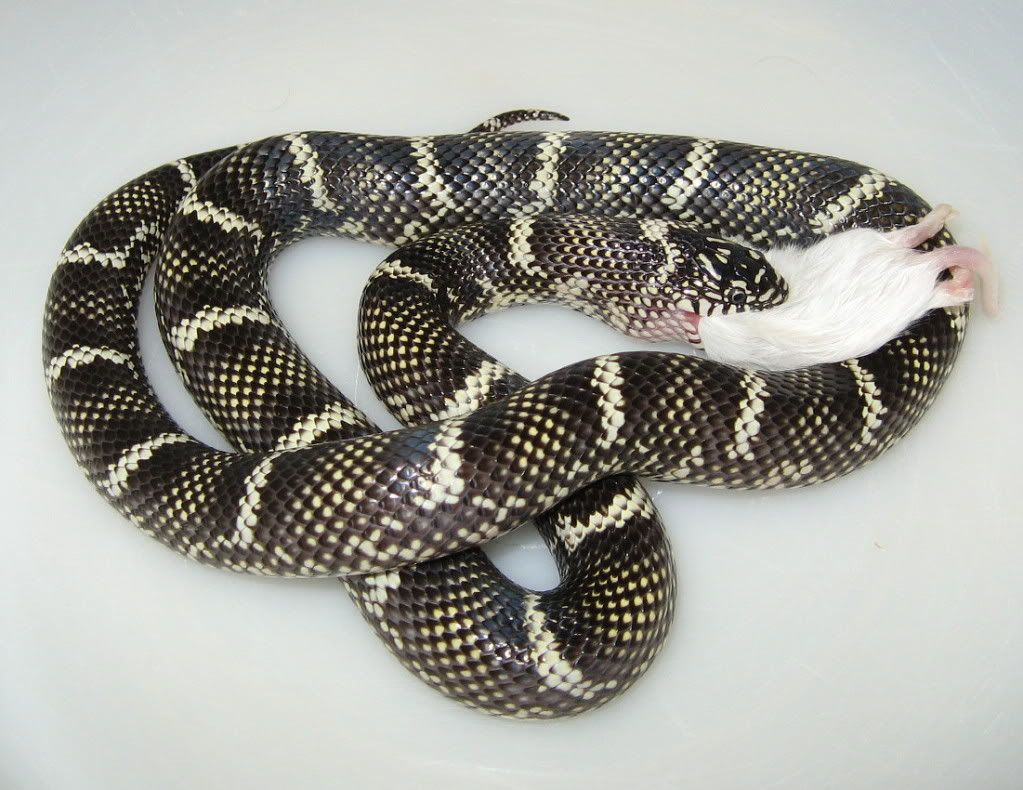
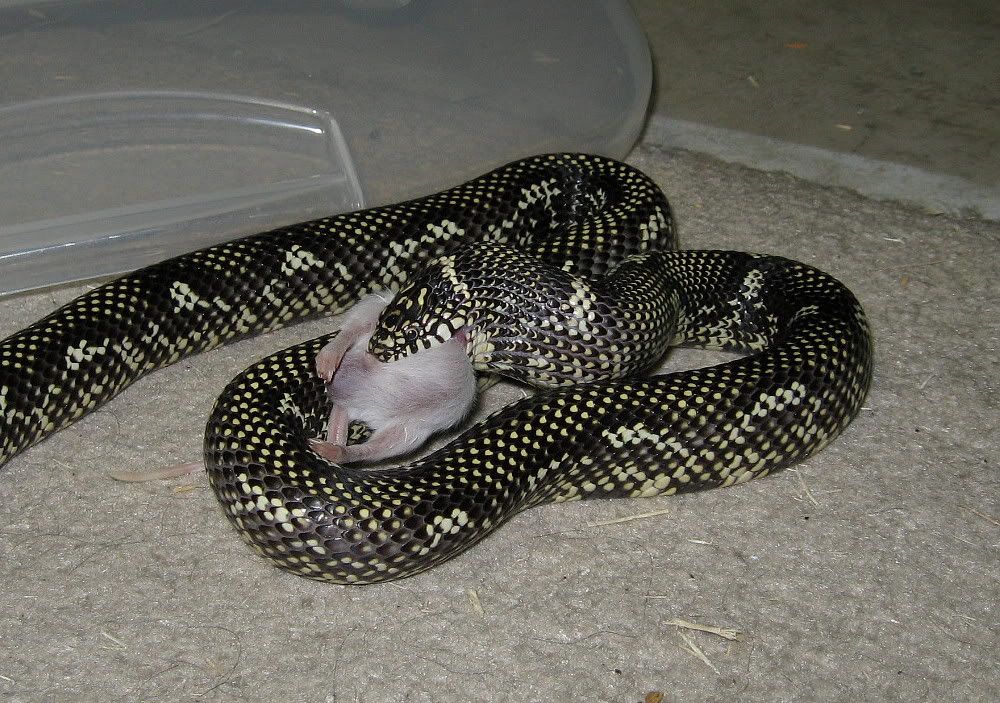
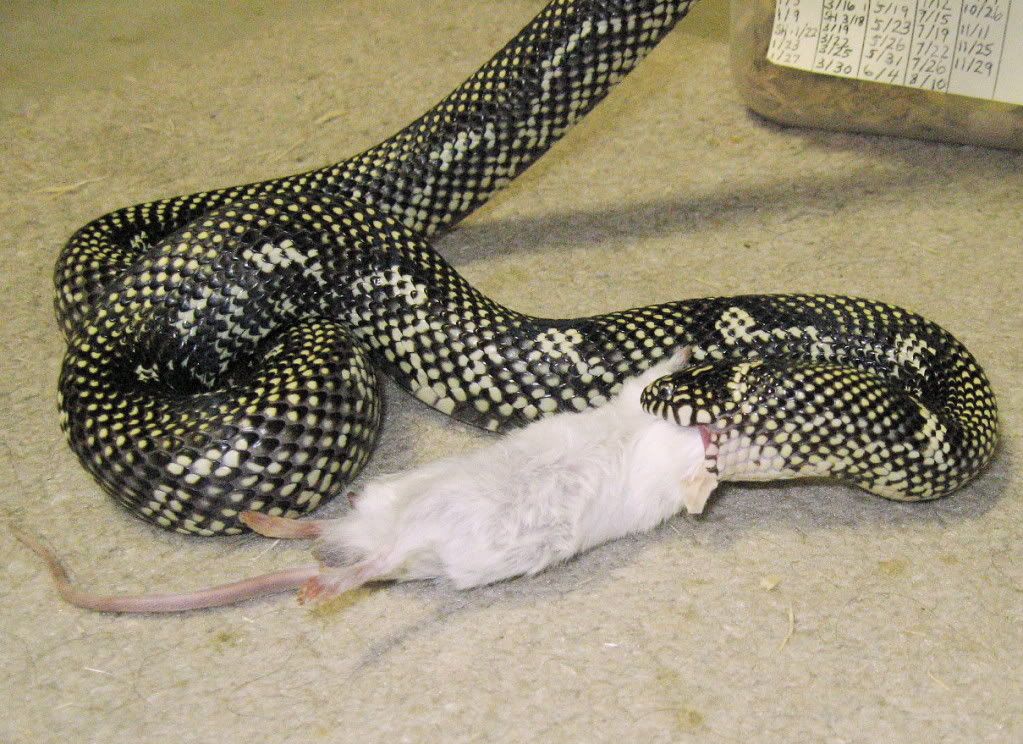
Well, they are FAR more robustly-built than corns though, and this is so they can overpower and consume just about anything that moves in nature that will fit down their heads. Cal. kings, Eastern kings, Florida kings, etc...do best if fed TWO of whatever they can possibly fit into their heads. If their meal doesn't put a VERY noticeable bulge in their mid-section, then it is far too small for a young growing kingsnake. Kings are absolute EATING MACHINES, and have to be fed more than cornsnakes would. Their high metabolism demands lots of food, especially when young. Young kings do great on two very good-sized meals about every 4-5 days for optimum growth.

These are appropriately sized prey items for the snakes body size. And they get two at a time with no problem at all no less than every 5 days when young and in need of the calories for growing best. When they become adults, you can tweek the diet some so they don't become obese depending on the plans for the snakes, like breeding females, etc...they will need good body weight, but you don't want them too heavy.


cheers, ~Doug

IMG_0014-4.jpg


IMG_0001-3.jpg


IMG_0040-1.jpg


IMG_0051-1.jpg


IMG_0051-2.jpg


IMG_0025-1.jpg


IMG_0012.jpg
 
Doug, I also wanted to thank you again for all the terrific info and time you've taken to write it up! (plus the photos... so nice!)

I talked to the breeder of my lil king and the father was a black and high-white king from California City and the mother was an aberrant 'banana' king with brown saddles and yellow coloration... so a total mix! I'll add some pics once I get a new camera.
 
Doug, I also wanted to thank you again for all the terrific info and time you've taken to write it up! (plus the photos... so nice!)

I talked to the breeder of my lil king and the father was a black and high-white king from California City and the mother was an aberrant 'banana' king with brown saddles and yellow coloration... so a total mix! I'll add some pics once I get a new camera.

You are very welcome, April,......my pleasure!

Look forward to the pics later on..:thumbsup:


~Doug
 
I talked to the breeder of my lil king and the father was a black and high-white king from California City and the mother was an aberrant 'banana' king with brown saddles and yellow coloration... so a total mix! I'll add some pics once I get a new camera.

Finally got my camera, so here is a quick photo of my little baby, named Mayo:

Mayo7_11_2011.jpg
 
My pleasure Ross, and thanks a bunch for the kind words. Coming from a Cal. king aficionado/guru such as yourself that is quite a compliment my friend!.. :thumbsup:

Those are certainly some nice kings in those posts as you mentioned!


~Doug
 
Back
Top