• Responding to email notices you receive.
    **************************************************
    In short, DON'T! Email notices are to ONLY alert you of a reply to your private message or your ad on this site. Replying to the email just wastes your time as it goes NOWHERE, and probably pisses off the person you thought you replied to when they think you just ignored them. So instead of complaining to me about your messages not being replied to from this site via email, please READ that email notice that plainly states what you need to do in order to reply to who you are trying to converse with.

  • IMPORTANT! PLEASE READ!! About the Google Adsense ads being displayed

    =====================
    Posted 08/15/2025
    =====================


    Yeah, I know. They are a pain in the butt. But they pay the bills to keep my server running. Just a fact of life, I am afraid.

    Want to get rid of them? Simple. Just become a Contributor level member or above and they will be gone. -> Please click HERE."

    Is that too much for me to ask of you to keep this site running? Well, sorry about that. I too wish I could get everything for free. But alas.....

    =====================
    Addendum: 01/10/2026
    =====================


    Google Adsense ad revenue for December, 2025 was just $30 over the cost of the lease for the server running this site. So, in effect, the money providing the incentive for me to continue running this site is coming SOLELY from the paid memberships and sponsorships here. Which honestly ain't much....

need info,recommendations or encouragement

lol - snake's don't have a gag reflex...
(keep in mind that their means of ingesting food is quite a bit different than that of mammals; and that their glottis is well forward of their esophagus so they can eat without "choking")
That doesn't mean it is necessarily easy to push something down their throat, if they don't want it. They can, and will, tighten up, twist around, and attempt to expel whatever foreign body you are trying to place.

You are right, "want to gag" and "puke" were poor choices of words, "attempt to expel" and "regurgitate" are more accurate. The point is still the same, a sudden belly full of food can come right back up on you, regardless of whether it's technically "regurgitation" or "vomiting".
 
I had posted a vid tubing medication (and injecting) one of my boas when she was sick, not sure if it will be useful at all to you, but here you go:
https://www.youtube.com/watch?v=IpFsC7xOAyE

I also tube fed her for months in hopes she would recover (I tubed organic chicken baby food per my vet's instructions). I won't go into her whole story here (I posted about it in the boa forum I believe) but I did end up making the decision to euthanize her for necropsy as her condition was not improving.
I'm wishing you both the best of luck.
 
thanks for the reply Lupine,

For now , the redness is looking m better, scales look as if they dried up some on the body..
Another Vet on a forum mentioned a same study as the one you read, where baytril may still be effective even if injected lower, but nothing confirmed as well.. so as you said, most will still play safe..

vet did not suspect any viruses for now and did not feel a blood test was neccessary as of yet. we did the stool sample testing because when the sent gland prolapse i found blood in her stool..

as for the force feeding, i'm intregued now... i was under the impression that tube feeding would create less stress and less chances of just spitting the rat back out,just slide the tube down and inject the mix, but it makes sense..

i had tried to force feed a smaller prey item but did not want to stress her more, her feeding response did not kick in and she kept trying to avoid it being put in her mouth..
i will try again with something really smaller like a rat pup to start with..

thanks for the suggestion.

Why would your vet feel bloodwork is not necessary yet? Nothing bad will come out of running bloodwork regardless of the signs/symptoms of the patient, bloodwork will rule out sooo many different pathogens that could be the culprit, or at least give clues to what might be happening. Just coming from experience ive found bloodwork to be always considered.
 
I had posted a vid tubing medication (and injecting) one of my boas when she was sick, not sure if it will be useful at all to you, but here you go:
https://www.youtube.com/watch?v=IpFsC7xOAyE

Thanks for posting a video, I never thought to suggest looking on youtube. I have however, never tried to tube feed a snake as flaccid (for lack of a better word) as the one in your video. I have always experienced them fighting back, sometimes enough to die, tho fortunately I've only had to tube snakes a few times in my career!
One thing I feel I need to point out for future reference and others who learn from your video, is that at least from watching the video, the way you were administering the Metronidazole, you could not have been getting the entire dose in the snake, as well as you would have been pushing a tube-full of air in first (not sure how a snake handles that), then when the plunger is fully depressed, there's a few mL's left in the tube, probably a significant amount with medication. You should be pushing the med into the tube until it reaches the tip before introducing the tube into the snake, then after administering, flush the tube with the liquid food if you're feeding too, or the right amount of water to push the rest of the med thru (you'd measure beforehand how much water is needed for the size of tube you're using, so the snake actually gets very little if any water, it just acts as a way to push the med remaining in the tube into the snake's gut).


Why would your vet feel bloodwork is not necessary yet? Nothing bad will come out of running bloodwork regardless of the signs/symptoms of the patient, bloodwork will rule out sooo many different pathogens that could be the culprit, or at least give clues to what might be happening. Just coming from experience ive found bloodwork to be always considered.

I'm curious what reptile pathogens you've had identified thru bloodwork at your vet. The Bloodwork done at the veterinary hospital does not identify specific pathogens (except the snap tests, of which there are few, and none for reptiles). The two components of what is referred to as "bloodwork" are (1)the CBC- Complete Blood Count, for which there is far less known about reptiles than mammals. Values tested for in reptiles are red and white blood cell counts and wbc type ratios, which cannot be tested for on a machine, it must be done manually for reptiles by someone trained to do so (unless there's a new device out there I don't know about); and (2) Chemistries- which indicate mostly organ function. There are very few chemistries run on reptiles because of the lack of information on them. Primarily, the values used for snakes are Blood Glucose, Uric Acid, Calcium, Phosphorus, Electrolytes (Sodium, Potassium and Chloride) and Plasma Protein, and sometimes Bile Acids. Mostly these values are only helpful in diagnosing dehydration and/or kidney function, and Bile Acids indicate liver function.

To the OP- the limited information from reptile bloodwork may be the reason your vet is not in a hurry to do it. The CBC could tell you what you already know- your snake has an infection, and the Chemistries may shed some light on the snake's overall health. Having this information could help you decide whether to keep trying to treat or euthanize based on what you're up against in term of organ function/failure. It is likely that your vet will have to send the blood sample out to a laboratory, as most vets don't have equipment capable of reading reptile blood, and the wbc differential would have to be done by hand. If you can afford it, and your vet knows how to interpret the results, it can't hurt to have it done, as long as the trip and restraint doesn't stress her out too much. It can always serve as a baseline to compare with future testing.
 
Thanks for posting a video, I never thought to suggest looking on youtube. I have however, never tried to tube feed a snake as flaccid (for lack of a better word) as the one in your video. I have always experienced them fighting back, sometimes enough to die, tho fortunately I've only had to tube snakes a few times in my career!
One thing I feel I need to point out for future reference and others who learn from your video, is that at least from watching the video, the way you were administering the Metronidazole, you could not have been getting the entire dose in the snake, as well as you would have been pushing a tube-full of air in first (not sure how a snake handles that), then when the plunger is fully depressed, there's a few mL's left in the tube, probably a significant amount with medication. You should be pushing the med into the tube until it reaches the tip before introducing the tube into the snake, then after administering, flush the tube with the liquid food if you're feeding too, or the right amount of water to push the rest of the med thru (you'd measure beforehand how much water is needed for the size of tube you're using, so the snake actually gets very little if any water, it just acts as a way to push the med remaining in the tube into the snake's gut).


I'm curious what reptile pathogens you've had identified thru bloodwork at your vet. The Bloodwork done at the veterinary hospital does not identify specific pathogens (except the snap tests, of which there are few, and none for reptiles). The two components of what is referred to as "bloodwork" are (1)the CBC- Complete Blood Count, for which there is far less known about reptiles than mammals. Values tested for in reptiles are red and white blood cell counts and wbc type ratios, which cannot be tested for on a machine, it must be done manually for reptiles by someone trained to do so (unless there's a new device out there I don't know about); and (2) Chemistries- which indicate mostly organ function. There are very few chemistries run on reptiles because of the lack of information on them. Primarily, the values used for snakes are Blood Glucose, Uric Acid, Calcium, Phosphorus, Electrolytes (Sodium, Potassium and Chloride) and Plasma Protein, and sometimes Bile Acids. Mostly these values are only helpful in diagnosing dehydration and/or kidney function, and Bile Acids indicate liver function.

To the OP- the limited information from reptile bloodwork may be the reason your vet is not in a hurry to do it. The CBC could tell you what you already know- your snake has an infection, and the Chemistries may shed some light on the snake's overall health. Having this information could help you decide whether to keep trying to treat or euthanize based on what you're up against in term of organ function/failure. It is likely that your vet will have to send the blood sample out to a laboratory, as most vets don't have equipment capable of reading reptile blood, and the wbc differential would have to be done by hand. If you can afford it, and your vet knows how to interpret the results, it can't hurt to have it done, as long as the trip and restraint doesn't stress her out too much. It can always serve as a baseline to compare with future testing.

The bloodwork we run in house is mostly used to help give clues as to what might be causing the problem, Other than that we send out bloodwork and biopsies to the lab, there have been so many advances in the last decade in viral study with reptiles, and it also depends on who you send it out to and who your vet works with
 
The bloodwork we run in house is mostly used to help give clues as to what might be causing the problem, Other than that we send out bloodwork and biopsies to the lab, there have been so many advances in the last decade in viral study with reptiles, and it also depends on who you send it out to and who your vet works with

I don't understand this reply. :shrug01: You just summed up what I had said in reply to your previous statement "...bloodwork will rule out sooo many different pathogens that could be the culprit...". I am aware there are many major independent and university labs, some of which run things others don't. It sounds like you work for a vet who specializes in exotics (?) and you seem to know more about the reptile pathogen tests available than I do, so please enlighten us on what's out there, particularly with advances in treating these viral infections.
 
If you have to choose between force feeding whole prey and tube feeding, I would say that tube feeding is the less stressful of the two. The tube diameter is small enough to feed in easily - just make sure the outside is lubricated. A 16 french size works well for ball pythons. Use a section of empty pen tube, and open the snake's mouth and place the tube inside the long way - so the holes are front to back. You can then hold the snake's mouth shut over the pen tube, and you have an opening to feed the feeding tube through. It's easier than trying to hold the mouth open. Try to straighten out the snake as you feed in the tube. I would do very small meals at first.

Also, since the glottis opening is in the mouth, not the throat, it would be extremely hard to accidentally put the tube down the trachea.

For viral testing, the University of Florida now has a blood test for exposure to paramyxovirus.
http://labs.vetmed.ufl.edu/sample-requirements/zoo-med-infections/opm/
 
...Also, since the glottis opening is in the mouth, not the throat, it would be extremely hard to accidentally put the tube down the trachea.

Actually snakes are intubated for anesthesia thru the glottis as well. It is harder to get into the trach most of the time, however sometimes it just wants to go that way. This video shows intubation. Note the length of the trach tube. Also note that the tech is holding the trach tube to the right, as the trachea lies to the right of the esophagus. http://www.youtube.com/watch?v=84NrlU5WcB8.

This video shows force feeding a rodent. I like this video. http://www.youtube.com/watch?v=MmuxLsMboJE.

This video was the only one I found besides the one already posted in this thread. Note the maker of the vid added later that Gatorade is NOT GOOD. I also dont see the point of added liquid, seeing that it dilutes the nutritional value per the amount of food being introduced. The food he was using (Hill's a/d) is smooth enough to go thru a 10 Fr or bigger tube undiluted. The reason I'm posting a link to this video is to demonstrate the length of the feeding tube the guy uses on the first (smaller) snake. It is of appropriate length IMO. Then he uses the SAME tube, uncleaned, on the next snake- hope there's no transmissible diseases there!:bandhead0
http://www.youtube.com/watch?v=NjIkufAZ0A8.

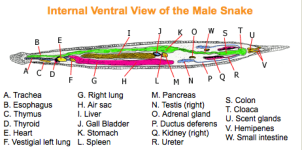
Here's a drawing I found via google image search, that should also help (credit PetEducation.com) Note that it is a ventral (belly) view. You'll see as I stated in an earlier post (I think), the trachea is much shorter than the esophagus.
 

Attachments

  • Male_Snake_Anatomy.png
    Male_Snake_Anatomy.png
    35.1 KB · Views: 122
I realize that you are trying to be helpful; but something isn't translating well.
Of course snakes are intubated through the glottis - though I'm not sure why the "as well" was included (because intubation involves a tube being passed through the glottis, regardless of species)...April's statement was that the glottic opening is in the mouth, not throat; the point being that the glottis is easily viewed, and it is a simple measure to make sure the feeding tube doesn't go there. Because of the location of the glottic opening in snakes, there really isn't an acceptable excuse for "accidentally" putting a feeding tube there. It is no more involved than looking, and making sure it goes where it is supposed to.
The trachea is located to the right of the esophagus
I'm sorry - what? Perhaps I'm not understanding what you are trying to say...the opening for the esophagus is at the back of the throat. Passing an endotracheal tube through the snake's glottis - which is found further forward in the mouth - ensures that it will enter the trachea (unless it is too large, or too short). The esophagus doesn't even come into play.
 
I realize that you are trying to be helpful; but something isn't translating well.
Of course snakes are intubated through the glottis - though I'm not sure why the "as well" was included (because intubation involves a tube being passed through the glottis, regardless of species)...April's statement was that the glottic opening is in the mouth, not throat; the point being that the glottis is easily viewed, and it is a simple measure to make sure the feeding tube doesn't go there. Because of the location of the glottic opening in snakes, there really isn't an acceptable excuse for "accidentally" putting a feeding tube there. It is no more involved than looking, and making sure it goes where it is supposed to.

I'm sorry - what? Perhaps I'm not understanding what you are trying to say...the opening for the esophagus is at the back of the throat. Passing an endotracheal tube through the snake's glottis - which is found further forward in the mouth - ensures that it will enter the trachea (unless it is too large, or too short). The esophagus doesn't even come into play.

I guess I'm making too big a production out of trying to explain a statement I made earlier intended to help the unexperienced. Sure, it should be clear and easy to put the tube in the right place especially on a snake the size of a ball, I was delving too deep, forgive me, didn't mean to confuse. The reason I went into it in the first place, is in my work, I see a lot of home medicating/treating accidents/actions there is no excuse for, including, yes- feeding into the trach which is of course fatal, this is why I mentioned it in the first place. If people didn't do it, it wouldn't have occurred to me to mention it. The mention of the trach being on the right and esoph on the left (posterior to their openings) was simply to illustrate that it requires working it to the right to get into the trach. To anyone well versed in snake anatomy (or maybe anyone with a tiny bit of intelligence) this whole thing seems pretty easy, tho I never had the luck of a totally motionless snake making it easy in regard to restraint, but I have seen a few people screw up and do stupid things, especially with the wrong size/type of tube, hence my over-explaining things, and unfortunately poorly at that. I shall not go on anymore, as I see am not being helpful. Hopefully the videos I posted will help someone in the future, where my yammering has not. I've never been good at verbalizing things. :crap:
 
I'm fully aware of how snakes are intubated. I've helped with it myself on more than one occasion. I understand that feeding a tube into the trachea can be done accidentally on dogs and cats because the trachea opening is further down the throat. Ive seen it done (though it was noticed during the initial check of the tube) and saw the aftermath from another clinic (a lung full of charcoal). As Harold is also saying, this isn't an issue in snakes. I just felt more was made out of it than needed to be. In snakes, it's not one of the risks when force feeding. There's no confusing the openings. If you start in the back of the mouth, the only place to go is the esophagus.
 
I'm fully aware of how snakes are intubated. I've helped with it myself on more than one occasion. I understand that feeding a tube into the trachea can be done accidentally on dogs and cats because the trachea opening is further down the throat. Ive seen it done (though it was noticed during the initial check of the tube) and saw the aftermath from another clinic (a lung full of charcoal). As Harold is also saying, this isn't an issue in snakes. I just felt more was made out of it than needed to be. In snakes, it's not one of the risks when force feeding. There's no confusing the openings. If you start in the back of the mouth, the only place to go is the esophagus.

I wasn't going to go on anymore, but I feel I need to give a (short) reply. As in my last post, if I hadn't had someone bring in a snake after tube feeding thru the trachea, I wouldn't have (OK, I shouldn't have anyway) brought it up, yes I see that I made too much of it. Sorry. I do also see that the "as well" part of my reply makes no sense as well as a few other places for confusion. I actually had a lot more there and cut a bunch out to make it not so long and rambling, and wound up leaving some extra words and other things that were a little out of place/order. I shall be much more careful when cutting/pasting, and more concise from now on. Sorry to all for the confusion and commotion.

Perhaps to get back on track- maybe the OP can give us an update?
 
I don't understand this reply. :shrug01: You just summed up what I had said in reply to your previous statement "...bloodwork will rule out sooo many different pathogens that could be the culprit...". I am aware there are many major independent and university labs, some of which run things others don't. It sounds like you work for a vet who specializes in exotics (?) and you seem to know more about the reptile pathogen tests available than I do, so please enlighten us on what's out there, particularly with advances in treating these viral infections.

I dont know much about how they specifically run the tests, all i know is that my doctor would be pulling blood on this animal from the first visit, and if it were my animal i would leave no stone unturned. One simple way for finding viral infections is looking for inclusions in blood cells. Rotors can be used for finding elemental values in the animals blood, if you know what the "standards" are for that animal you can try comparing them to it and see if somethings off. You can find these "standard" values in texts books like Dr. Maders.
 
I dont know much about how they specifically run the tests, all i know is that my doctor would be pulling blood on this animal from the first visit, and if it were my animal i would leave no stone unturned. One simple way for finding viral infections is looking for inclusions in blood cells. Rotors can be used for finding elemental values in the animals blood, if you know what the "standards" are for that animal you can try comparing them to it and see if somethings off. You can find these "standard" values in texts books like Dr. Maders.

OK, I'm going to give this another try, and make it short. :eek:

The U of Fla has developed an agglutination test for paramoxyvirus (which I didn't know about until someone posted a link to their site), however it is much like testing for Rocky Mtn Spotted Fever titers, here's a quote from UF's website regarding it:

"A hemagglutination-inhibition test (Figure 14) has been developed to determine the presence of specific antibodies to OPMV in plasma/sera of exposed snakes. Blood samples are easily obtainable by cardiac puncture. See submission of samples below...As in mammals, a positive titer is simply indicative of exposure to OPMV. Based upon a single sample, it would be impossible to make a statement about presence of virus and shedding status. If 2 samples are obtained form the same animal at a 2-4 week interval, and a rising titer can be demonstrated, this would be supportive evidence for recent OPMV infection."

It sounds to me like this would only be useful for identifying snakes in a collection that were exposed but not yet clinical, as the time needed (up to 4 weeks) is unrealistic with a sick snake. For a sick snake, histopath is still the way to go.

For IBD they(pathologists at a lab) do read blood smears looking for inclusion bodies, however, this is not considered reliable due to false negatives, according to UF "we do not know how often inclusions are seen in a peripheral blood film of a snake with IBD. It must be remembered that absence of inclusions in a blood film does not necessarily mean the snake is free of IBD." Inclusion bodies are hard to rely on for a diagnosis in any species/virus because they are not always going to be there. Again, histopath is generally relied on, at least among the few herp vets I know. But UF says they are working on a blood-based immunohistochemical staining test. Hopefully they market that soon.

Paramoxy, IBD and Adenovirus are the only viruses I know of affecting snakes (and Adenovirus is questionable in snakes IMO) that can be tested for at a lab. The point of my posts in regard to this matter, has been that there is no (as far as I am aware or can find) in-house or "simple" blood test for a snake virus. Histopath testing for IBD/Paramoxy is, IMHO, too expensive for most people to warrant running them with no basis for suspicion of a viral infection. My whole point is, I just don't think it's as simple as you think it is to identify the specific viral or bacterial pathogen in a live snake (barring fecal exam for GI parasites/infections), and certainly not thru in-house bloodwork.
 
You should be pushing the med into the tube until it reaches the tip before introducing the tube into the snake, then after administering, flush the tube with the liquid food if you're feeding too, or the right amount of water to push the rest of the med thru.

yes, actually I did do that (made sure the med was coming out the end of the tube before putting it in her) but I did not mention it in the vid which I should have (I was very stressed when making that). I didn't know about flushing it the rest of the way through. I believe my vet had given enough so what dose did go in was enough because I seem to remember him saying that it didn't matter what was left in the tube, but I don't recall exactly. Anyways... good points, thank you.
:thumbsup:

edit to add I found this photo of one of my boas yawning - the glottis is the part that lays along the bottom of the mouth, like a flesh tube, don't put the tube down there. XD
AutumnYawn12_10.jpg
 
Thanks everyone so much for all the info, I was away a few days so i didn't get to read all of the replies..

just finished reading :)

I will try to get to everything witghout leaving out info, and give an update plus the plan for the next fee days.

for the bloddwork, I honestly don't know why/what reason they had for not feelibng it was needed ?? I will ask again next time i bring her in.

I haven't force fed or tub fed yet, but I did try to feed normally a small rat pup, i was sure she was going to take it, was out, smelling it and roaming all over it.. but in the end she left it there.... soooo i tossed it out the next morning, figured maybe she wil eat it over night..

as for the tube feeding, i'm still on the fence about witch route to take.
My initial feeling was as April said, that it would be less stressfull ??

I have no problem knowing where the tube should go in, that part is easy.
It's the rest that i'm reading on, more precisely is how far in is it safe to release the food..

from what i read, the tube should go in about 3/4 of the ways down, then i should feel restriction, this means i'm at the stomach...
so at tghis point, do i releas the food or do we need to go slightly in more to inject inside the stomach, or is releasing the food at the entrance the way to do it ???

the way i would set up is, suck the amount of food needed from the tube it self, there may be no food in the seringe itself since it will be all inside the tube, this way no air would be injected and the total amount desired would go in..

unrelated to snakes, but i've been keeping salt water reef for over 20 years now, all the testing and additives are done this way, when dosing, you have to factor in the air space taken from the needle or the tip, you find yourself with an air pocket inside the seringe between the plunger and the fluides, this is normal, you all know this, but when helping out others, many don't know this and fill, tap to get the air out and then refill the ex: 2cc mark
with a small 0.5 cc seringe it may not make a big difference but with bigger ones and certain meds , one could overdose.. I know that in salt water testing, some test are thrown completly off if this is done..
so using a 36" + long tube full of food there may be none inside the seringe, but it would all be inside the tube.

thanks for all the videos, watching them all , and some i've seen before :)

update on the snake, well she hasn't eaten yet, but the soakings seem to help out the hydration part, her skin seems to fit her body now ( if this makes sense)
she started looking like a pug :(
the redness /inflamation has gone away, traces are left as if the blood dried ??? and with her last shed, it isn't visible all that much.
most of her dry scales are getting better.
along with the soakings, after 15 mins in luke war water, I add pavidone (betadine) solution to help..
the RI seems to be gone now, and the last 2 pees she had , her sent gland went back in on it's own.... that alone is a stress factor gone... i think it was related to her being dehydrated.
don't get me wrong, we aren't out of the woods yet !!! until she starts feeding and gaining weight back, i'm extremely nervous about her final outcome, at least now things are looking a little better..

looking forward to any and all info you may add, feel free to share experiences as well, I would never consider it an ijack :) but good info to read.

thanks you all so much again

Steph

 
For IBD they(pathologists at a lab) do read blood smears looking for inclusion bodies, however, this is not considered reliable due to false negatives, according to UF "we do not know how often inclusions are seen in a peripheral blood film of a snake with IBD. It must be remembered that absence of inclusions in a blood film does not necessarily mean the snake is free of IBD." Inclusion bodies are hard to rely on for a diagnosis in any species/virus because they are not always going to be there. Again, histopath is generally relied on, at least among the few herp vets I know. But UF says they are working on a blood-based immunohistochemical staining test. Hopefully they market that soon.
The molecular PCR blood test for IBD became available earlier this year. Blood samples have to be submitted by a veterinarian. The lab's web site is http://labs.vetmed.ufl.edu/sample-requirements/zoo-med-infections/ if you want a test done. They suggest two tests 90 days apart to reduce the chance of false negative results. The cost is $100 for the test, plus whatever your vet would charge for the blood draw and shipping the sample to the lab.
 
unrelated to snakes, but i've been keeping salt water reef for over 20 years now, all the testing and additives are done this way, when dosing, you have to factor in the air space taken from the needle or the tip, you find yourself with an air pocket inside the seringe between the plunger and the fluides, this is normal, you all know this, but when helping out others, many don't know this and fill, tap to get the air out and then refill the ex: 2cc mark
with a small 0.5 cc seringe it may not make a big difference but with bigger ones and certain meds , one could overdose.. I know that in salt water testing, some test are thrown completly off if this is done..
so using a 36" + long tube full of food there may be none inside the seringe, but it would all be inside the tube.

Sorry it took so long to reply.

I've been a reef keeper since the 90's too, and use syringes from work instead of those plastic droppers they give you with test kits. Anyway, I want to say that all syringes are marked accounting for the amount remaining in the hub. When you remove the air bubble from the hub (or don't get one in the first place;)), and the syringe is drawn to, say, the 1 mL line, when you express the plunger all the way (injecting the liquid out) you will have dispensed exactly 1 mL, because the hub remains filled when the plunger is all the way in. So overdosing is not possible.

The amount still in the tube is why I advised measuring how much the tube holds, and pushing that much water thru to get all the food/med dispensed.

Still clear as mud?
 
cool , that makes complete sense, taping to replace the air pocket would only result in waisting fluides, not injecting more.

I guess from all the instructions and techs telling not to worry about the air pocket and just draw in and stop at the Ml you need had me thinking this from habbit.when having to deal with ivermectin it's important to be carefull..

especially (in reef related) you probably heard or used the anna calcium checker :)
this little gem of technology, you had to replace the cheap harware supplied with medical ones, otherwise results were off by a mile.. but again , unrelated hehehe

she had another shed on the week end , she;'s now looking perfect, no more redness or dried up ugly scales...
now if she can eat, since she hasn't lost anymore weight, i'm going to keep trying normal feeding for a while before streesing her with either force feeding or tub feeding..
she was out cruising last night.. will try to feed her tonight and hope she snags it..
 
Back
Top