• In the past two days I have gotten emails asking about being requested to provide credit card info in order to register and also to make a post in the classifieds forums. PLEASE NOTE: In no instance will this site ask you for this sort of information. The only time any request for payment is made is if you choose to opt-in for a higher membership level, and that is done SOLELY through PayPal. Anything else is coming from a source other than this site. My guess is that this is coming through Google Adsense, but when I can get someone to send me a screen shot of this sort of request, I will know more.
  • Responding to email notices you receive.
    **************************************************
    In short, DON'T! Email notices are to ONLY alert you of a reply to your private message or your ad on this site. Replying to the email just wastes your time as it goes NOWHERE, and probably pisses off the person you thought you replied to when they think you just ignored them. So instead of complaining to me about your messages not being replied to from this site via email, please READ that email notice that plainly states what you need to do in order to reply to who you are trying to converse with.

Rick Sisco - Sisco Reptiles

I decided to do some tegu research on my own since I am thinking of putting together a small breeding group of my own, and I emailed Ron St. Pierre to ask him about these, since that is were they (supposedly) came from originally.

The reply I got was extremely helpful and very interesting. It does explain some things. Basically, the St. Pierre's worked with four different "color varieties" (for lack of a better term) of Black & White Tegus.

1. Normal - average, not much white, males got about 4'

2. Chacoan - original breeding stock came from Bert, and the founding male was very large. In the second year of producing them, they noticed the animals had more white on the heads than normal B & W's, the best were held back, and this was the start of the "Chacoan" strain, in which some of the tegus were a bit larger than average (averaged about 4.5' for males but a couple were even bigger). The explanation for the name "Chacoan" is quite interesting: "The difference between these babies and our normals were like comparing and average California kingsnake to a Desert phase california kingsnake (hence why Ron picked the name Chacoan to describe them as in Chacoan desert even though black and whites do not occur in the desert areas - bad name choice for range but good for color"

3. White Headed - These were simply exceptional, high white Chacoans. These could be up to 50% white. The amount of white they would have could not be determined until they were about 18", and average size for males was, again, 4.5'. Apparantly, right around the same time a bunch of tegus from Paraguay were imported that had a lot of white on them, and importers and wholesalers called them whatever they wanted to and marketed them as such.

4. White headed laced - bright white heads with a laced pattern. These animals were given away as pets so the line probably does not exist any longer.
 
varnyard said:
Ding Ding Ding, we have a winner!!! :thumbsup:
Enough's enough Bobby you started this mess with accusations you have yet to prove. When questions have been asked of you , you have only given vague answers if any or have tried to redirect people with more accusations against Rick. I don't know Rick from Adam but I've known you on this and other forums for years and the Bobby I've seen here lately isn't the one I use to know.

How about some simple straight forward answers ! I've seen you hammer people for the very thing you have done in this thread, you got this going and I hate to say it but you're the one looking a bit devious here. Randy
 
ravensgait said:
Enough's enough Bobby you started this mess with accusations you have yet to prove. When questions have been asked of you , you have only given vague answers if any or have tried to redirect people with more accusations against Rick. I don't know Rick from Adam but I've known you on this and other forums for years and the Bobby I've seen here lately isn't the one I use to know.

How about some simple straight forward answers ! I've seen you hammer people for the very thing you have done in this thread, you got this going and I hate to say it but you're the one looking a bit devious here. Randy

All of the answers are there is you will look, it really does not matter how much I prove, it is a broken record.
 
varnyard said:
All of the answers are there is you will look, it really does not matter how much I prove, it is a broken record.

Is = IF... :rolleyes:
 
All of this seems to boil down to:

Bobby: Humongous size; no specific origin known
Rick: above average docileness; no specific origin known

Is that it in a nutshell? I think both have redirerected business inadvertently to Burt based on this thread's contents. Both are coming out of this a lil bloodied.
 
Randy, what is the northern half of Paraguay?

Chacoan to describe them as in Chacoan desert even though black and whites do not occur in the desert areas - bad name choice for range but good for color"

Apparantly, right around the same time a bunch of tegus from Paraguay were imported that had a lot of white on them

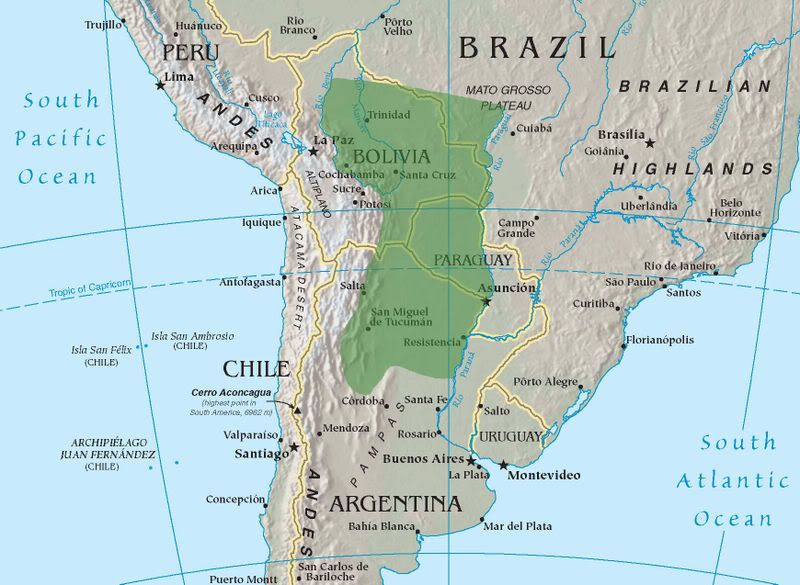
Chaco plains covers the extreme northern range, this includes parts of Paraguay. Lowland alluvial plain, south-central South America. An arid lowland, it is bounded by the Andes Mountains to the west and the Paraguay and Paraná rivers to the east; its northern and southern margins, generally considered to be a marshy area in Bolivia and the Salado River in Argentina, respectively, are less well defined. Its area is about 280,000 sq miles.


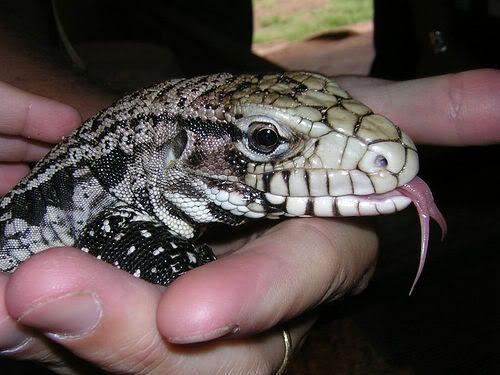
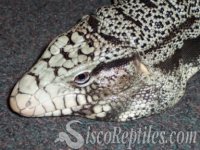
This White head tegu was caught in Tanti Argentina, this is the region known as Cordoba. So, calling these Chacoan White heads would be a false statement based on the region where this animal came from. Tanti is not part of the Chaco range, but rather Cordoba and is found much farther south in central Argentina.

27223220_9a43cd817c.jpg

27223209_00d009dccd.jpg


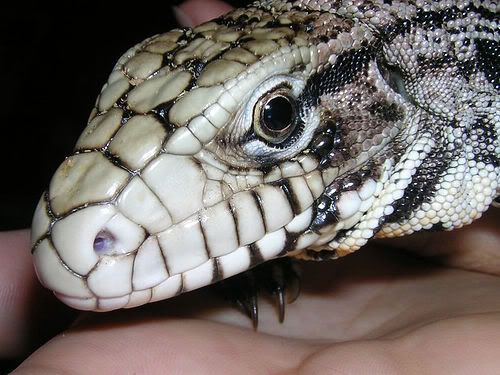
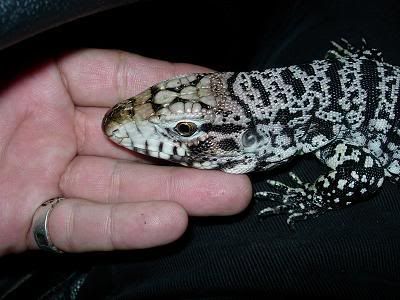
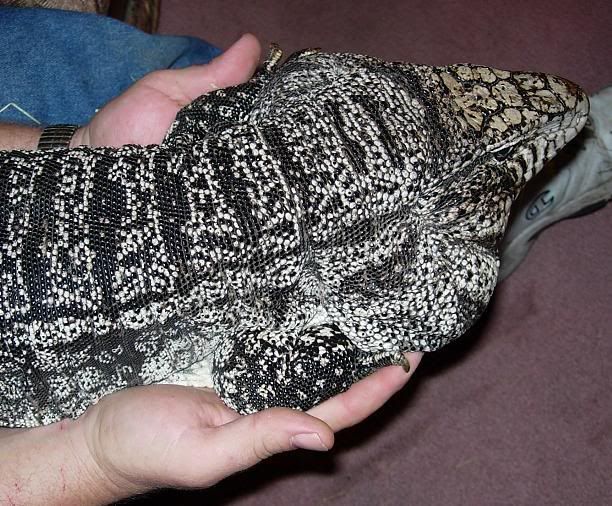
This is a picture of a yearling from Rick's stock he is calling Chacoan, note that this animal and the one from Cordoba look very much alike.

DSCN1717.jpg


800px-GranChacoApproximate.jpg


You want to know the age of my animals, well they are not old and are still reproducing. I would say about five, but then you would want proof and so it goes with the dumb 50 questions. However if I was to ask almost anyone on here for proof of the age of the animals they have, would they have it? No.

Does Rick have proof? No it seems he does not need any. I have posted pictures you can see, maps and even gave you all of the info, and still you want more, yes, it is a joke.

I even asked Rick if that tegu from Tanti is a white head like his, he did not want to answer that either.
 
KelliH said:
I decided to do some tegu research on my own since I am thinking of putting together a small breeding group of my own, and I emailed Ron St. Pierre to ask him about these, since that is were they (supposedly) came from originally.

The reply I got was extremely helpful and very interesting. It does explain some things. Basically, the St. Pierre's worked with four different "color varieties" (for lack of a better term) of Black & White Tegus.

1. Normal - average, not much white, males got about 4'

2. Chacoan - original breeding stock came from Bert, and the founding male was very large. In the second year of producing them, they noticed the animals had more white on the heads than normal B & W's, the best were held back, and this was the start of the "Chacoan" strain, in which some of the tegus were a bit larger than average (averaged about 4.5' for males but a couple were even bigger). The explanation for the name "Chacoan" is quite interesting: "The difference between these babies and our normals were like comparing and average California kingsnake to a Desert phase california kingsnake (hence why Ron picked the name Chacoan to describe them as in Chacoan desert even though black and whites do not occur in the desert areas - bad name choice for range but good for color"

3. White Headed - These were simply exceptional, high white Chacoans. These could be up to 50% white. The amount of white they would have could not be determined until they were about 18", and average size for males was, again, 4.5'. Apparantly, right around the same time a bunch of tegus from Paraguay were imported that had a lot of white on them, and importers and wholesalers called them whatever they wanted to and marketed them as such.

4. White headed laced - bright white heads with a laced pattern. These animals were given away as pets so the line probably does not exist any longer.

So, it would seem none of the "chacoan" tegus actually came from the Chaco region of Argentina. Since Bobby's four Chacoan (Extreme Giants) came from Ron, as Bobby himself admitted, than we know the origins of this stock is from Bert's Argentine Black & White Tegus, and they were merely selectively bred for higher white and larger size.

As I have stated, my "chacoan white heads" are not as large as Bobby's "chacoan extreme giants", but many people who have seen or held examples of both can state that his are larger, mine are whiter and more social. I admit that Bobby has only recently aquired his chacoans, so perhaps with a few years of selective breeding, he too may be able to get his as tame and social as mine.

http://www.siscoreptiles.com/tegu-attention.php

Personally, I would rather have a 4 to 4.5 male tegu that is pretty and very social, rather that a 5+ foot male tegu that is not so social, but I am sure there is a market for both.

Thank you for the time you put forth to contact Ron & Stella at bluetegu.com. I have no doubts now that mine are infact "Chacoan white heads". It appears that Ron and Stella bred one group (Chacoans) for size more than color, and another (Chacoan White Heads) for their brighter color.

I think this clears up the issue in a manner that can no longer be denied since Bobby did publicly admit his four founding chacoans came from Ron (thus from Bert) as Chacoans, not White Heads.

Rick Sisco
 
varnyard said:
Randy, what is the northern half of Paraguay?


Chaco plains covers the extreme northern range, this includes parts of Paraguay. Lowland alluvial plain, south-central South America. An arid lowland, it is bounded by the Andes Mountains to the west and the Paraguay and Paraná rivers to the east; its northern and southern margins, generally considered to be a marshy area in Bolivia and the Salado River in Argentina, respectively, are less well defined. Its area is about 280,000 sq miles.


This White head tegu was caught in Tanti Argentina, this is the region known as Cordoba. So, calling these Chacoan White heads would be a false statement based on the region where this animal came from. Tanti is not part of the Chaco range, but rather Cordoba and is found much farther south in central Argentina.

27223220_9a43cd817c.jpg

27223209_00d009dccd.jpg


This is a picture of a yearling from Rick's stock he is calling Chacoan, note that this animal and the one from Cordoba look very much alike.

DSCN1717.jpg


800px-GranChacoApproximate.jpg


You want to know the age of my animals, well they are not old and are still reproducing. I would say about five, but then you would want proof and so it goes with the dumb 50 questions. However if I was to ask almost anyone on here for proof of the age of the animals they have, would they have it? No.

Does Rick have proof? No it seems he does not need any. I have posted pictures you can see, maps and even gave you all of the info, and still you want more, yes, it is a joke.

I even asked Rick if that tegu from Tanti is a white head like his, he did not want to answer that either.


Bobby, with all due respect (and when it comes to Tegus you are due A LOT of respect), while you've shown a great deal of information to prove that there are indeed Tegus that come from the Chaco region of South America, I have yet to see any definite proof that YOUR tegus come from that region.

I'm not trying to further the debate, but I think that is the point where a lot of the confusion in this thread comes from.

Thanks
 
Rick: Bobby goes on and asks why I didn't sell them as Chacoan White Headed the year prior. That is a fair question.. The answer is the year prior I bred tegus and sold them all as "Argentine Tegus", some where the Chacoan White Heads, which is still just a regional variance of the Argentine Black & White tegu. Both are the same species. People specifically started asking me why some were normal and some were really white. I explained it was regional and I sold both at the same price. I sold out in 40 days, but my Chacoan White Heads, which I didn't label any differently at the time were asked for specifically and sold first. Just because I had some regional variance in my stock, I didn't realize the white heads I had would be so popular. As a matter of business, of supply and demand, of course the following season I sold my Chacoan White Heads for a little more.

You bet, he said a mouthful there; he jacked the price on the normal Argentines to collect extra cash, correct? Yep, that’s what he said.

Rick: I do have and hope to breed blue tegus this coming season. Last season I had a stroke of bad luck. Tegus are difficult to breed here in Maine and Blues are the harder tegu to produce. I purchased my blue tegus over the years from various spots in an attempt to make the bloodlines as diverse as it can possibly be with the limited diversity available in Blue Tegu bloodlines. It is commonly believed that the Blue Tegu may also be a regional variance of the T.merianae. If this is proven to be the case, I will be able to add some fresh diversity to my stock using my White Headed tegus.

But he is a breeder of blues, but never produced not even one. Hell, ask him if he has.

Rick: I will not be specifically breeding for Albino or Snow tegus. If I produce some accidentally, I will know which adults are carriers for the gene and will not be breeding that pair together again. I will sell any albino or snow I accidentally produce rather than destroy the animal, this is of course if there is a market for them. I will inform any potential customers that albinos or snows do have sensitivity to direct sunlight, but will be perfectly fine under normal UVB bulbs, which do not put off intense UVA/UVB like the sun.

Knowing there are no snows, he will sell them as snows.

Bobby has also questioned how he had eggs a week or two before me, yet some of my eggs started to hatch before his. This I quite honestly can not answer. I incubate mine in a homemade 'upright' freezer at 90F though it is outside and during the day the summer heat actually makes the temps of the incubator hit temps as high at 96F. Bobby did tell me that this season he did put his clutches in a box on his porch and did not incubate them for the entire period. Perhaps the delayed hatching was related to the differences in incubation methods.

It was not a week, it was at least three weeks, prob more like four. It stays colder much longer in Maine the Florida.
So how did Rick have hatchlings the same age as mine? He told me he had eggs "weeks" later. 30 day incubation period? I don't think so, it was prob the 90 from Bert.

And just how many here think I use my porch for an incubator? How many have even seen my incubator? And Dennis sold me the thermostst I use.


See, this is yet more lies told by Rick, all of this posted on his site after he banned me for telling him to go to hell.
 
From what we've read so far in this thread his tegus originated one male (one = 1). If what Rick sates is right there are only four (4) Chacoan breeders. In the thread "The truth about blue tegus" was stated:

varnyard said:
No Steve, it was blind, as many others I have seen the same way. As for coming forward, who better than me? :shrug01: I am just tired of the breeders that know the history of them hiding the facts. Somehow they seem to think, what people don't know won't hurt them. Me on the other hand think people should know the truth and than have the choice to choose if they want an animal that might just come with many problems due to the history of inbreeding so heavy.
I just want people to understand why I do not and will not breed this species. It just goes against everything I stand for as one of the top breeders of tegus. I will continue to keep my animals pure and free from any type of inbreeding.

Now don't get me wrong, I think the high white Blues are awesome looking, I just cannot get past their history.
 
The BoidSmith said:
From what we've read so far in this thread his tegus originated one male (one = 1). If what Rick sates is right there are only four (4) Chacoan breeders. In the thread "The truth about blue tegus" was stated:

Nice try, but no!!

Chacoan - original breeding stock came from Bert, and the founding male was very large. In the second year of producing them, they noticed the animals had more white on the heads than normal B & W's,
 
Bobby, again a long winded post without the answers, why are you being so evasive? Why not look at Kelli's post that has been quoted a number of times and answer each question. We shouldn't have to go back through your long post to find the answers to these very simple questions. You came here to Rick's good guy thread and made and still make accusations against him . Yet I don't see evidence provided by you that proves anything you've said. I've seen you read into post Rick made and draw conclusions from them that I for one don't see.

Now people are questioning you and you get all defensive and evade answering straight forward questions. You want us to decide this without providing any real proof or answering the questions posed to you. From what I see here you have wasted everyone's time and may have hurt someones reputation over a personal matter and add in the damage you've done your own reputation this thread is just a bust..

Look at comments like this """This is a picture of a yearling from Rick's stock he is calling Chacoan, note that this animal and the one from Cordoba look very much alike.""

That would be something if you had any real clue where yours or Ricks came from ! you don't so why keep making comparisons?


Why don't you want to admit the ages of your animals? Hey you could guess, you've had them so long the person you got them from had them for so long ETC.. I could tell you the ages of most my animals and of those that I have no info on I could make a good guess. Randy
 
Chacoan - original breeding stock came from Bert, and the founding male was very large. In the second year of producing them, they noticed the animals had more white on the heads than normal B & W's,

Mine are not the white heads, yours are Rick. You have White heads, remember. Yours must be from that one male.
 
Yes but it sounds as if they ALL originated from the original breeding group that the St. Pierre's called "Chacoan". The "White Heads" are just a selectively bred higher white Chacoan. Both are, according to the St. Pierre's, the same sizewise. Right?
 
KelliH said:
Yes but it sounds as if they ALL originated from the original breeding group that the St. Pierre's called "Chacoan". The "White Heads" are just a selectively bred higher white Chacoan. Both are, according to the St. Pierre's, the same sizewise. Right?

Yea, the normals and the white heads like this:
 

Attachments

  • WRick.jpg
    WRick.jpg
    39.7 KB · Views: 137
Originally Posted by Rick Sisco:
Bobby goes on and asks why I didn't sell them as Chacoan White Headed the year prior. That is a fair question.. The answer is the year prior I bred tegus and sold them all as "Argentine Tegus", some where the Chacoan White Heads, which is still just a regional variance of the Argentine Black & White tegu. Both are the same species. People specifically started asking me why some were normal and some were really white. I explained it was regional and I sold both at the same price. I sold out in 40 days, but my Chacoan White Heads, which I didn't label any differently at the time were asked for specifically and sold first. Just because I had some regional variance in my stock, I didn't realize the white heads I had would be so popular. As a matter of business, of supply and demand, of course the following season I sold my Chacoan White Heads for a little more.
Then...
Originally Posted by varnyard / Bobby:
You bet, he said a mouthful there; he jacked the price on the normal Argentines to collect extra cash, correct? Yep, that’s what he said.
To me that is the same as pricing High White Pieds a little higher than Low White Pieds, pricing High White Spiders with very reduced patterns higher than Low White Spiders with some normal pattern, Bright Pastels higher than Dark/Dirty Pastels, where it's hard to even tell if they are in fact Pastel. That pretty much applies to anything. If you have finer examples of any animal and the demand is there for them you price them higher, or jack the price to collect extra ca$h, correct?
Originally Posted by Rick Sisco:
I do have and hope to breed blue tegus this coming season. Last season I had a stroke of bad luck. Tegus are difficult to breed here in Maine and Blues are the harder tegu to produce. I purchased my blue tegus over the years from various spots in an attempt to make the bloodlines as diverse as it can possibly be with the limited diversity available in Blue Tegu bloodlines. It is commonly believed that the Blue Tegu may also be a regional variance of the T.merianae. If this is proven to be the case, I will be able to add some fresh diversity to my stock using my White Headed tegus.
Then...
Originally Posted by varnyard / Bobby:
But he is a breeder of blues, but never produced not even one. Hell, ask him if he has.
Ok, Rick did you even produce one Blue? What I read is that he claims that he has not. He said that he had a stroke of bad luck, that tegus are difficult to breed in Maine, and Blues are the harder tegu to produce. Did I miss something there?
 
You bet, he said a mouthful there; he jacked the price on the normal Argentines to collect extra cash, correct? Yep, that’s what he said.

If I had a "normal" ball python with a white head I sure as hell would be jacking the price up. Especially if everyone wanted one. Evidently "white-head" has been proved to be genetically passed on, something that can't be said for the "giant" as yet.
 
Back
Top