• Responding to email notices you receive.
    **************************************************
    In short, DON'T! Email notices are to ONLY alert you of a reply to your private message or your ad on this site. Replying to the email just wastes your time as it goes NOWHERE, and probably pisses off the person you thought you replied to when they think you just ignored them. So instead of complaining to me about your messages not being replied to from this site via email, please READ that email notice that plainly states what you need to do in order to reply to who you are trying to converse with.

  • IMPORTANT! PLEASE READ!! About the Google Adsense ads being displayed

    =====================
    Posted 08/15/2025
    =====================


    Yeah, I know. They are a pain in the butt. But they pay the bills to keep my server running. Just a fact of life, I am afraid.

    Want to get rid of them? Simple. Just become a Contributor level member or above and they will be gone. -> Please click HERE."

    Is that too much for me to ask of you to keep this site running? Well, sorry about that. I too wish I could get everything for free. But alas.....

    =====================
    Addendum: 01/10/2026
    =====================


    Google Adsense ad revenue for December, 2025 was just $30 over the cost of the lease for the server running this site. So, in effect, the money providing the incentive for me to continue running this site is coming SOLELY from the paid memberships and sponsorships here. Which honestly ain't much....

Selective spider breeding

LadyOhh said:
I have greatly enjoyed this thread, and have discussed it with several other people as well... A topic dear to my own heart.

So my other Devil's advocate question is this...

There is a theory spinning around cyber space that spiders that are "clean" (no alien heads) exhibit the trait of wobbling/spinning much more often than those with more pattern to them (dots on the sides, etc).

Does anyone have a comment on that?


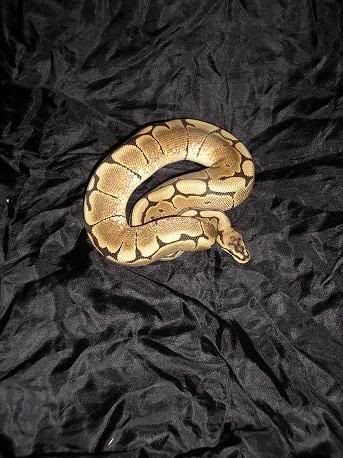
No wobble and no spots.
And I can touch her nose without her going into convulsions (or biting me). :D She's a pig but prefers the taste of rats over me. :D

DSCN0214.jpg
 
Clay Davenport said:
Herein will lie your problem though. If your spider does produce offspring with the wobble, then your female will be shown to possess the gene that causes wobbling, in whatever form it might be. If your intent is to attempt to get rid of the gene and develop a wobble free breeding group, then your female must be retired as well.

Absolutely, she would have to be retired and her offspring not bred.

And I'll work my other projects and look for another wobble-free Spider to try out down the line. Yes, it's a risk. Thanks for the well wishes. I'm more worried about the Caramel project than I am this one. I sure hope my Spider girlie does well next year. Great opportunity & risk usually go together.
 
LadyOhh said:
I have greatly enjoyed this thread, and have discussed it with several other people as well... A topic dear to my own heart.

So my other Devil's advocate question is this...

There is a theory spinning around cyber space that spiders that are "clean" (no alien heads) exhibit the trait of wobbling/spinning much more often than those with more pattern to them (dots on the sides, etc).

Does anyone have a comment on that?

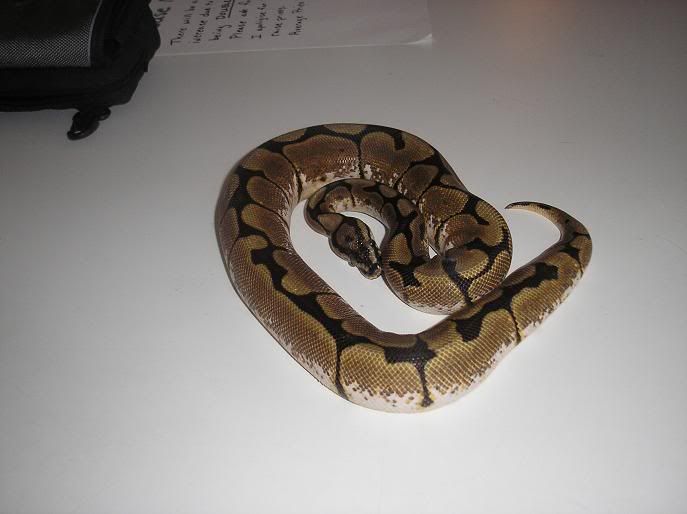
Here's my girl; named Cincomy as she was born 050505 :D

x1pWZZh3TCHCz6IrBNz2lfRCySV7KLXCo12Fc4SQtJhkvWHPXsZLnf57g6UC4bKzJLx3nPxFykSsfrFIskSQTNBru0mYEmJTYXjvrUGCLVR_Fo


x1pWZZh3TCHCz6IrBNz2lfRC_6unpcAHgwVus3KY8YYmCV9ch946TtXQxClZ1gittK2rj31kyteE992vKagPvFvBMmVXPbPF7UOXCF3oPzW7GBdzsjI3jhMsg


PS Steve, your Spider ROCKS!
 
I guess the point is there are two fundamentally different models for what might be going on here. On one side is the idea that some separate gene (not the mutation gene we want) is causing spiders to spin and caramels to kink. If that is the case then ruthless culling should be the answer.

The other model is that spinning and kinking are just one of the several tendencies inherent to the spider and caramel mutant genes themselves. If this is the case perhaps your decision will be that these morphs should not be bred. Alternatively, you could try to figure out why some report large numbers of non spinning spiders and non kinking caramels in the hopes there is some way to suppress the genetic tendency of the mutation.

The first step is to ascertain if there really is a significant variation from collection to collection. The two claims to the effect that all spiders have it to some extent that I referenced where both from big breeders. One juvenile spider that may not have shown it yet doesn’t mean much but there are claims from spider breeders of not seeing it in groups of animals. There was also a claim by a fair sized caramel breeder of no kinks. If any of these claims are true and not just a blind eye to marketing they offer some hope. What is different about these collections? Could a simple supplement make all the difference?
 
Theresa,

Both are very cute. I don't know enough about the defect, but note the joined dark out-line on Hepburn's head? Heard that a connected head outline was something to avoid...

Note that all 3 "non-wobblers" have a break in this outline? I don't know, this business can be so darn secretive- drives me nuts!

I do hope someone does figure out the true nature of the defect just as much as I hope my girl & her offspring prove out wobble-free along with your boy & Steve's too, of course!
 
Deb, can you elaborate? I'm trying to see what you mean about the photos.

As for everyone else, the photos you post are of NON-wobblers?
 
LadyOhh said:
Deb, can you elaborate? I'm trying to see what you mean about the photos.

As for everyone else, the photos you post are of NON-wobblers?

Yes. Theresa's female Hepburn was the only one that was a wobbler.

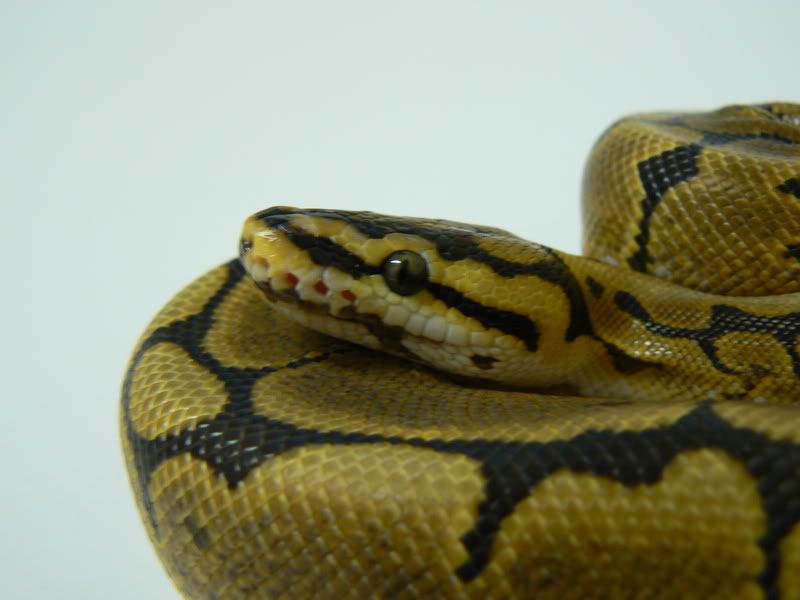
This one has no wobble at all so I don't think it has anything to do with a reduced pattern or having a lot of white. I am curious about the head outline being connected though.
DSCN0048.jpg
 
Back when I was looking to buy... I had been hearing a bit of rumors about "problems" with the Spider. At the time Kevin (NERD) had most the spiders but some had been sold off. I posted in the BC forums, Kingsnake & other places... the theory about the wobble ranged from "excessive line breeding" to "well there's your Super" (the later a rather interesting case NOT to try to produce a homozygous Spider).

If the true nature of the defect was known at the time, no one came right out with it- Spiders had hiccuped down under 10K but 5-7K was still a chunk of change. I remember that there was an interactive discussion about Spiders (on Kingsnake I believe)...

I asked what everyone "looked for" in a Spider. I paid attention when this was replied to- some liked high white some said low white with the "thinner" web markings... and more than one biggie mentioned a break in the head pattern as desireable. Does it mean anything? I DON'T know, but I find it interesting that all photos of the non-wobblers have breaks in the outlines on their heads.

If anyone has a non-wobble head Spider with a connected head pattern like Hepburn, I hope they post... it's be too easy to have that be a visual marker of trouble wouldn't it?

I believe that the double expression of the gene should be avoided. Cornnut, do the Pastel & Spider gene share locus or ? Do you think the defect could be due to the homozygous expression of the Spider gene (instead of homozygous lethal, it's a homozygous "gimp" so to speak?).

PS
Cornnut, The Caramel issue IMO may well be linked to a calcium deficiency... more like a predisposed difficulty in absorbing calcium- what do are your thoughts on that? If true then supplementation may prevent the defect.
 
The existence of killer bees proves that pastel and spider are at different loci. Actually, as quickly and often as they have been produced tends to indicate that the spider and pastel mutations aren't even on the same chromosome, at least not very close together if on the same.

I don't think there have been enough spider X spider breedings to account for the spinners. In fact, the average spider might be more outbred than the average egg pulled out of the wild. For whatever reason there doesn't seem to be much interest in breeding spider X spider any more and I'm not sure much was ever done in comparison with all the spider X normal clutches.

One thing that I think is interesting is the idea that some spiders start and stop spinning at different times in their life. Like a lot of the information on this subject it's hard to know what to believe. The pattern would be set by hatching time so if there is a link between pattern and spinning then that would tend to indicate some early development variable or gene penetrance or what the mother was fed or something like that. However, if all appearances of spiders can stop or start spinning at different times it might be more likely some environmental variable like a nutrient in their diet that could be used to control the problem in any spider at any time in its life.

With caramels I believe it has to be some variable that has worked by the time they hatch (either kinked or not). If there are some producing large numbers of not kinked caramels it would be interesting to know what they are feeding their rodents. Could calcium or folic acid make a difference? Maybe in both cases something needs to be avoided that normals can tolerate better? To complicate the caramel picture I understand there may be several new variations of caramel that in some cases appear to be compatible but consistently look different. Perhaps there are multiple mutant versions of the gene at the caramel locus (and I'm still not sure this isn't also the regular albino locus - i.e. I don't think caramel and regular albino have been proven not compatible yet). Maybe there will be a version that doesn't have the kinking side effect and culling will result in it eventually replacing the one that does.
 
CornNut said:
The existence of killer bees proves that pastel and spider are at different loci. Actually, as quickly and often as they have been produced tends to indicate that the spider and pastel mutations aren't even on the same chromosome, at least not very close together if on the same.

I thought so, so a homozygous pairing of the Spider gene in a bee could be why some wobble...

CornNut said:
I don't think there have been enough spider X spider breedings to account for the spinners. In fact, the average spider might be more outbred than the average egg pulled out of the wild. For whatever reason there doesn't seem to be much interest in breeding spider X spider any more and I'm not sure much was ever done in comparison with all the spider X normal clutches.

Back at the start, I'd argue- but I fear you're right... which would nix the homozyous theory.

CornNut said:
One thing that I think is interesting is the idea that some spiders start and stop spinning at different times in their life. Like a lot of the information on this subject it's hard to know what to believe. The pattern would be set by hatching time so if there is a link between pattern and spinning then that would tend to indicate some early development variable or gene penetrance or what the mother was fed or something like that. However, if all appearances of spiders can stop or start spinning at different times it might be more likely some environmental variable like a nutrient in their diet that could be used to control the problem in any spider at any time in its life.

If true, I agree that we might be looking well beyond genetic factors & more towards a environmental trigger. If so, then the defect could be controled. Still, the weakness or predisposition would still technically be genetic, don't you agree? We'd just have to work around it.

CornNut said:
With caramels I believe it has to be some variable that has worked by the time they hatch (either kinked or not). If there are some producing large numbers of not kinked caramels it would be interesting to know what they are feeding their rodents. Could calcium or folic acid make a difference? Maybe in both cases something needs to be avoided that normals can tolerate better?

I believe that it's possible that the gravid female may hold the key in the kinking issue- that correct supplimentation to her during the breeding cycle may be the fix... but only time will tell. This is why I need to get to more herp shows & ply a few folks with drink...

CornNut said:
To complicate the caramel picture I understand there may be several new variations of caramel that in some cases appear to be compatible but consistently look different. Perhaps there are multiple mutant versions of the gene at the caramel locus (and I'm still not sure this isn't also the regular albino locus - i.e. I don't think caramel and regular albino have been proven not compatible yet). Maybe there will be a version that doesn't have the kinking side effect and culling will result in it eventually replacing the one that does.

Funny you mention this! There is a yellowhead strain of "normal" Albino that is supposed to be genetic yet compatable with other Albino strains, I'm checking into it for my projects. Perhaps the colour & pattern mutations happen to be present in the single animal but can be distributed singly or like you suggest the locus is very complex...

I always enjoy your posts BTW, thanks for taking time to discuss!
 
Good eyes!! I never spotted the connected head pattern as different. Perhaps something we could look through pictures of non-wobble spiders for? That would be rather ignominous.
I don't think wobbles are homozygous, since non-wobbles have produced wobbles and vice versa, with normals thrown into the mix all over. I thinkt hey may very well be some little side thing that happens to be linked with the spider gene. Some people have said they have non-spider wobblers. Locating them and seeing if they have spider relatives, and if they are in fact wobblers and not injuries or something unrelated would be a good thing. In fact the problem is locating wobblers. You know there has to be quite a few out there(if people haven't culled them all) but getting people to admit they have one, that's a different story.
Wolfy
 
Wolfy-hound said:
you can't see the top of its head in any of those pictures.
wolfy

That's why I said I emailed him about the top of the head. :rofl:
 
I hate to double post, but I realized that was an entire thread after I posted about the picture.
In that thread there is the following information,
MKReptile: 2 normal spider siblings that wobbled
Steve Harrison: spider that wobbled when young, but doesn't wobble now. Pic shows a solid band across the back of the head, but it doesn't connect to the side lines.
phoerner: spider that wobbles, is still young but breeding. Pic: no solid line across the back but solid lines from side wrapping to the other side(across the nose-mustache)
DZBReptiles: 3 female spiders, 2 wobble and have no spots, clean pattern, 1 does NOT wobble, and has the alien head type spots.
Kim @ N.A.R.C.: Had some that wobbled but they mostly grew out of it.

Some good information there and a couple posts imply that they had a LOT of wobblers that were bred anyway, producing some non and some wobblers later.
Very tre cool linkage there, thank you!
Theresa
 
Well from that thread it may be only a matter of time before I see wobbling in my girl's offspring, but I'll still give it a try & hope for the best. It is true that in mammals, (I bred show rabbits & dogs in the past): you linebreed to go for a "type", then outcross to keep the defects down; if you get defects... you cull the defects. That's the accepted procedure. Even with pedigrees & proof of parentage there are certain "typey" breeds I wouldn't touch; too many defects.

If enough BP folks cull & out cross maybe the defect will eventually be eliminated. Since it's a dominant trait it's very easy to outcross but if Kevin's theory is right & it's tied straight with the pattern itself... that's a long road.

The Spider has got to be my favorite pattern mutation (tied with pied). I truly hope we find a way to understand how the motor issues are passed. -Deb
 
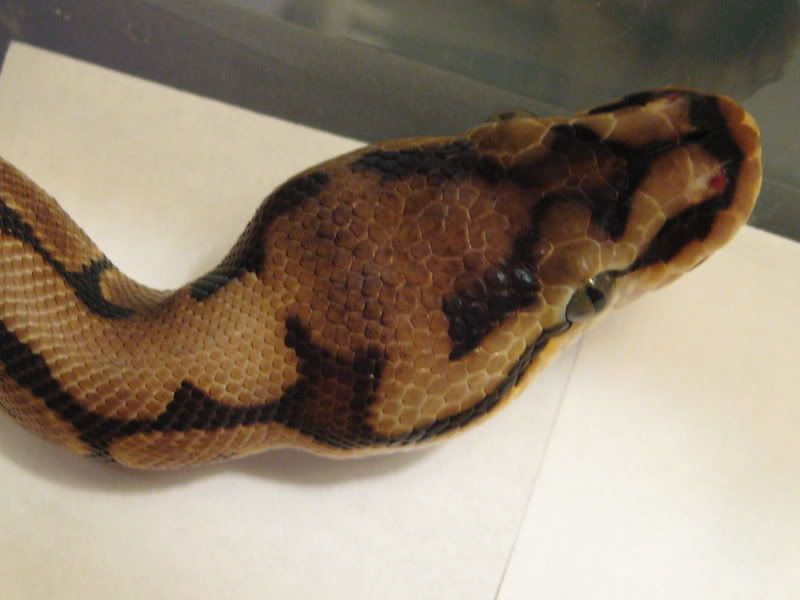
I can't tell if it's all the way connected, if the black outline we see in profile is without break from nose, along sides AND connected in back above the neck then it's the pattern. Good to know he's not a wobber; figures that head markings would be way too simple a way to tell if there's a problem.

Most folks say that if a Spider shows the problem it will be evident when they are young & less so as they age. Has anyone had a young wobble-free Spider develop the problem later? This is important as I need to know how long to hold the offspring from my girl- if none of them wobble I do intend sell a few of them at some point. No hurry, but I am curious what the lastest age is for the potential onset of the defect would be, in order to be confident it's not an issue.

My plan was and is to keep a some females back- the reputation of the Spider as such a hearty morph had me convinced that the females would be good breeders. That's still my plan if the offspring are free of defect like my sub-adult female is.
 
Well, I just learned of the wobble issue with the spider morph- cause I was starting to freak out about some odd behavior from my spider. I have had the spider for a month, just got it from a show. Just this past sunday I saw it corkscrewing minorly as he was checking out the top of his cage. That was th eonly time I saw him do it, and he doesn't do it outside of the cage.

I am now concerned b/c I planned on breeding him. Truth be told, if I was aware of this issue in th espider morph, I would not have invested in th emorph.

My question is:

How can one prevent from buying a wobbler spider? My spider show sno signs of wobbling when being held, and I have seen him cruising around his cage not wobbling. I have only seen him wobble once.
Now, would a breeder be truthful if asked if the spider they were selling wobbles?
Originally, I just planned on buying a new spider morph in a few months, but I'll be honest- if I ask a breeder if it wobbles and they say no, and it turns out to wobble, i'd be really mad. Yes, the price has dropped, but still, it is alarge chunk of change and I wouldn't want to invest in another spider if it was just going to wobble. How can one go about to be sure to get a non-wobbling spider?

Just for pic reference, here is th epattern on my snakes head. I'd consider him a minor wobbler ( so far, I have only observed him wobbling once, and I am keeping an eye on him to see how severe/how often he wobbles)

IMG_0533.jpg


:sigh: I wish I knew about this before I purchased a spider morph. BUT worse case scenerio- I have a beautiful pet spider bp. :D

edf
 
Back
Top