• Responding to email notices you receive.
    **************************************************
    In short, DON'T! Email notices are to ONLY alert you of a reply to your private message or your ad on this site. Replying to the email just wastes your time as it goes NOWHERE, and probably pisses off the person you thought you replied to when they think you just ignored them. So instead of complaining to me about your messages not being replied to from this site via email, please READ that email notice that plainly states what you need to do in order to reply to who you are trying to converse with.

  • IMPORTANT! PLEASE READ!! About the Google Adsense ads being displayed

    =====================
    Posted 08/15/2025
    =====================


    Yeah, I know. They are a pain in the butt. But they pay the bills to keep my server running. Just a fact of life, I am afraid.

    Want to get rid of them? Simple. Just become a Contributor level member or above and they will be gone. -> Please click HERE."

    Is that too much for me to ask of you to keep this site running? Well, sorry about that. I too wish I could get everything for free. But alas.....

    =====================
    Addendum: 01/10/2026
    =====================


    Google Adsense ad revenue for December, 2025 was just $30 over the cost of the lease for the server running this site. So, in effect, the money providing the incentive for me to continue running this site is coming SOLELY from the paid memberships and sponsorships here. Which honestly ain't much....

Silver-ish spots on BRBs back?

kyle13404

New member
Joined
May 6, 2015
Messages
8
Reaction score
0
Points
0
Location
Lake Park, Georgia
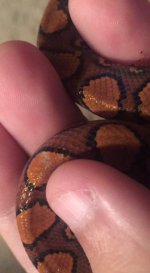
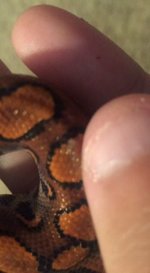
I asked for help on a different forum and couldnt get any help. My baby male BRB that has some weird silverish spots on his back. He had mites not to long ago but they are finally gone. He has shed after this but the spots are still there. Someone said they could be mite poop? If someone can tell me how to upload pictures, I will upload a couple pictures of the spots.
 
Here is a picture of the spot
 

Attachments

  • image.jpg
    image.jpg
    30.5 KB · Views: 72
Do you use plastic bowls (dog/cat bowls), that the snake can go under, for water or as a hide?

I have a water dish and I have a small plastic container that I made a humid hide out of. He had mites not too long ago but theyre finally gone. He shed last week too.
 
It's definitely not mite feces. Mite feces are tiny flecks upon a scale. Not loss of color of a scale.

As long as there is no fluid, and no blistering, what it looks like, to me, are rub marks. From either plastic sensitivity or rubbing in general.
A forced shed, that damaged some scales, is another possibility.
Loss of scales (from rub off or injury), where new ones came in and pigmentation is delayed, is another possibility.

If it is from rub, removing what its head/back rubs against, and the snake having a couple/few sheds, should make it go away.

If from a forced shed, or injury, it should go away after "two or three" good sheds.
 
It's color loss, Kyle. I've seen it before. It can hit a few random scales and spread no further (most common by far), or it can continue and affect the whole snake…though that is *exceedingly* rare with anything young. I find that if it is going to spread, that usually happens very quickly, within a few months. If it only hits a few scales and stops you have no worries; I’ve never seen a case spread once stopped. In those cases, it is more like a scar or a birthmark.

No one is quite sure what causes it. It could be a pathogen, an environmental factor, or genetic.

For disease, I had a fully color-faded animal tested once via biopsy and found no evidence of pathogens, but would like an independent confirmation. I've battled other breeders for years to have one of their faded animals tested, and no one wants to spend the cash (or, in many cases, admit they have any affected animals at all).

As of right now I lean towards a genetic susceptibility, which is triggered by later environmental factors. The full fades are most common with gravid females, which indicates that hormones may play a role. Toxins in the water, food, or air may also play a roll. As another poster surmised, specially in minor cases that affect only a few scales, it may also set off by physical damage, which heals *except* for the color.

I had several animals fade out a few years back, but with my collection now on purified water and a set feeder source have only had one since…and he was just rehomed.

FYI, you will see some folks look at your pictures and tell you have a goldmine calico in the making…don't believe then. Calico is different, and a true calico rarely happens.

The good news is that your snake is completely healthy, and the area is very unlikely to spread. Even if it does, he will live out a full and normal -- if slightly less colorful -- life. :)
 
It's color loss, Kyle. I've seen it before. It can hit a few random scales and spread no further (most common by far), or it can continue and affect the whole snake…though that is *exceedingly* rare with anything young. I find that if it is going to spread, that usually happens very quickly, within a few months. If it only hits a few scales and stops you have no worries; I’ve never seen a case spread once stopped. In those cases, it is more like a scar or a birthmark.

No one is quite sure what causes it. It could be a pathogen, an environmental factor, or genetic.

For disease, I had a fully color-faded animal tested once via biopsy and found no evidence of pathogens, but would like an independent confirmation. I've battled other breeders for years to have one of their faded animals tested, and no one wants to spend the cash (or, in many cases, admit they have any affected animals at all).

As of right now I lean towards a genetic susceptibility, which is triggered by later environmental factors. The full fades are most common with gravid females, which indicates that hormones may play a role. Toxins in the water, food, or air may also play a roll. As another poster surmised, specially in minor cases that affect only a few scales, it may also set off by physical damage, which heals *except* for the color.

I had several animals fade out a few years back, but with my collection now on purified water and a set feeder source have only had one since…and he was just rehomed.

FYI, you will see some folks look at your pictures and tell you have a goldmine calico in the making…don't believe then. Calico is different, and a true calico rarely happens.

The good news is that your snake is completely healthy, and the area is very unlikely to spread. Even if it does, he will live out a full and normal -- if slightly less colorful -- life. :)

Thank you! I was worried that it was serious. I am relieved now.
 
You are most welcome. Keep a loose eye on it, just in case, and if starts looking "funky" -- raised scales, growths, etc. -- then post back and let us know. Otherwise you should be fine. :)
 
You are most welcome. Keep a loose eye on it, just in case, and if starts looking "funky" -- raised scales, growths, etc. -- then post back and let us know. Otherwise you should be fine. :)

I just checked them a little while ago. It kinda looks like they might be starting to go away. Like theyre starting to go back to a brown color.
 
Back
Top