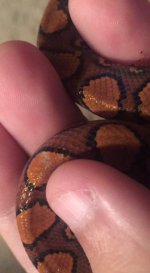
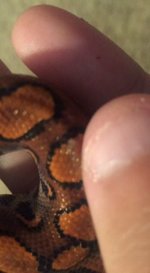
It's color loss, Kyle. I've seen it before. It can hit a few random scales and spread no further (most common by far), or it can continue and affect the whole snake…though that is *exceedingly* rare with anything young. I find that if it is going to spread, that usually happens very quickly, within a few months. If it only hits a few scales and stops you have no worries; I’ve never seen a case spread once stopped. In those cases, it is more like a scar or a birthmark.
No one is quite sure what causes it. It could be a pathogen, an environmental factor, or genetic.
For disease, I had a fully color-faded animal tested once via biopsy and found no evidence of pathogens, but would like an independent confirmation. I've battled other breeders for years to have one of their faded animals tested, and no one wants to spend the cash (or, in many cases, admit they have any affected animals at all).
As of right now I lean towards a genetic susceptibility, which is triggered by later environmental factors. The full fades are most common with gravid females, which indicates that hormones may play a role. Toxins in the water, food, or air may also play a roll. As another poster surmised, specially in minor cases that affect only a few scales, it may also set off by physical damage, which heals *except* for the color.
I had several animals fade out a few years back, but with my collection now on purified water and a set feeder source have only had one since…and he was just rehomed.
FYI, you will see some folks look at your pictures and tell you have a goldmine calico in the making…don't believe then. Calico is different, and a true calico rarely happens.
The good news is that your snake is completely healthy, and the area is very unlikely to spread. Even if it does, he will live out a full and normal -- if slightly less colorful -- life.