I mean after all, (for the sake of arguement lets say Kahl was first), Peter Kahl had already claimed the term "albino boa." And if the Sharp strain didn't have the same genotype then, we can't really call it albino anymore now can we?
You are continually making the mistake of confusing terms used specifically to describe a biological concept with those subjective terms applied to help boost sales.
Albinism can have multiple causes, the word itself is directly related to a biological anomaly...
Pastel is a term that was applied to an animal as a selling point, to identify both phenotype and, once it was proven out, genotype.
Since there is, despite your apparant claims to the contrary, an industry reccognition of the equation between selling point term and biological alteration of phenotype, you misrepresent an animal by applying a term to it that comes with an added meaning and implies a genetic morph as you have.
OK Seamus, so you're saying that because Tom payed thousands of dollars for his snake and has a piece of paper from some breeder it has more inherant value than mine.
Yes. I am.
Tom's snake is carrying genes that will allow more animals with the same traits to be produced...
Tom's snake was properly represented by the industry reccognized terms for it's phenotype AND genotype.
Seamus, where do I sign up a term so that it can be "recognized?"
You know very well that it's a matter of public reccognition. Once the term is widely applied, it sticks. In the instance of Pastel, it was applied and stuck to a phenotype caused by a specific genotype.
A genotype your animals have not been proven to have.
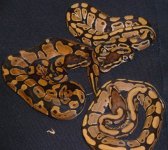
That ball I just posted has "a soft hew" to it's color. Therefor, it fits the definition of pastel. Frankly, I think it fits your definition too.
It does not fit my definition. The definition of "pastel" AS IT RELATES TO BALL PYTHONS is a soft hue CAUSED BY A GENETIC MUTATION.
Based on your logic if I hatched a bright green corn snake tomorrow and decided to call it the "Flouresent corn," no one else could ever use that name unless they used my bloodline to create their offspring.
If... you were to do so... And if your bright green corn snake was proven to be genetic... And if your Flourescent Corns were widely called Flourescent Corns, to the point where the pattern is reccognized when not labeled... Yes, essentially nobody could ethically use the name flourescent corn unless it had an identical genotype to the animals you produced.
Again, there is a difference between terms that define the physiological difference and one that started as an adjective unrelated to biology and became commonly associated with a specific pattern.
But they cannot then say that only thier snakes can be considered pastel.
I propose an experiment... go to a forum where people might not be aware of this thread and pose an innocent and neutral question...
Like the BP forum over at... the other site... and just ask...
"In Ball Pythons, are pastels a genetically proven morph?"
If the answer is as it should be (overwhemlingly "Yes.") and I seriously suspect it will be... Then you are using a term that is reccognized to have certain qualities inherent in it, one of which is that it is applied to a specific genetic pattern. Since your animals have not been proven to hold the same genetics, you are misrepresenting the animals you have for sale by using the term.
The dragons are red and orange, my snake has a pastel like appearance (a soft hew -dictionary definition).
Alright then... "piebald" can be quickly defined as being "Of different colors" every ball python on the planet except snows just became Piebald. Do you see the problem with that?
What phenotypic trait is my snake not showing?
You don't seem to be willing to admit it, but...
Genotype matters.
Pastel is used within the realm of ball python sales to indicate a specific genotype.
And yall are assumming I'm going to try and sell this thing for 10k tomorrow or something. I'm not. But when and if I do try to sell it, I can use the word pastel to describe it
Will you be selling them/it for more than any ball pythons you have of similar ages and genders that have a more commonly seen darker color?
Has it been proven to have a genotype that is compatible with the Pastels already on the market?
If you're so up front and honest with your customers about this... why use the term at all? I mean, you'll be very carefully explaining to every single person that it's not a genetically proven morph and explaining that chances are pretty low that it would ever prove out and that you don't have any adults from the same bloodline that you know for a fact held this color and can't even guarantee that it will look like that after it's next shed...
So why not just call it "Light colored ball python" and avoid even the faintest hint of the possibility that someone who doesn't know better might be confused?
As has been said... the dictionary defenition of "pastel" really doesn't come quickly to mind when the animal is seen... so it must be an amazing coincidence that you happened to choose that word out of aaaaaaaaaaall the avaliable words... Doubly so since you claim there is no industry reccognition of the morph by that name.
What you are doing is deceptive. It is something that misrepresents your animals as something they are not in order to justify a price increase higher than what you would apply to any other ball python that just happened to look a bit different.
Just as a matter of potentially related interest...
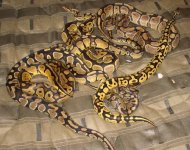
Here's a really... really... light colored ball python. And not being sold as a "Pastel" either.