• Responding to email notices you receive.
    **************************************************
    In short, DON'T! Email notices are to ONLY alert you of a reply to your private message or your ad on this site. Replying to the email just wastes your time as it goes NOWHERE, and probably pisses off the person you thought you replied to when they think you just ignored them. So instead of complaining to me about your messages not being replied to from this site via email, please READ that email notice that plainly states what you need to do in order to reply to who you are trying to converse with.

  • IMPORTANT! PLEASE READ!! About the Google Adsense ads being displayed

    =====================
    Posted 08/15/2025
    =====================


    Yeah, I know. They are a pain in the butt. But they pay the bills to keep my server running. Just a fact of life, I am afraid.

    Want to get rid of them? Simple. Just become a Contributor level member or above and they will be gone. -> Please click HERE."

    Is that too much for me to ask of you to keep this site running? Well, sorry about that. I too wish I could get everything for free. But alas.....

    =====================
    Addendum: 01/10/2026
    =====================


    Google Adsense ad revenue for December, 2025 was just $30 over the cost of the lease for the server running this site. So, in effect, the money providing the incentive for me to continue running this site is coming SOLELY from the paid memberships and sponsorships here. Which honestly ain't much....

Yes, I'm going there: any updates on the scaleless gene yet?

Thanks for the tip, April. I just checked out his page. He only has an image of a scaleless het (aka scaleless head) that is also 100% het for pied breeding a pied, so it's not a homozygous scaleless animal. Or is there another photo you saw? I admit I didn't go digging too far back in the posts.

yes that's the photo. I didn't know 'scaleless' was a het? silly BP names, why not call it a het scaleless? It's listed as scaleless het pied so I thought it was one. oh well, sorry
:eek:
 
I wanted to update this thread with the information I received last night and today.

I talked to Steve about the scaleless snake dying and decided to look into it myself. Supposedly it was sold at the Daytona show by BHB to Daniel Allison. I hadn't heard anything about it being sold so I found this interesting.

What's especially interesting is that Daniel currently has the WHS line of Scaleless Heads, so why would he buy the BHB line visual male? The people I talked to said they haven't heard anything about this at all, and they are people who are very involved in the project. Also, I'm pretty certain that if he bought Mr. Smooth he would have posted it on his facebook page (considering he was excited enough about his scaleless heads to post those), but he didn't do anything of the sort.

As far as any facts that I have are concerned, BHB still has Mr. Smooth and people should be hatching out more scaleless this year. Until they hatch out, everything is just going to be speculation or rumors to lower the price. If they end up not being healthy or have issues, I will be the first to come back here and openly state it.
 
Thanks, Nick. I appreciate the civil discussion we've all had here. I'm still hoping everything is alright, but I am nervous. I wish other breeders working with the gene would chime in their experiences, good and bad. I feel honesty is extremely important.
 
It works the same way no matter how you define it. Technically since the scaleless heads are visual you could call them codom, but they're basically just het. scaleless that you can see.

It's no different than het. red axanthic or het. russo, they're technically "recessives" for red axanthic and russo but since you can visually see them they're considered codoms. Genetically it doesn't matter how you describe it, it doesn't change how it passes.

You can look at it either way; the super scaleless head is a scaleless ball python, or the scales missing on the head is a visual marker on a het. scaleless.

That is not what recessive means, Nick.

Heterozygosity can occur in any mode of inheritance with the potential for differing allelic copies at a given locus, but you should not be calling a single-copy co-dominant animal / single-copy incomplete dominant animal recessive at all. They are "technically" not and they are technically not. Saying the single copy is het for the super form (when there is a super form) should be fine, though, since it is exactly that (het).

I understand and agree (of course) that the probability calculation is the same, but applying an inappropriate genetic term (that has a definition; not yours and not mine to rewrite) for labeling or description for which it is not a fit is really bad territory for a breeder to step into. It can come back in a bad way. On stats and hets, we agree, but tread carefully on calling something recessive when it is not. I know what you mean to say and you know what you mean to say and we therefore understand each other, but it is still incorrect when said that way.

As for the rest of the conversation, I find it stimulating and it should be interesting to see what happens here.
 
You're right Nickolas, the main point I was arguing was that the mode of inheritance is identical. I think for a period people were referring to it as a het. scaleless, which I agree is a misnomer (which is why I drew the comparison to het. red axanthic and het. russo).

I shouldn't have stated that it was recessive because the scaleless head is clearly visually different than the wild-type, I simply meant that because it takes two copies of the gene to produce a visual scaleless that it's similar to waiting for visual recessives to hatch out. It absolutely would be considered a codom, thank you for clarifying.
 
You're right Nickolas, the main point I was arguing was that the mode of inheritance is identical. I think for a period people were referring to it as a het. scaleless, which I agree is a misnomer (which is why I drew the comparison to het. red axanthic and het. russo).

I shouldn't have stated that it was recessive because the scaleless head is clearly visually different than the wild-type, I simply meant that because it takes two copies of the gene to produce a visual scaleless that it's similar to waiting for visual recessives to hatch out. It absolutely would be considered a codom, thank you for clarifying.

No. The mode of inheritance is not identical. That is my very point.

The probability of heterozygosity and homozygosity is statistically calculated the same way, though, and that -as far as I can see- is what you were intending to express. This latter piece is where we surely agree.
 
No. The mode of inheritance is not identical. That is my very point.

I think the main issue is that I don't have the genetic vocabulary to explain what I mean lol. But you're right, I'm referring to the statistical aspect of inheritance, the odds of passing on a recessive trait are exactly the same as passing on a co-dom or incomplete dom trait. In that sense I consider them equivalent, without going into it any further than that.
 
I think the main issue is that I don't have the genetic vocabulary to explain what I mean lol. But you're right, I'm referring to the statistical aspect of inheritance, the odds of passing on a recessive trait are exactly the same as passing on a co-dom or incomplete dom trait. In that sense I consider them equivalent, without going into it any further than that.

As the negotiation phrase goes, we have come to terms. :)
 
I wanted to update this thread. I just heard back from Daniel at Constrictor Addiction about him supposedly buying the scaleless from BHB and having it die (the rumor that was started somehow). He was actually pretty mad that I would even suggest something so ridiculous, and said that's the sort of thing that has been hurting this project since the beginning. People who aren't invested in the project in any way who are continually spreading rumors with absolutely no evidence, for no reason other than to try to lower the price so that they can buy into it. No truth behind it whatsoever, and all I've managed to accomplish is make him angry lol.

Winston at WHS just posted pictures of his scaleless head female who laid 5 eggs, so a good chance he'll be having a full scaleless come out. Florida reptile ranch also has a clutch of 6 eggs from a SH x SH and will hopefully pop out a fully scaleless baby or two. As I mentioned before, no one had females up to size until now, so we should see some out in a couple months.

Females take a while to grow and I'm not sure how many other breeders will have a girl up to size this year, but if the odds are in our favor we should really see this thing take off in a few months. If there are any issues with the project we should know soon enough, but as of now it's still going strong. Personally I'm beyond excited about it, I can't wait to see some scaleless combos. Winston did a pastel SH x pastel SH, I'm interested to see how the color holds up once the scales are gone.
 
Thanks for the update, Nick. That's great news, I'm eager to see what happens this year.
 
Awesome!

It would help curb the rumors if the owner of the Scaleless would/could post more up to date pics of him. You know, be a bit more transparent about things...but oh well.
 
Awesome!

It would help curb the rumors if the owner of the Scaleless would/could post more up to date pics of him. You know, be a bit more transparent about things...but oh well.

If he did there probably wouldn't have been any rumors to begin with :p. I don't think anyone saw or heard about it for almost a year and then he randomly showed up with it at Daytona. How you can have a snake so amazing and not want to post pics of it every day I don't know...he's either incredibly lazy or has superhuman willpower lol.
 
The lack of pics/info on him seems quite detrimental to the project, for sure. It makes me wonder how many more people would have bought into had there been more transparency/information/openness about it. Hopefully we'll see other scaleless babies soon, and there won't be all the secrecy.
 
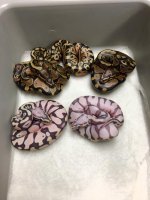
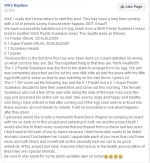
On their Facebook page WHS Reptiles has announced that they have produced a healthy scaleless clutch. The pairing was WHS Pastel Scaleless Head bred to another WHS Pastel Scaleless head, producing:
1.0 Pastel Scaleless
0.1 Super Pastel Scaleless
1.1 Scaleless Heads
0.1 Pastel
 
Yes, I saw that! So now we have two confirmed scaleless lines, BHB and WHS. I believe they are two independent lines anyway. I've attached their photo and their post.
 

Attachments

  • 13627152_1047776515336259_3548280563332468859_n.jpg
    13627152_1047776515336259_3548280563332468859_n.jpg
    73.6 KB · Views: 196
  • scaleless.PNG
    scaleless.PNG
    40.2 KB · Views: 188
I meant to come update this but have been too busy. He also posted a FAQ which I think is good, I'll post it when I have a minute. I'm really happy that he got both a male and female out so that (hopefully) any concerns about females having issues will be put to rest.

A couple other people should have some out soon as well.
 
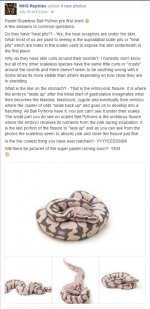
Looks like Nick didn't find time to share the FAQ that WHS posted, so I'll post it in screenshot and text format. I've formatted it to make it easier to read but I attached a direct screenshot as well. Very cool.

Pastel Scaleless Ball Python pre first shed :)
A few answers to common questions-

Do they have "heat pits"?
- Yes, the heat receptors are under the skin. What most of us are used to seeing is the supralabial scale pits or "heat pits" which are holes in the scales used to expose the skin underneath in the first place.

Why do they have skin curls around their nostrils?
- I honestly don't know but all of my other scaleless species have the same little curls or "crusts" around the nostrils and there doesn't seem to be anything wrong with it. Some times its more visible than others depending on how close they are to shedding.

What is the line on the stomach?
- That is the embryonic fissure. It is where the embryo "seals up" after the initial start of gastrulation invaginates what then becomes the blastula, blastocyst, zygote and eventually then embryo where the cluster of cells "seals back up" and goes on to develop into a hatchling. All Ball Pythons have it, you just can't see it under their scales. The small part you do see on scaled Ball Pythons is the umbilicus fissure where the embryo receives its nutrients from the yolk during incubation. It is the last portion of the fissure to "seal up" and as you can see from the photos the scaleless seem to absorb yolk and close the fissure just fine.

Is the the coolest thing you have ever hatched?
- YYYYEEESSS!!!

Will there be pictures of the super pastel coming soon?
- YES! :)

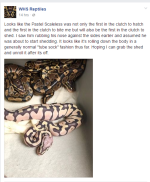
Because his scaleless photos do not have a watermark, I won't crosspost them here in full size - but recent updates indicate that they seem to be normal in almost every way, including that the pastel scaleless is having its first shed. Pretty exciting stuff.
 

Attachments

  • scaleless.jpg
    scaleless.jpg
    183.4 KB · Views: 177
  • scaleless2.png
    scaleless2.png
    295.4 KB · Views: 182
Back
Top