I work in law and deal primarily with internet crime, so am going to share my insight and background. Not trying to point fingers at anyone.
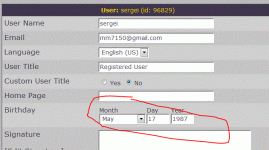
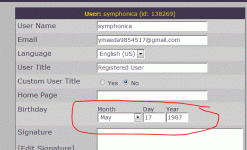
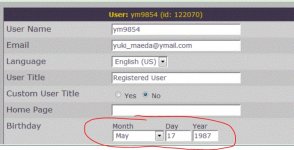
I ran a search, and this site has quite a few members that either share the same name, or are the same person acting as multiple. There are at least two members named Yuki Maeda. This site also makes is very inviting and easy for scammers to take advantage of. There's no need to prove any information. I could be Ronald MacDonald from MyShoe, CA. I could also be Andrew Covert from IN. From a professional's standpoint, the only reason this site is still operating and not facing federal charges, is because the actual transaction of money isn't happening here. Now, how many of you make sure that the name and email address of the member here matches up to their actual email account or PayPal address?
How many of you look to see when a member joined, how frequently they log in, and when the last time they logged in was, before making a purchase? Frequently, scammers take over abandoned accounts. You're more likely to earn the trust of others if you've been a member since 2007, rather than last week. Also, they need to keep using new accounts. Recycling old, unused ones is much easier than continuously creating new ones. For not requiring members to provide much information, this site sure does give away a lot. A scammer could easily look up everybody's email addresses. The other problem is that you can't delete accounts on this site. There are stagnant accounts all over the place. This site is harbors scammers.
Here's a trick used by scammers. They look for usernames that haven't been accessed in a while. These "dead" accounts mean that the owners don't frequently log in, which means if they hacked it, chances are they wouldn't notice. From here, they hack the registered email address. Hacking emails is one of the easiest things to do, especially if you use a free host. Yahoo and hotmail are the two easiest to hack into. By hacking the email address, they can tell if it's an email account they regularly use or not. If they do, they turn off notifications from this site from going to their active email, so that they don't realize that someone is using their fauna account.
I'd like to say that PayPal is hard to hack, but it's really not. Quite simple, actually. Again, this works especially well if the account holder doesn't frequently access PayPal. They hack into their account, temporarily change the email address settings to disable notifications from being emailed. Then, they accept money. Then, they immediately send that received money to their PayPal account. They change back the email settings. The scammer just used your PayPal account to steal money. Even if they were to notice, it's really not a huge deal because they didn't lose money. Money that wasn't theirs all of a sudden appeared, and disappeared just as quickly. No loss, just a net balance of zero. No change. So you're thinking, why can't we just track down who the money got sent to? Because given how easy it is to hack, these scammers could be using multiple accounts to bounce money through, not to mention that they could split it into multiple accounts to make it even harder to trace.
PayPal is no safer than MoneyPak or Western Union if you're going to use it to send money to people you don't know. Their seller and buyer protection policy is so faulty. For example: buyer files claim that item they received was damaged or not as described. How easy is it to dump the contents out of the box to take a photo of an empty box, to claim they sent you nothing but an empty box? Or, to replace the real contents with something else before taking a picture? Or even taking a hammer to it? There's no way for a buyer to prove these claims. Ergo, 9 times out of 10, seller wins.
Signature confirmation: PayPal requires it for transactions over $250 if sellers want to be covered. Sellers often send their partners out to the same zip code as the buyer. They access FedEx to reroute package (will speak more about this shortly). Package gets sent to partner instead of buyer. Partner signs. Buyer never receives, but PayPal doesn't refund. Why? Because they don't specify that the signature has to be that of the account holder's. It just had to be somebody's. They assume it was someone else at the house who knew about the package and received it. After all, they assume that people won't just sign for unknown packages from strangers, for fear that there maybe a bomb inside or something. If you signed for it, you must have known about it. Therefore, you must have been the intended recipient.
Andrew, did you use any other carrier besides FedEx? They're known to be pretty unreliable. Why? Because they've had problems in the past where hackers have managed to reroute their packages. They're able to access the network to change the shipping address or tracking info in their system. Therefore, the tracking number doesn't match up to the address or label. They can cross cross different orders. For example, let's say the scammer made a $2 purchase, and it was scheduled to arrive to him. However, they know that someone else made a $500 purchase that's also scheduled to arrive. They're able to flip flop the two orders, where they get mailed the $500 order and the other person the $2 item purchased as a scamming tool. This is clearly more advanced than lurking at the end of someone's driveway and grabbing the packages and running off with them as they are dropped off. Although this foolproof method does still happen more frequently than you'd think.
And don't trust phone numbers. Anybody can get a line without any ID for about $10.
And screenshots and PDF files of emails, texts, etc aren't considered strong evidence without IP addresses or phone towers as back-up. Anyone can easily fabricate these documents. You won't get IP or phone records without court order or subpoena, and you won't get one for a chameleon trade gone bad.
I'm sorry, Andrew, but with all due respect, you set yourself right up for this one are going to have to cut your losses. Law enforcement isn't going to seriously look into a chameleon trade gone bad. Because of the reasons mentioned above, they're going to have a really difficult time proving who did what. They're not going to spend their costly resources on a chameleon trade of he said she said.
If you really want to help to warn people on here, it's not by naming names. Do you have any idea how many more scammers are lurking on this site? Naming them all would be endless. If you really want to help, educate people on internet safety.
Andrew, you fell for what appeared to be a scam that you set up yourself. You gave the scammer a perfect opportunity. You just offered to send him a chameleon if he sends you his in return. That's like two kids agreeing to trade their candy, except the bully takes the other kid's candy, eats it, and then proceeds to also eat his own. The kid runs home to mom to tell her that he took both pieces and you got none! What's the mom going to tell her son? That she's sorry it happened to him, that some people are mean, you need to be the better person, you need to outsmart them, and it was a good life lesson to not trust people.
Did you actually look into seeing whether the advertised chameleons were real? Did you see them in video chat? Did you run an image search? Call me old school, but I won't send anybody money unless I know the money is going to who I intend for it to go. Why would you just send money to an email address that a complete stranger gives you?
Also, I'm appalled by how easy everyone is making it for the scammers. You guys get so heated up over these threads. This is exactly what scammers want. From people's responses, they are able to gauge to would be gullible and ignorant enough to fool next. The lack of knowledge about how the scamming and internet crime process works is so obvious in some people's threads. That's when these people are targeted as being good victims. They'll likely point fingers at exactly who they want them to point fingers at. And they're so worked up and distracted by this thread, that it would be so easy to fool them. The people who tend to overreact (drama queens) tend to be good targets. These people will fall exactly into place where they want them to, follow their leads precisely, and will be the puppets controlled exactly how the puppet master wants them controlled.
I think this person tried to scam for cash upfront, but then you just happened to fall into his lap, and this was way more convenient for him because how are you guys going to prove anything if there was no cash trade involved? Think a cop, lawyer, or judge is going to know whose chameleon is whose and who should have gotten what? Unlikely
Hobby sites are the most easily targeted. Motorcycle and auto sites being the top targets. Antiques and collections are also major. Bird and exotics are also popular. I guess reptiles would fall under exotics. Scammers know how passionate people are about their hobbies and how much money they're willing to spend on it.
Sent from my iPhone using Tapatalk