• Responding to email notices you receive.
    **************************************************
    In short, DON'T! Email notices are to ONLY alert you of a reply to your private message or your ad on this site. Replying to the email just wastes your time as it goes NOWHERE, and probably pisses off the person you thought you replied to when they think you just ignored them. So instead of complaining to me about your messages not being replied to from this site via email, please READ that email notice that plainly states what you need to do in order to reply to who you are trying to converse with.

  • IMPORTANT! PLEASE READ!! About the Google Adsense ads being displayed

    =====================
    Posted 08/15/2025
    =====================


    Yeah, I know. They are a pain in the butt. But they pay the bills to keep my server running. Just a fact of life, I am afraid.

    Want to get rid of them? Simple. Just become a Contributor level member or above and they will be gone. -> Please click HERE."

    Is that too much for me to ask of you to keep this site running? Well, sorry about that. I too wish I could get everything for free. But alas.....

    =====================
    Addendum: 01/10/2026
    =====================


    Google Adsense ad revenue for December, 2025 was just $30 over the cost of the lease for the server running this site. So, in effect, the money providing the incentive for me to continue running this site is coming SOLELY from the paid memberships and sponsorships here. Which honestly ain't much....

Selective Breeding - Pastels

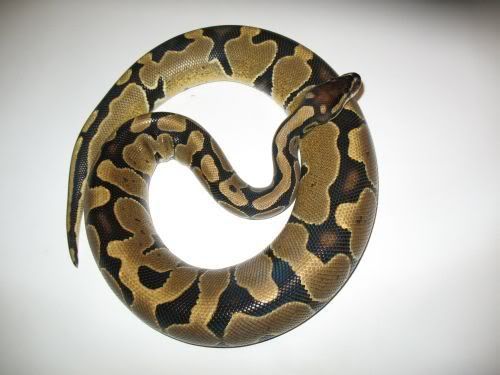
Your yellow CH with the very reduced blushing has the look of a Woma, very nice. I am really liking her color and pattern:yesnod:. I think some yellows were proven to have a "surprise" gene..have you followed up on this?).

The last CH that I posted? I'm breeding her this year for her first year. The "yellower" one in the same post likely won't be going this year, while she's got the weight, I'd prefer that she be a little bigger, because she's a bit longer and therefore, overall less girthy than my other girls.

This one of mine reminds me of a woma more (although she's not). But she does have the black belly markings going one, so she'll be fun to dink around with:

BindiBall6.jpg


What are Mojaves SUPPOSED to look like, cause mine are much lighter than the one that you show above. (not scarastic nothing..just trying to find out).

No, don't take it sarcastically at all. I do like Albey's mojaves - they are very light and he breeds for light. I'm not sure what the Mojo standard is color wise. Maybe there's not one?
 
I thought that the health of a bloodline went without saying...but I guess it's good that someone said it anyhow. <lol>

And actually, I have every intention of selecting for animals that lay large clutches, because that matters to me. I also think it will matter to other breeders--all else being equal. After all, why not? My 5+ foot 10 lb girl who laid the 13 egg clutch is vibrantly healthy, and handled it without problems. I'd love to have more females like HER--and I will breed for them. I don't even want to bother with a female who will lay 4 egg clutches her whole life. To me, that's inferior stock. Assuming that clutch size can be tied to genetics (and there's no reason to think it's completely divorced from them), there are a lot of reasons to breed for larger clutch sizes in pet ball pythons.

Likewise, there is every reason to breed for a good temperment--and for good feeding habits. I would never hold back an inconsistant feeder, or a very picky mouse-eater, no matter how pretty they were.

There's a lot more to a strong bloodline than simple physical health and appearance--it's a pretty complex package.

It seems odd to me that someone would consider breeding dark pastels to other dark morphs to be 'an excuse to breed substandard pastels'. That implies some sort of benefit to be gained from breeding pastels people consider less attractive...I mean, some benefit other than producing an impressive combination. I'm failing to follow this train of thought. I mean, the reason I'm not breeding my current male again is that I don't want to produce more dark pastels--they aren't worth as much money, and I have enough of them for any future projects I might want to run with them. Why would I want an 'excuse' to breed animals that don't sell as well? Why would anyone? Any female I put them with could be put with my lesser, instead--or any one of my other morphs, they would all produce offspring worth more than a dark pastel. Well, perhaps not my albino, but at the rate pastels in general are falling, even albino hets will probably be worth that much next year.

Honestly, what possible motivation would there be for it? If someone who's just starting out and can only afford a $70 pastel wants to breed it, so what? There is a market out there for it--other people who want to do the same thing. You're calling the animal 'substandard' because you don't like its looks...but obviously other people do, or they wouldn't be buying it, and it wouldn't be worth more money than a normal. I think people are losing sight of the fact that the PRIMARY concern with breeding ball pythons should be their suitability as pets. These animals aren't going back to Africa, they will spend their entire lives as pets, and so will all of their offspring--and so on, and so on. They are PETS. First and foremost, they should be healthy and happy, and make their OWNERS happy as well. Being a shining example of an appearance type that hasn't even been defined yet is only a small part of that. Right now, pet owners love normal ball pythons just as much as most morphs.

Appearance is something for us to play with to keep us interested and happy--and it's a money-maker. Nothing beyond that. No one's set any 'morph standards', and I don't see it happening anytime soon, because people are still developing their own 'brands' of various morphs.

Then there is the idea that 'it's already been done (breeding darker pastels to other dark morphs)'...by whom? Give some names, I'd love to see photos of the animals that resulted from those projects. Show me a burgundyXdark pastel. I want to see a dark pastel pewter and compare it with a light pastel pewter. I want to see chocolate X dark pastel. What happens if you pair it with a calico?

Maybe a lot of those projects will turn out animals that don't look great--but if even one such pairing creates a neat look that is both beautiful and different from the same done with a light pastel, then it will all have been worth the trying.

You would think I'd spoken blasphemy when I mentioned breeding pastels specifically to be darker. I'm thinking of an animal as dark as it can be made with very high yellow washing on the sides--as high as I can breed for, and mad blushing. I think it would be quite an interesting look in its own right. If you don't like it...you don't have to get one. (I think clowns are ugly, and I'm not getting one of those). lol

Where's the fun in always doing what everyone else is doing? The snake doesn't care if it's yellow or black. Pastel is a gene. We haven't even scratched the surface of the possibilities it holds for changing the appearance of ball pythons. Don't get me wrong, I love high-yellow pastels, I think they're gorgeous. I love colorful snakes. But the extreme contrast that could be created by breeding for super dark pastels with high yellow on the sides could be pretty darned striking too.

There are already two lines of pastels that are pretty different in appearance--why not another that goes in the extreme opposite direction from the others? I'm not talking about 'plain brown pastels', after all--nothing that you're going to find floating around on the market already. But that's what you have to start with, of course. I find it enormously appealing to consider taking an animal rejected by others as 'substandard' and using it as a base to create something brand new, and beautiful in a completely different way.

 
The last CH that I posted? I'm breeding her this year for her first year. The "yellower" one in the same post likely won't be going this year, while she's got the weight, I'd prefer that she be a little bigger, because she's a bit longer and therefore, overall less girthy than my other girls.

This one of mine reminds me of a woma more (although she's not). But she does have the black belly markings going one, so she'll be fun to dink around with:

BindiBall6.jpg


No, don't take it sarcastically at all. I do like Albey's mojaves - they are very light and he breeds for light. I'm not sure what the Mojo standard is color wise. Maybe there's not one?

She does have a Woma look going on, she's gorgeous!! Where did you find her?

(response to the bolded) I wish someone would tell...someone should know.:yesnod:
 
I thought that the health of a bloodline went without saying...but I guess it's good that someone said it anyhow. <lol>

And actually, I have every intention of selecting for animals that lay large clutches, because that matters to me. I also think it will matter to other breeders--all else being equal. After all, why not? My 5+ foot 10 lb girl who laid the 13 egg clutch is vibrantly healthy, and handled it without problems. I'd love to have more females like HER--and I will breed for them. I don't even want to bother with a female who will lay 4 egg clutches her whole life. To me, that's inferior stock. Assuming that clutch size can be tied to genetics (and there's no reason to think it's completely divorced from them), there are a lot of reasons to breed for larger clutch sizes in pet ball pythons.

Likewise, there is every reason to breed for a good temperment--and for good feeding habits. I would never hold back an inconsistant feeder, or a very picky mouse-eater, no matter how pretty they were.

There's a lot more to a strong bloodline than simple physical health and appearance--it's a pretty complex package.

It seems odd to me that someone would consider breeding dark pastels to other dark morphs to be 'an excuse to breed substandard pastels'. That implies some sort of benefit to be gained from breeding pastels people consider less attractive...I mean, some benefit other than producing an impressive combination. I'm failing to follow this train of thought. I mean, the reason I'm not breeding my current male again is that I don't want to produce more dark pastels--they aren't worth as much money, and I have enough of them for any future projects I might want to run with them. Why would I want an 'excuse' to breed animals that don't sell as well? Why would anyone? Any female I put them with could be put with my lesser, instead--or any one of my other morphs, they would all produce offspring worth more than a dark pastel. Well, perhaps not my albino, but at the rate pastels in general are falling, even albino hets will probably be worth that much next year.

Honestly, what possible motivation would there be for it? If someone who's just starting out and can only afford a $70 pastel wants to breed it, so what? There is a market out there for it--other people who want to do the same thing. You're calling the animal 'substandard' because you don't like its looks...but obviously other people do, or they wouldn't be buying it, and it wouldn't be worth more money than a normal. I think people are losing sight of the fact that the PRIMARY concern with breeding ball pythons should be their suitability as pets. These animals aren't going back to Africa, they will spend their entire lives as pets, and so will all of their offspring--and so on, and so on. They are PETS. First and foremost, they should be healthy and happy, and make their OWNERS happy as well. Being a shining example of an appearance type that hasn't even been defined yet is only a small part of that. Right now, pet owners love normal ball pythons just as much as most morphs.

Appearance is something for us to play with to keep us interested and happy--and it's a money-maker. Nothing beyond that. No one's set any 'morph standards', and I don't see it happening anytime soon, because people are still developing their own 'brands' of various morphs.

Then there is the idea that 'it's already been done (breeding darker pastels to other dark morphs)'...by whom? Give some names, I'd love to see photos of the animals that resulted from those projects. Show me a burgundyXdark pastel. I want to see a dark pastel pewter and compare it with a light pastel pewter. I want to see chocolate X dark pastel. What happens if you pair it with a calico?

Maybe a lot of those projects will turn out animals that don't look great--but if even one such pairing creates a neat look that is both beautiful and different from the same done with a light pastel, then it will all have been worth the trying.

You would think I'd spoken blasphemy when I mentioned breeding pastels specifically to be darker. I'm thinking of an animal as dark as it can be made with very high yellow washing on the sides--as high as I can breed for, and mad blushing. I think it would be quite an interesting look in its own right. If you don't like it...you don't have to get one. (I think clowns are ugly, and I'm not getting one of those). lol

Where's the fun in always doing what everyone else is doing? The snake doesn't care if it's yellow or black. Pastel is a gene. We haven't even scratched the surface of the possibilities it holds for changing the appearance of ball pythons. Don't get me wrong, I love high-yellow pastels, I think they're gorgeous. I love colorful snakes. But the extreme contrast that could be created by breeding for super dark pastels with high yellow on the sides could be pretty darned striking too.

There are already two lines of pastels that are pretty different in appearance--why not another that goes in the extreme opposite direction from the others? I'm not talking about 'plain brown pastels', after all--nothing that you're going to find floating around on the market already. But that's what you have to start with, of course. I find it enormously appealing to consider taking an animal rejected by others as 'substandard' and using it as a base to create something brand new, and beautiful in a completely different way.


You have got to be the densest person I've ever responded to. With just a little looking you will find more than 1 website or resource with the morph description located therein.

The market for butt-ugly breeding stock was created by those that have no clue what selective breeding is and looked for the cheapest morph to jump in the BP game with. Judging by your continued ignorance of how the BP market progressed from just another pet store animal to folks mortgaging their houses to buy into $25k invest stock to what we have now , anyone trying to explain it to you is wasting precious time of their lives that could better spent beating their heads against a wall.

Your assumptions that people buy brown pastels because they " love the look " holds no water. If all they have is $70 and the better bred stock is $150 but they just gotta have a pastel then they will buy the $70 freezer bait ugly pastel because they just gotta breed a pastel.

Seriously , research , try it. It might give ya something to twist what I said much better than what ya got now.
 
She does have a Woma look going on, she's gorgeous!! Where did you find her?

(response to the bolded) I wish someone would tell...someone should know.:yesnod:


Thanks Deb! I got her from Michael Cole 2 years ago in Daytona along with another nice girl. He let me come behind the table that year and go through all the CH girls he had brought to the show. :) Her name is Bindi because of her head dots. I'm a reduced pattern nut, but the head dots put her over the edge for me!
 
Thanks Deb! I got her from Michael Cole 2 years ago in Daytona along with another nice girl. He let me come behind the table that year and go through all the CH girls he had brought to the show. :) Her name is Bindi because of her head dots. I'm a reduced pattern nut, but the head dots put her over the edge for me!

I am going to have to conquer my fear of WC and CH!!:rofl:

Which morph do you plan to pair her with when it's time? I am seeing clown..those spots on her head may give the Clown an "extra" after two generations of breeding if she has any genetic markers in her (genetic..hoping those spots on her head may be).

I was also thinking about Spider pairing..it would be awesome if the pattern gave the Spider some "eyes," but I am getting a bit leery of that morph although I have hatched out some this year that do not display the wobble (to my sight).
 
I have a question. How did the mophs get started? Someone said "I like the looks of this one and I wonder what will happen if I pair it with this one". Some of the combo's that have color on them can produce pure white snakes. Who would have supected that. How many morphs have resulted in that "WOW" moment when someone gets something totally unexpected from the parents? Is the pastel gene just one gene? Why are there dark pastels? If only the "new" breeders paired them wouldn't that mean that the high end breeders have only very light ones? Why are there two lines? I have seen them both and am surprised that both are called "pastels" because they are so different. Maybe I am showing my ignorance but I would really like to know. What would be the different in the offspring from a dark pastel to lets just say an spider vs a light pastel from the same animal? Would you get a "BEE" that is brown with lines with the dark pastel? If this was the case would you not call the offspring a bee because it was not yellow yellow and black? I have seen some very dark bees out there and am not sure what to think. If the information is out there I have missed it would you post some links(maybe I am too stupid to find them).
There are so many morphs out there and I can't keep track of them all. Shoot I have been looking for someplace simple that has a breeding chart that says "when you breed a sipder to a pastel you will get...... when you breed a spider to an albino you will get... and so on all the way from simple morphs to the very complicated morphs. If you know of a site like this PLEASE let me know. I can figgure out the charts but that dosen't SHOW you what the offspring would look like.
Again I ask because I would like to know. What I do know is beauty is in the eye of the beholder. I LOVE albinos and one day I will get one. My roommate thinks they are ugly. Sorry for such a long post but this is something I am truely interested in. I would like to try and breed albino pastels and would love to know what a dark pastel vs a light pastel would make combined with that gene. :D
 
I do think it's the same gene, but selective breeding can produce some very distinctive looks--I've seen the dark bees you're talking about, too. I've also been seeing some very dark spiders. In most cases these brown/dingy animals are the result of simply breeding a random spider to a random normal, but there's a potential there as well to breed for darker and darker coloration. It's just that no one's thought to do it (or thought it was worth doing).

I've seen people breeding spiders for extreme high white on the sides, which I don't personally think is at all attractive.

Your question about the albinos was a very good one--I would also be curious to compare the two, and in fact I just might do that. We have an albino project, and we're planning on making albino cinnies eventually. I'm fairly well set on taking some pastels and selecting for darker and darker, and seeing what I can do with them. I can just picture what this animal could potentially look like, in my head. I could cheat and add hypermelanism in, but selectively breeding the line would probably work better in the long run--and allow me to try the albino experiment. It would also give me something much more suited to add the hypermelanism gene to.

Can you imagine an extreme dark brown/charcoal spider with black markings? Keep the white washing on the sides. I think it would be pretty spiffy.

The part I'm interested in also is seeing if I can get that super-extreme dark coloration but keep a very bright high yellow wash on the sides of the belly. That contrast would be wild, and the bees would have to be pretty darned different-looking.

By the way, I didn't say people were buying darker pastels because they 'love their looks'--I said that "just pet owners" love normals as much as morphs, and thus don't care, and the only reason morphs are so expensive is because people can make more money from them. So according to you, that guy who can only afford the $70 pastel does not deserve to make any money, because he can't afford the $300 pastel. Since the gene pool of his $70 snake is very unlikely to ever mix with that of a $300 pastel, I'm not sure I'm following the logic. The $70 pastel is worth $70 because someone out there wants to buy it, and breed it, to make more $70 pastels for more people who want to buy a $70 pastel and breed it--in order to make money to buy something more expensive, or maybe just for the experience. This is different from buying a $300 pastel how? I hope you aren't trying to argue that a $70 pastel is inherently inferior...if the animal is healthy, and it's being given a good home and treated with at least as much respect as a normal ball python, then the only issue is the fact that you don't like its looks. The guy who bought it doesn't mind its looks. He probably likes its looks--they generally do look prettier than a normal, especially in person. I don't think darker pastels are ugly, personally--they certainly are different from the ones bred for extreme high yellow, but they're pretty in their own right.

As long as my local pet store has its highest demand ball python be a normal, there is no earthly reason to turn up one's nose at any morph--even the ones that look almost like normals. There aren't any ball python morphs turning up in shelters, last I knew (that'd have to be a crazy rare event). So the source of derision is escaping me.
Due to 'graded pricing', which is being promoted more and more, you can't even argue that breeding a lower grade pastel is bringing the market price down. Since the gene pools aren't mixing much either...want to explain why we should be upset that folks are breeding 'less pretty' versions of morphs?
Do you believe such animals should ONLY be pets? There's virtually no market for morphs as "just pets" because they cost too much. I think you want things to be different from the way they actually are. Give it time, and the 'low-end morphs' will come down in price to the point where a low-grade low-end morph is worth the same as a normal--and then people will want them as 'just pets'.
And people will probably produce far less of them, due to the low return. But there are still people breeding normal ball pythons just for the experience, because they like them, so there will be people breeding low-end pastels for the same reasons.

Then again, if super-dark pastels prove to make some wicked combinations, the grading is going to look more like a seesaw than a wedge.
 
By the way, I didn't say people were buying darker pastels because they 'love their looks'--I said that "just pet owners" love normals as much as morphs, and thus don't care, and the only reason morphs are so expensive is because people can make more money from them. So according to you, that guy who can only afford the $70 pastel does not deserve to make any money, because he can't afford the $300 pastel. Since the gene pool of his $70 snake is very unlikely to ever mix with that of a $300 pastel, I'm not sure I'm following the logic. The $70 pastel is worth $70 because someone out there wants to buy it, and breed it, to make more $70 pastels for more people who want to buy a $70 pastel and breed it--in order to make money to buy something more expensive, or maybe just for the experience. This is different from buying a $300 pastel how? I hope you aren't trying to argue that a $70 pastel is inherently inferior...if the animal is healthy, and it's being given a good home and treated with at least as much respect as a normal ball python, then the only issue is the fact that you don't like its looks. The guy who bought it doesn't mind its looks. He probably likes its looks--they generally do look prettier than a normal, especially in person. I don't think darker pastels are ugly, personally--they certainly are different from the ones bred for extreme high yellow, but they're pretty in their own right.

If you learned to read what has been presented to you then you could get the logic but then you wouldn't have a reason to stir the crap pot by pretending to be ignorant.

Your assumptions that people buy brown pastels because they " love the look " holds no water. If all they have is $70 and the better bred stock is $150 but they just gotta have a pastel then they will buy the $70 freezer bait ugly pastel because they just gotta breed a pastel.

That is what I said. If Joe Blow bred his $70 freezer bait ugly pastel and produced more of the same, his primary customer base will be folks who ...

1) Don't know any better.
2) Cheap asses that don't care as long its a good deal.
3) Noobs that have no clue how the pastel gene really works , know what to look for or have no idea what selective breeding is.

The biggest reason for the browner pastels today has a strong link to those that jumped into the BP game when pastels were thousands and pumped out 200 - 400 clutches a season by breeding anything with a pulse. Any time someone new to the hobby emulates the same mentality then the morphs take a hit as they typically don't select females to be bred that will reinforce the gene giving them babies that look more like the morph should be.


As long as my local pet store has its highest demand ball python be a normal, there is no earthly reason to turn up one's nose at any morph--even the ones that look almost like normals. There aren't any ball python morphs turning up in shelters, last I knew (that'd have to be a crazy rare event). So the source of derision is escaping me.
Due to 'graded pricing', which is being promoted more and more, you can't even argue that breeding a lower grade pastel is bringing the market price down. Since the gene pools aren't mixing much either...want to explain why we should be upset that folks are breeding 'less pretty' versions of morphs?
Do you believe such animals should ONLY be pets? There's virtually no market for morphs as "just pets" because they cost too much. I think you want things to be different from the way they actually are. Give it time, and the 'low-end morphs' will come down in price to the point where a low-grade low-end morph is worth the same as a normal--and then people will want them as 'just pets'.
And people will probably produce far less of them, due to the low return. But there are still people breeding normal ball pythons just for the experience, because they like them, so there will be people breeding low-end pastels for the same reasons.

Then again, if super-dark pastels prove to make some wicked combinations, the grading is going to look more like a seesaw than a wedge.

I can argue the typical breeding of pastels have tanked the market since the " graded pricing " wasn't widely used. If the animal is considere sub par by definition of the morph , then yes , its pet quality only. Get over it , its not a new concept designed just for reptile breeders. Dog breeders have been using it for years , some even going so far as to destroy any sub par animal to keep it from polluting the gene pool.

It is the way it is. I'm not the one trying to defend or justify breeding a sub par animal because of idiocy or ignorance. There are more than just a few folks who have been screwed by breeders mass producing poor quality morphs that turn into crap as they age. Feel free to be one of those producing piss poor quality if you wish. If you don't get it by now , then your either choosing to be completely ignorant of anything and everything that has been explained already or you really need to wear a helmet to get through the day.
 
All of this has brought up many questions for me as I recently acquired this little guy from a buddy. I think he is awesome but what should I look for in a normal female?
 

Attachments

  • 004.JPG
    004.JPG
    264.7 KB · Views: 130
Nowadays it is all about selective breeding.


whether you breed for contrast, overall bright or darker color, blushing, stripes... whatever it may be the whole objective behind it is fun and exciting.

I do also feel that there have been some less then below average pastels floating around however there have been a few folks that have really kept some lines very clean. As far as lineages goes in my opinon buy the best animal from that line you can find and go from there...


Alice Cobb - Florida Reptile Room produced this beautiful pastel female and we love her high contrast and bright colors. Something we would like to eventually cross into other combo's for the HC pastel looking combo's...

1234155.jpg


Here's a really blushed female window pastel from Micheal Cole... we're really looking to see how her dorsal blushing carry's over to her offspring...

1234174.jpg
 
Nowadays it is all about selective breeding.


whether you breed for contrast, overall bright or darker color, blushing, stripes... whatever it may be the whole objective behind it is fun and exciting.

I do also feel that there have been some less then below average pastels floating around however there have been a few folks that have really kept some lines very clean. As far as lineages goes in my opinon buy the best animal from that line you can find and go from there...


Alice Cobb - Florida Reptile Room produced this beautiful pastel female and we love her high contrast and bright colors. Something we would like to eventually cross into other combo's for the HC pastel looking combo's...

1234155.jpg


Here's a really blushed female window pastel from Micheal Cole... we're really looking to see how her dorsal blushing carry's over to her offspring...

1234174.jpg


Now that last Pastel is certainly a beauty!!
 
Now that last Pastel is certainly a beauty!!

Thanks Deb! You have produced some beautiful stuff this year congrats!


As for other morphs there are some out there I feel have almost been like pastels lately have in the sense that you just don't see too many that really stand out from the rest. IMO I think hypo's are a good example and should be selectively bred just as much as pastels...

This male was purchased also from Micheal Cole earlier on in the year and IMO is a great example of an Orange Line. He's an 07 and is at the 500-600g mark.
1234184.jpg
 
Thanks Deb! You have produced some beautiful stuff this year congrats!


As for other morphs there are some out there I feel have almost been like pastels lately have in the sense that you just don't see too many that really stand out from the rest. IMO I think hypo's are a good example and should be selectively bred just as much as pastels...

This male was purchased also from Micheal Cole earlier on in the year and IMO is a great example of an Orange Line. He's an 07 and is at the 500-600g mark.
1234184.jpg

That's a good looking ghost!:yesnod:
I agree with that. It appears that there are two (?) lines. One is greenish and the other is orange? Perhaps we need to make sure we don't mix the colors and wash them out..keep the lines separated?

Thanks Steven, my girls did beautifully and every male stepped up to the plate and performed.

I have both colors, the greenish one came from Coldbloodedaddiction. It's quite nice. Then I found a goldish silver color from Rcreptiles and got that one two...I'll be working with the Orange ghost this year.

Photosforwebsite025.jpg


If he cooperates!! That is the het ghost girl that I am pairing him with. I am trying for a more reduced pattern.
 
All of this has brought up many questions for me as I recently acquired this little guy from a buddy. I think he is awesome but what should I look for in a normal female?

Ron , for a pastel breeding you want to find females with as much yellow as possible. In a lot of cases the yellow will darken but not turn a dark brown. Orange is not your friend in Pastels as that is the color that turns the dark brown.

For older females look at the spinal color , if it is stark yellow that's a good sign combined with yellow at the belly. If the side colors aren't brown then its a fair sign that there is little to no orange. Some females will stay yellow all their lives but those getting to be few & far between to find.

Part of what darkens any normal is a wash of melanin. If you look close at the sides you see the black laid over the color. The less of the melanin wash the better.
 
These are my pastels. The male has shed 3 times and gets brighter with each shed. My girl hasn't shed yet. I absoutly LOVE the blushing on both of them. I can't wait till she is big enough to breed.


my boy below
P1050404.jpg


P1050401.jpg


my girl below
P1050408.jpg

the pic above taken with a flash the one below without the flash
P1050409.jpg
 
I have to agree. I am just getting started myself. I chose 2 nice het pieds, the female was a hatchling when I baught her. When she turned a year and a half and only 1100grams I bred her. She gave me 9 perfect eggs out of which were 2 med to high white pieds that were evenly marked beautiful animals.
 
I have to agree. I am just getting started myself. I chose 2 nice het pieds, the female was a hatchling when I baught her. When she turned a year and a half and only 1100grams I bred her. She gave me 9 perfect eggs out of which were 2 med to high white pieds that were evenly marked beautiful animals.

I'm not sure what you are agreeing with, but I don't think breeding ANY Ball Python female at a year and a half old and 1100g is something to be bragging about. They are not mature enough, it is very hard on their bodies, and can take a toll in the long term if not right away.

It's kind of like an 11 year old human having a baby....just because they CAN doesn't mean that they SHOULD. :nonod:

I'm sure when Angela said that she "couldn't wait to breed her", she simply meant that she was anxious for her to get up to a proper, healthy breeding size.

deborahbroadus said:
I agree with that. It appears that there are two (?) lines. One is greenish and the other is orange? Perhaps we need to make sure we don't mix the colors and wash them out..keep the lines separated?

There are a lot of different lines of ghost - there are orange ghosts, green ghosts, yellow ghosts, butterscotch ghosts....and different lines within the different colors. Bell line, NERD line....some are compatible with others, some are not.
 
First of all I dont think you can compare any animal to a human. Certainly not a snake. You cant tell me that under the right conditions out in the wild that this this snake would not breed. Where humans have no control over it.I also have yet to see any proof of this being harmful to a perfectly healthy snake. Yet I am sur you have no problem with breeding Albinos or spiders, and everyone knows and there is proof that they breed issues such as spinning, kinked tails. We all know these snakes are not found like this in the wild since they would not live long. Yet people possible even you seem to have no problem breeding them. Any animal under the right conditions that is healthy with plenty of good quality food will grow faster and larger and produce sooner in the wild. That is natural!
 
First of all I dont think you can compare any animal to a human. Certainly not a snake. You cant tell me that under the right conditions out in the wild that this this snake would not breed. Where humans have no control over it.I also have yet to see any proof of this being harmful to a perfectly healthy snake. Yet I am sur you have no problem with breeding Albinos or spiders, and everyone knows and there is proof that they breed issues such as spinning, kinked tails. We all know these snakes are not found like this in the wild since they would not live long. Yet people possible even you seem to have no problem breeding them. Any animal under the right conditions that is healthy with plenty of good quality food will grow faster and larger and produce sooner in the wild. That is natural!

You may be thinking of the Caramel Albinos for the kinks. I've never heard of spinning kinked tails tho so no idea where that came from. This is more like a grade school retort since you obviously have no problem breeding / reproducing a morph that likely wouldn't survive in the wild either unless it was extremely low white. Oh wait , thats right , a lot of the morphs on the market came from the wild but you knew that due to extensive research right?

Comparing a well fed animal 18 month old 1100 gram animal in captivity to a 1100 gram female in the wild is going to take a bit more work than what you've done to prove your point. It takes longer for a female to gain those 1100 grams in the wild since food has to be searched for leaving a female with time to develop mature muscle mass along with age as it grows. The Africans aren't running around with buckets full of food feeding them.

You bred her earlier than most would , you put it out there for everyone to see now deal with the arguments that will come from it. Before your " sure " of how anyone else does anything or why , do a little research first to make " sure " your right.
 
Back
Top