Ed Clark said:
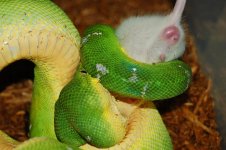
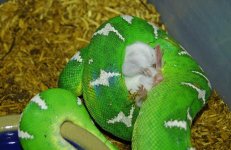
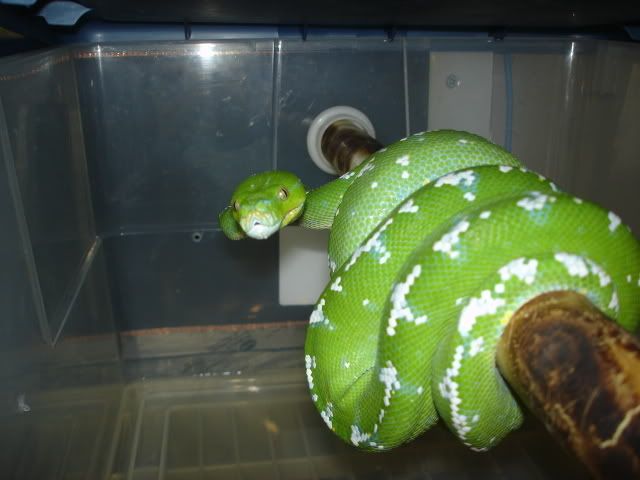
Seamus, in post 18 I stated I knew I needed taller boxes and had to get them off the ground and that I also needed perches for them. they are just eating so good right now this is going to be the set-up for a short time till their nice and fat.
You're courting more problems than you're solving though and something you said in an earlier post made me believe you're attributing the result of changing one set of variables with the reality behind a second set that you may not be paying attention to.
There's more to the need to be "up" than just the removal of a potential stress by allowing an instinctive behavior to happen. The environment of "up" is vastly different than the environment at ground level in a few, fairly signifigant ways and the risk versus reward of the method you've got pictured there just isn't worth it. First and foremost would be the issue of moisture. Humidity and dampness and how one will often lead to the other. I'm not sure if you've caught your emmies drinking the standing water in the enclosure, many certainly will but some won't- taking droplets off solids in their environment and occassionally off their own bodies. To facilitate that behavior, the animal and it's enclosure should be misted fairly heavily a few times during the day and terrarium fixtures should be present to assist the behavior. In your enclosure though, misting things will automatically result in damp substrate- something the species is not particularly well equipped to deal with. Humidity is great, dampness for a prolonged period (especially when combined with the animal being constantly on the same plane as their waste) is just asking for bacterial dermatitis of one kind or another. So temporary conditions are looking awesome, since the humidity is at appropriate levels but long term it's not a positive practice.
Additionally, there's the ever present issue surrounding the facial scales. While it's not a guaranteed end result and emmies will often move up and down of their own accord given the proper arboreal terrarium fixtures, keeping them without appropriate perches puts the animals on a level with the substrate for prolonged periods of time. You're just asking to get cypress dust and fine pulp caked in the labials and inside the mouth. You've provided some... bundles of sticks, which are probably underused since they seemed to be largely parallel to one another with no perpendicular angles or forks- and the result is a load of photos of enimals trying to fold themselves up on the edges of a small water bowl. The logical conclusion is that the bundles just aren't fitting the profile demanded by the instinctive behavior to coil.
You're keeping them dark and minimizing external stimulus. That right there is probably the single biggest factor behind your success with feeding them. You had described tall cages as "empty" which indicates to me that you've never put together a successful arboreal enclosure for a snake that's likely to be experiencing some stress. You can just as easily provide tall and dark as you can provide squat and dark. Opaque enclosure walls or a dimly lit room are all that takes- hell, most the time you don't even need to go that far and simply providing arboreal cover and visual barriers will do the trick and still allow you to meet the desire of the species to be off the ground much of the time.
You changed a couple things; you minimized stimulus and stress and you put them in squat little ball racks. You then jumped to a conclusion that it was the enclosure height that was making the difference in the behavior you then witnessed (stronger feeding response)- when it is far, far more likely that the other factor played the signifigant role. Additionally, while the species is somewhat notorius for feeding issues, unless these specific animals were displaying those issues prior to you deciding you had a leftover leopard gecko bin to cram them into, you can't even draw a conclusion that *anything* is responsible for a non-existant change. Additionally there are potentially dozens of other factors that can mean the difference between successful feeding and unsuccessful attempts that you haven't addressed but certainly seem to have ignored... or been utterly oblivious to.
You apparantly have had experience with failure to feed... while keeping the animals in a bright, sterile, coverless, stressful box, feeding... unknown prey items at an unknown time of day with unknown humidity and temperatures, at an unknown angle, after unknown interaction.
You changed at *least* two things from the bad experiences you had before, quite likely subtly or overtly changing many of the others in the process... and with (this part is important) an entirely different group of animals, lept to the most extreme change you made (and the most blatantly incorrect one) and have arrived to
brag about the success of that factor. Without testing it on control groups, without any kind of understanding of exactly what you had done- and you promulgated it as a positive.
You may have noticed that I tend to avoid interacting with you unless I see you writing something wrong. Or something stupid. Or something that's both... I have frankly given up all hope of
you ever really grasping anything anyone tries to explain, no matter how loudly they shout. You refuse to comprehend anything that doesn't fit into your delusional view of how things are and you haven't got even the minimal background required to understand the casual biology that shows up in pet related forums. I just can't stand the thought of someone who doesn't know any better reading something you wrote and accepting it at face value, or thinking you're credible- and then trying the crap you preach or spreading it conversationally as factual. Maybe someday you'll manage to consider those people as well, the innocently naive ones- before you go encouraging them to share your overwhelming ignorance.