• Responding to email notices you receive.
    **************************************************
    In short, DON'T! Email notices are to ONLY alert you of a reply to your private message or your ad on this site. Replying to the email just wastes your time as it goes NOWHERE, and probably pisses off the person you thought you replied to when they think you just ignored them. So instead of complaining to me about your messages not being replied to from this site via email, please READ that email notice that plainly states what you need to do in order to reply to who you are trying to converse with.

  • IMPORTANT! PLEASE READ!! About the Google Adsense ads being displayed

    =====================
    Posted 08/15/2025
    =====================


    Yeah, I know. They are a pain in the butt. But they pay the bills to keep my server running. Just a fact of life, I am afraid.

    Want to get rid of them? Simple. Just become a Contributor level member or above and they will be gone. -> Please click HERE."

    Is that too much for me to ask of you to keep this site running? Well, sorry about that. I too wish I could get everything for free. But alas.....

    =====================
    Addendum: 01/10/2026
    =====================


    Google Adsense ad revenue for December, 2025 was just $30 over the cost of the lease for the server running this site. So, in effect, the money providing the incentive for me to continue running this site is coming SOLELY from the paid memberships and sponsorships here. Which honestly ain't much....

Hypo, xantic, SHTCT, het for this or that...

the trait itself is called a recessive (albino,giant,patternless,blizzard,jungle,str

this means it is reccessive (hides behind) to any other trait , including "normals" the "normal" trait is the only trully dominant ....hypo -line is said to have alot of influence .... so if u breed a hypo to anything else . some babies will be "hypos" .....same thing applies if you breed any morph except for a normal , to a high-yellow or a tangerine or ct (some will show color) ...so i dont (think ) its really any more dominant than a normal ,but some beleive this ... now if you breed a normal to anything else recessive or not you will get "normals" (some color or hypo may show) as this is the trully dominant form :) ! these are all "normal" animals technically !!....hi-yellow , hypo, tangerine , carrottail ,snow/lavender etc. ....all these colors and hypos have been selectively bred for from "normal"-geckos ......first.... hi yellow (which hypo came from) ......and so on and so forth technically these are all "normal" animals PEOPLE SEEM TO FORGET THIS :) this is why i beleive that hypo or colors have some amount of dominance .... and normal -phase is trully a dominant characteristic !
 
Pics of the Double.

Blazin, can you post a pic?
I'll take one for you. He is fairly "normal" looking but boy does he have some Genes!
 
Doesn't that, by definition, make them dominant characteristics then?
no it makes them proven mophs... recessive, dominant and co-cominant are all gene types.

a morph is a color or pattern mutation created by useing an already proven genetics wether it be a recessive gene, dominant or co-dominant genes.


VMS- Learning Center genetics 101

this is a good site, it is explained in very simple easy to understand lingo
the site is owned by VMS not me but it explains very well in laymens terms about genetics... it also has some great more advanced genetics
 
ok, here we go (again)....

I'll start off with this link:

http://webpages.charter.net/geckos/genetics.htm

Now, most of what I've read here and what people have said has been on the notion of only knowing <b>Mendelian Genetics</b>, or the study of trait (whether a 'good or 'bad' trait) transmission pattern within families. These traits are 'simple' or rather, there is only 1 gene (2 allelic states) that controls the trait. Height or weight, on the genetic level, are controlled by MULTIPLE genes and environmental factors (I'll explain later on why giants are NOT FULLY GENETIC). Now for some more definitions:

<b>gene</b>: an area on a chromosome that carries the instructions for a certain trait.

<b>allele</b>: different form/variation of a gene

<b>homozygous or homozygote</b>: an individual in which the 2 copies of a gene are the same allele.

<b>Heterozygous or Heterozygote</b>: an organism with unlike members of any given pair or series of alleles that consequently produces unlike gametes. Lay: has different alleles for a single trait or gene.

<b>dominance</b>: a condition in which one member of an allele pair masks that of the other.

<b>incomplete dominance</b>: expression of 2 alleles in a heterozygote that allows the heterozygote to be distinguished from either of its HOMOZYGOUS parents. Classic example: flower color in snapdragons. White (rr) and red (RR) varieties are homozygous for different alleles of a color-determining gene; when crossed they produce heterozygotes (Rr) that have pink flowers. Therefore, red color (R) is said to be incompletely dominant over white (r).

<b>codominance</b>: alleles that produce independent effects when heterozygous. Example, blood type. I<sup>A</sup> = Type-A, I<sup>B</sup> = Type-B, and i = type-O, you can have people with blood types A (I<sup>A</sup>I<sup>A</sup> or I<sup>A</sup>i), AB (I<sup>A</sup>I<sup>B</sup>), B (I<sup>B</sup>I<sup>B</sup> or I<sup>B</sup>i), and O (ii).

<b>Complex trait</b>: trait that is controlled by more than 1 gene and environment.

<b>Genotype</b>: allele combinations, the genetic constitution (gene makeup) of an organism. The genotype for an albino would be aa and the genotype of a 'normal' would be AA, or possibly Aa if it is heterozygous for albinism.

<b>phenotype</b>: the observable characteristics of an organism.

<b>albinism</b>: absence of the pigment melanin in skin, hair, and sometimes eyes of an animal. Sometimes called <i>amelanism</i> in reptiles as they have more pigments than just merely melanin.

Now to throw some of you for a loop. Everyone reading this that is of normal height, that is you aren't a midget/dwarf, you are RECESSIVE. The condition achondroplasia, or dwarfism, is a dominant trait. Individuals heterozygous for this trait are also dwarfs.

Speaking of height (length in the case of leoaprd geckos), gigantism can be genetic. However, as I'm seeing in the 'giant' leos, there are variations in height. Individuals are breeding giants to giants and not getting giants, though they may get larger leos. The reason for this is that the GENES (plural) for height are dependent of both your genetics and your environment. This trait is called <b>continuous</b>, where the trait(s) have a continuous distribution of phenotypes over a range. This spawns <b> quantitative genetics</b> or the study of the inheritance of contiuous traits. Quantitative traits can be measured, are influenced by MANY genes, and are influenced by many ENVIRONMENTAL factors. Continuous traits show a variety of phenotypes over a range (restating what I said previously). But, how are multiple phenotypes created?

1. They arise due to numerous genotypes due to multiple genes. There are <b>polygenic traits</b> that are controlled by many genes and many genotypes code for the SAME phenotype.

2. Both multiple genotypes and environmental factors influence contiuous traits. Environmental factors in the argument of leos would be caging, temps, amount of food (what the hell is with all the OBESE leos I keep seeing?) offered, prey items, breeding, etc.

In polygenic inheritance, each allele can contribute to the overall phenotype. These contributions can be additive.

For the sake of argument, say you have a giant 'normal colored' leo. He's normal for everything except the giant trait. Now, we'll hypothesize that the giant trait is comprimised of multiple genes (say 2) and is dominant. The tallest (longest) gecko will have the genotype AABB. The shortest gecko will be aabb. The rest (AABb, AaBB, Aabb, aaBb) will be intermediate in size.

Example: 2 genes control length in leopard geckos

AABB = 50 cm long gecko
aabb = 20 cm long gecko

What's the length of the F<sub>1</sub>? Breeding the AABB X aabb geckos all offspring (the <b>F<sub>1</sub></b>) will be AaBb, and thus will be approximately 35 cm long.

Now if you breed brother to sister from the F<sub>1</sub>, you'll get a mix of genotpyes consisting of:

AABB - longest

AaBB - 2nd longest
AABb - 2nd longest

AaBb - 3rd longest
aaBB - 3rd longest
AAbb - 3rd longest

aaBb - 4th longest
Aabb - 4th longest

aabb - shortest

and....that's all I have for now as I have 20 minutes to get onto campus for Evolution class. More to come later today........

 
ok chis, that was great
but i wonder if like in humans giantism causes physical problems ... like heart problems and skeletal problems joint and muscular problems
ect. ect. ect
 
it could be a hypo

hypo only means reduced-patterning or spotting ....any "color" could also be a hypo .....who said that freckles is a hypo ?
 
the only questionable animals genetics wise are hypos (some say dominant some say co dom), snows, even though they are line bred the trait is believed to come from a certain subspecies, and jungles and stripes...

Isn't that what Robin meant? Sounds like describing snows as hypos...

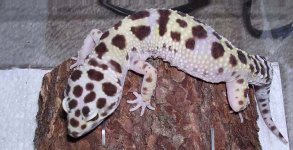
Freckles' pattern is not reduced. She has a very light, yellow on white background and lots of huge spots all over.

Wanda
 
This is Freckles
 

Attachments

  • freckles-2.jpg
    freckles-2.jpg
    82.1 KB · Views: 91
ok, so back to where I left off....

So with height being controlled by multiple genes, one can <b>selectively breed</b> for it. It may turn into a morph like tangerine, hypo, or snow, where over time and lots of inbreeding/selectively breeding (one in the same virtually) one will start to see results of the desired phenotype they are after. Again, this is with multiple genes, it's much easier to accomplish this using simple recessives/dominants where only 1 gene controls the trait you're after. However, even though you breed your longest leos together you could even hatch out normal length animals. Again, just like with the early tangerines. You could (and still can) breed beautiful tangs together and get normals, maybe with tang influence.

This brings me to the striped/jungle, what's recessive, what's dominant, etc debate. According to my own breedings since 2000, stripe and jungle are GENETIC and with my breedings are recessive, with jungle being dominant over stripe. I, however, can't explain why jungle is dominant over stripe. I just know that jungle X jungle yields jungles and stripe X stripe yield stripes, but stripe X jungle yields jungles or a mix. I also know this on the het level through breedings of my former male tremper albino to a jungle and a striped female. The albino het offpsring were jungles or stripes. Breedings of those offspring to each other resulted in normals, albinos, jungles, and 1 striped. The ratios were close to 9:3:3:1, which is the ratio one would expect if testing to see if a trait is genetic. Also, when I say jungle or stripe I'm also inferring that they have a either a striped or abnormally patterned tail. This isn't to say that you could have a partial stripe/jungle" with a normal tail and produce 100% striped or jungle offspring. Knowing this makes me wonder if the abberant body and tail are 2 separate traits, but maybe on the same chromosome. If this is the case, then when these chromosomes independently assort, both traits are expressed, but if crossing over occurs near those 2 traits, maybe one or the other gets expressed. This brings me to a definition:

<b>crossing over</b>: a process in which chromosomes exchange material through the breakage and reunion of their DNA molecules.

<b>recombination</b>: the production of gene combinations not found in the parents by the assortment of nonhomologous chromosomes and crossing over between homologous chromosomes during meiosis. For linked genes (like I suggested with jungles and stripes above), the frequency of recombination can be used to estimate the genetic map distance; however, high frequencies (approaching 50%) do not yield accurate estimates.

Now, without typing out a WHOLE semester's worth of lectures on genetics I'm going to finish...

Here is a list of what I think the leo morphs are, I'll start with simple genetic traits:

Genetic traits:

1. Albinism (bell, rainwater, tremper, leshock????)
2. patternless (patternless and blizzards)
3. Jungle
4. Striped
5. Normal (wild-type)
6. true melanism (single gene controlled like that in <i>thayeri</i>)


Genetic combinations:

1. patternless albinos
2. jungle albinos
3. striped albinos

Selectively bred/line bred (inbred) traits/traits containing multiple genes:

1. tangerine
2. hypomelanism (reduced black/browning markings, DOES NOT have to be less than 10 body spots)
3. snow (could probably place under hypopigmentation)
4. giant
5. hypermelanism (aka 'melanistic' - through selectively breeding for higher melanin production)

Codominant and/or Incomplete dominant traits:

1. carrot-tail/ ray hine hypomelanistic

Now here's why I state what I do for carrot-tails, and I'll test it further this year. When breeding my male rainwater albino to a hine line CT I got from albey, for the last 2 years, and breeding my HISS Hypo CT to a female rainwater, EVERY SINGLE clutch has had 1 hypo CT (not tangerine though) and 1 normal/tangerine-ish normal. Now, when Tim Rainwater produced his albinos within the first year, one of the first things he did was breed it into some hypo tangs he got from Golden Gecko and he also bred it into the patternless gene pool. With that knowledge it would explain why I'm getting hypo animals. But, if I remember correctly, Ray Hine's first "carrot-tail" was a WC hypo that produced hypo offspring when bred to normals. He then introduced it into his tangerines resulting in the carrot-tails we see today, at least lineage speaking. Even though I'm getting out of my leos, I do plan to keep a few animals back. This will allow me to run a few personal trails on other traits, one of which will be breeding a female carrot-tail to my 100% pure normals, no mutated inbred crap in their genes (to my knowledge).


Ok, now for the next topic, as i said before, what in the hell is going on with all these OBESE leos??!! I'll tell you what I and another breed think is going on: mealworms and super worms = higher in fat and protein than crickets.

I feed strictly crickets. My geckos are all housed individually in a rack system that is controlled by a Helix DBS-1000 thermostat set to 88°F. Everyone is fed every 2nd or 3rd day, ranging from 6-12 crickets depending on the animal's age, size, previous appetite. With this feeding regiment, it takes me about 10-12 months to get geckos breeding size, which is FINE by me. My geckos range from about 48-80 grams, roughly. I have NEVER had a leo die in my care, and that dates back to 1996. I supplement once a week with herptivite and every feeding to every other feeding with miner-al indoor. I use to supplement with reptivite before miner-al came out. With this said, NONE of my geckos look like Ricky Lake or Oprah on a 2 month eating binge. They look tone, not skinny, not fat, but tone. Kind of like how those dog or cat weight posters you see in the exam room of your Vet's office. My crickets are gutloaded on my old iguana diet:

collard greens
mustard greens
turnip greens
butternut squash
yellow squash
cactus pad
snow peas
greenbeans
kiwi
strawberry
banana

And I also use Fluker's High Calcium Cricket feed and cricket quencker, as well as either a piece of carrot, yam, orange, or apple for moisture. Every so often I'll put in moistened dog food for protein.

So, how many geckos do you know that actively burrow deep into the ground for beetle larvae (mealworms/super worms). All the terrestrial geckos I know, as well as other terrestrial herps minus varanids, go after surface active prey items. Or they might get lucky and un-earth a "treat" while digging out an empty rodent burrow.

Chris

EDIT:

Forgot three traits:

Combinations of genetic and selectively bred traits:

1. <b>RED STRIPED</B>

Hell if I know trait:

1. kink tail
2. deformed eyelids
 
Dan Poe said:

hypo only means reduced-patterning or spotting ....any "color" could also be a hypo

The word hypo means to be reduced (google search for hypo: Greek prefix for under, below). So for the sake of argument, if leos always had 1000 spots (NO exceptions) on their body and you owned one with 999 spots, it would technically be hypomelanistic. The real question is how does one define the DEGREE of hypo? If you really want to get technical, albinism is a form of hypomelanism/hypopigmentation.

Another thing...

Those of you wondering what the gamble was with hets, poss hets or how the terms 100%, 50%, 66.7% or 25% poss het came from, check the link in my original post. If still unclear, poost here and I'll try to decloud the cloudiness.

Chris
 
Off Topic kinda but Wanda, Freckles is beeuuteeful. I would classify him as a very nice pastel.
 
Thanks, Kelli, Freckles is a girl ;)
She is not breeder stock, she is a pet, so the classification is merely to satisfy my curiosity.

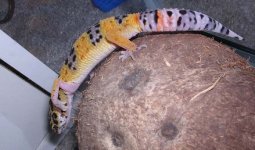
This is my son's, Lucky. Boy is he turning colors! He is very bright yellow and is getting orange on the tail. What is he?
 

Attachments

  • lucky 2.jpg
    lucky 2.jpg
    78.3 KB · Views: 87
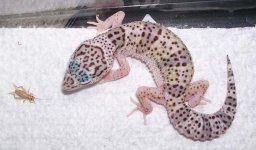
And then there's little Gem. She was my $15 purchase at White Plains. She is pink and purple, and just starting to get some hues of yellow...

Don't know what she is myself, several breeders speculated on another board. She is also just a pet.
 

Attachments

  • gem 2a.jpg
    gem 2a.jpg
    70.8 KB · Views: 85
quoting humpback1962:

Don't know what she is myself, several breeders speculated on another board. She is also just a pet.

looking at the size of the cricket, first off she's a young gecko or an underfed gecko (before you got her). Many times the over all coloration of an animal will deminish when malnurished. I'm not saying anything bad on your part or the breeder whom you got her from, just stating a fact.

Now, if the above is not the case (benefit of the doubt) then it looks like a low grade snow. But I've had some light leos hatch out that have developed into bright yellowish-tan normals as adults.

Chris
 
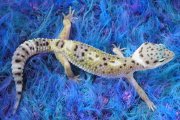
Is Pastel considered Snow?? I bought 4 Snow Geckos and they almost look identical to Freckles. Here is 1 of my girls, Mab.
Steve Smith
 

Attachments

  • 17sn729_180.jpg
    17sn729_180.jpg
    24.9 KB · Views: 76
Chris, I have a hard time calling her underfed. I have had her since the show a couple of weeks ago, and each day she gobbles up 6-8 crickets. Gutloaded, as you guys describe here and there: Fruits and veggies, calcium dust, cricket chow... And on top of it all, she could eat 3 crickets and if you put a mealworm in front of her, get out of the way! She has always fed like a litte pig since I got her, and did not notice bonesies or anything showing through her skin...

We'll see. Reading you guys makes me aware of the commitment to breeding, so I do not think I am interested in pursuing that. I enjoy petting them, warming them in my hands when I watch TV, and I think breeding takes quality time away. I am most interested in keeping them as pets.

I really like pastel colors. I prefer grays and whites over tangerines and yellows. And her pinks are colors I hope she never loses! I call her my Barbie gecko.

So, is Lucky (my son's) a carrot tail or high yellow?

Wanda
 
Back
Top