ok, here we go (again)....
I'll start off with this link:
http://webpages.charter.net/geckos/genetics.htm
Now, most of what I've read here and what people have said has been on the notion of only knowing <b>Mendelian Genetics</b>, or the study of trait (whether a 'good or 'bad' trait) transmission pattern within families. These traits are 'simple' or rather, there is only 1 gene (2 allelic states) that controls the trait. Height or weight, on the genetic level, are controlled by MULTIPLE genes and environmental factors (I'll explain later on why giants are NOT FULLY GENETIC). Now for some more definitions:
<b>gene</b>: an area on a chromosome that carries the instructions for a certain trait.
<b>allele</b>: different form/variation of a gene
<b>homozygous or homozygote</b>: an individual in which the 2 copies of a gene are the same allele.
<b>Heterozygous or Heterozygote</b>: an organism with unlike members of any given pair or series of alleles that consequently produces unlike gametes. Lay: has different alleles for a single trait or gene.
<b>dominance</b>: a condition in which one member of an allele pair masks that of the other.
<b>incomplete dominance</b>: expression of 2 alleles in a heterozygote that allows the heterozygote to be distinguished from either of its HOMOZYGOUS parents. Classic example: flower color in snapdragons. White (rr) and red (RR) varieties are homozygous for different alleles of a color-determining gene; when crossed they produce heterozygotes (Rr) that have pink flowers. Therefore, red color (R) is said to be incompletely dominant over white (r).
<b>codominance</b>: alleles that produce independent effects when heterozygous. Example, blood type. I<sup>A</sup> = Type-A, I<sup>B</sup> = Type-B, and i = type-O, you can have people with blood types A (I<sup>A</sup>I<sup>A</sup> or I<sup>A</sup>i), AB (I<sup>A</sup>I<sup>B</sup>), B (I<sup>B</sup>I<sup>B</sup> or I<sup>B</sup>i), and O (ii).
<b>Complex trait</b>: trait that is controlled by more than 1 gene and environment.
<b>Genotype</b>: allele combinations, the genetic constitution (gene makeup) of an organism. The genotype for an albino would be aa and the genotype of a 'normal' would be AA, or possibly Aa if it is heterozygous for albinism.
<b>phenotype</b>: the observable characteristics of an organism.
<b>albinism</b>: absence of the pigment melanin in skin, hair, and sometimes eyes of an animal. Sometimes called <i>amelanism</i> in reptiles as they have more pigments than just merely melanin.
Now to throw some of you for a loop. Everyone reading this that is of normal height, that is you aren't a midget/dwarf, you are RECESSIVE. The condition achondroplasia, or dwarfism, is a dominant trait. Individuals heterozygous for this trait are also dwarfs.
Speaking of height (length in the case of leoaprd geckos), gigantism can be genetic. However, as I'm seeing in the 'giant' leos, there are variations in height. Individuals are breeding giants to giants and not getting giants, though they may get larger leos. The reason for this is that the GENES (plural) for height are dependent of both your genetics and your environment. This trait is called <b>continuous</b>, where the trait(s) have a continuous distribution of phenotypes over a range. This spawns <b> quantitative genetics</b> or the study of the inheritance of contiuous traits. Quantitative traits can be measured, are influenced by MANY genes, and are influenced by many ENVIRONMENTAL factors. Continuous traits show a variety of phenotypes over a range (restating what I said previously). But, how are multiple phenotypes created?
1. They arise due to numerous genotypes due to multiple genes. There are <b>polygenic traits</b> that are controlled by many genes and many genotypes code for the SAME phenotype.
2. Both multiple genotypes and environmental factors influence contiuous traits. Environmental factors in the argument of leos would be caging, temps, amount of food (what the hell is with all the OBESE leos I keep seeing?) offered, prey items, breeding, etc.
In polygenic inheritance, each allele can contribute to the overall phenotype. These contributions can be additive.
For the sake of argument, say you have a giant 'normal colored' leo. He's normal for everything except the giant trait. Now, we'll hypothesize that the giant trait is comprimised of multiple genes (say 2) and is dominant. The tallest (longest) gecko will have the genotype AABB. The shortest gecko will be aabb. The rest (AABb, AaBB, Aabb, aaBb) will be intermediate in size.
Example: 2 genes control length in leopard geckos
AABB = 50 cm long gecko
aabb = 20 cm long gecko
What's the length of the F<sub>1</sub>? Breeding the AABB X aabb geckos all offspring (the <b>F<sub>1</sub></b>) will be AaBb, and thus will be approximately 35 cm long.
Now if you breed brother to sister from the F<sub>1</sub>, you'll get a mix of genotpyes consisting of:
AABB - longest
AaBB - 2nd longest
AABb - 2nd longest
AaBb - 3rd longest
aaBB - 3rd longest
AAbb - 3rd longest
aaBb - 4th longest
Aabb - 4th longest
aabb - shortest
and....that's all I have for now as I have 20 minutes to get onto campus for Evolution class. More to come later today........


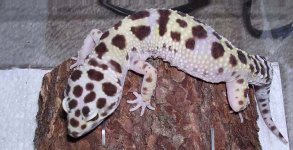
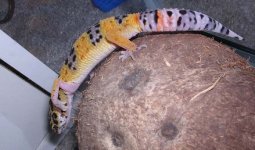
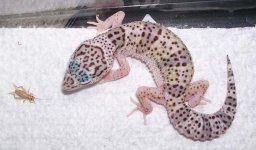
 ! these are all "normal" animals technically !!....hi-yellow , hypo, tangerine , carrottail ,snow/lavender etc. ....all these colors and hypos have been selectively bred for from "normal"-geckos ......first.... hi yellow (which hypo came from) ......and so on and so forth technically these are all "normal" animals PEOPLE SEEM TO FORGET THIS