• Responding to email notices you receive.
    **************************************************
    In short, DON'T! Email notices are to ONLY alert you of a reply to your private message or your ad on this site. Replying to the email just wastes your time as it goes NOWHERE, and probably pisses off the person you thought you replied to when they think you just ignored them. So instead of complaining to me about your messages not being replied to from this site via email, please READ that email notice that plainly states what you need to do in order to reply to who you are trying to converse with.

  • IMPORTANT! PLEASE READ!! About the Google Adsense ads being displayed

    =====================
    Posted 08/15/2025
    =====================


    Yeah, I know. They are a pain in the butt. But they pay the bills to keep my server running. Just a fact of life, I am afraid.

    Want to get rid of them? Simple. Just become a Contributor level member or above and they will be gone. -> Please click HERE."

    Is that too much for me to ask of you to keep this site running? Well, sorry about that. I too wish I could get everything for free. But alas.....

    =====================
    Addendum: 01/10/2026
    =====================


    Google Adsense ad revenue for December, 2025 was just $30 over the cost of the lease for the server running this site. So, in effect, the money providing the incentive for me to continue running this site is coming SOLELY from the paid memberships and sponsorships here. Which honestly ain't much....

Indigo umbilical scar

Stanley M. Ordonez

New member
Joined
Dec 29, 2013
Messages
47
Reaction score
1
Points
0
Location
Jackson, California
Hope I am doing this right. I recently purchased an eastern indigo snake 28 in. hatched around 8/14. It has some split sales on the ventral/belly. 3 inches anterior to the cloaca: 7 pairs of split scales. The seller said they will shed out within a year. Does this sound right? I am new to indigos. I know I could learn from this and may be helpful to others. The indigo is healthy, strong and an all around nice snake. Thank you, Stan
 
Hi Stan.

The scales will not "shed out". General opinion is that they are a result of inbreeding. Usually, it seems, this inbreeding happens as breeders try to amplify "red-throat" characteristics. My personal recommendation would be that you find a completely unrelated snake, from a different breeder, and preferably of the opposite color phase, to breed your snake with.

Other than that caution, I would not expect the condition to be harmful in any way.
 
Indigo Scar- Where's the beef???

I am finding that the famous indigo scar is a mystery to some breeders. One they have not seen one or it is better not know the difference. An umbilical scar only involves one or two scales . If it involves more scales then it is not an umbilical scar. It is an genetic defect ; probably due to inbreeding. If you have a pic of an umbilical scar please post it . There are indigos that do not have any scars. And good breeders that are breeding good animals. I am afraid that the mighty dollar is driving this problem. If it has scales that are split beyond the two. Then that inbreed indigo should be disclosed as having this genetic problem and sold accordingly. It should not be sold as a flawless indigo and should be sold at 30-50 % less than the current market value. These split scales do not heal . Thanks, Stan
 
Please don't take any offense at my reply, my friend; none is meant, but I am a lover of these snakes, and must share my response to your post:


I'd wonder about the term "umbilical scar" anyway, Stan. An umbilical cord is very much a mammalian feature - there is no "umbilical" anything on any reptile. I'd wonder how you've come to the conclusion that split scutes on any Indigo differ from split scutes on another Indigo, just by their number or location.

Certainly, "the FAMOUS Indigo scar" is not famous, or we'd all know about it. Considering your new involvement with the species, I think that declaring two split scales to be okay, and more to be a 50% monetary flaw, is a bit presumptuous. Maybe you're looking for a refund from the guy who sold you a snake with 7 split scales?

I have communicated quite extensively with some of the best known breeders of these special snakes, including those who are magnificently careful about preventing even the tiniest degree of shared genes between parents. Unfortunately, we have laws which prevent new genetics from being introduced to the captive populations....maybe you'll add your voice to convincing USFWS that this is counterproductive.

Meanwhile, though, with all the research and communications I've followed through, I have never heard of a "famous umbilical scar" which is okay if it's 2 scales, or any indication that an indigo with, say, five split scales is worth 50% less than one with 2 split scales.

Oh, over 35 years ago, I had a wild-born couperi with some split scutes.

Are you a member of Orianne Society?

We're all very concerned about couperi's long-term health....let's all try to keep track of the parentage and lineage of our snakes, for this goal.

Genetic weaknesses can be fixed in a single generation. Breed a South Florida snake with a South Georgia snake, and there will likely be no split scutes in any baby....at least, not if those split scales were indeed caused by shared genes!

I'm very glad that you've opened this discussion, and I hope that others will express their experience and thoughts. Maybe we'll both learn something valuable! There are some amazing biologists on this forum....maybe Vanessa will give her input!

Or how about you, Bob ? Tim? Aussie?
 
Split scales- Indigo

Chris, I agree that there needs to be more discussion on the problems of inbreeding and split scales. The situation is that the breeding of indigos are very inbred. You hear of the lower fertility rates. Clutches that do not produce indigos. And the extreme is stunted growth and enlarged heads. Could you post pics of your indigos with split scales? I returned my red throat indigo. The main reason I returned it was because the seller/breeder sold it as flawless indigo. He said that I would not be able to find better. I believed him and did not questioned him . He is a large breeder with a website and videos. I walked in blind trusting him. When I received the indigo I noticed the split scales which were 6-7. This might be a low number for split scales and might even be a great indigo in todays market. But that did not fit the definition of flawless. Needles to say he was not happy and neither was I. But enough of this. There needs to be better records and care in breeding these wonderful indigos. I have since purchased a Texas Indigo and he is in great shape and what I would expect from one in the wild. I have not given hope as I hope to post a "flawless'' red throat indigo before summer. She is on hold till my permit is granted. I have been unable to find good red throat indigos in California and would like to find a small time breeder with high standards. Sorry for the long post. Please post pics and lets hear your thoughts . Thank you, Stan Ordonez
 
Interestingly, my split-scale red-throats have a very different lineage for each of their parents; I have breeders names and litter numbers going back three generations. In my male's lineage, there is one common ancestor, who was a grandfather to one side of the family, and a great grandfather on the other side, in a different year. Other than that, lineage was from quite a few different breeders.

My boy and girl red-throats do not share any common ancestor at all. If the girl has any inbreeding responsible for her few split scutes, there is absolutely no record of it in her family tree. And I do absolutely believe the breeder's strictly documented account of their lineage.

My all-blacks are from entirely different lineages from each other, and from the red throats; none of the three all blacks have any split scales.

Let me also say this: I would not trade ANY of my snakes. If offered a "flawless" boy red-throat for my split-scaled boy, I WOULD NOT TRADE. His "personality" is magnificent, he's blatantly healthy, and I expect he'll father many young, "flawless" snakes. He'll be mating with several COMPLETELY unrelated girls; some all black, and at least one red throat, hopefully more. That represents "South Florida" to "South Georgia", in theory, at least....and a diversification of blood.


We have only opinion and guessing, as to whether these split scales are from inbreeding. Personally, I think that this is likely, because of the very limited genepool of a very rare snake, protected by law. Even if we assume this to be true, if we truly love these snakes, shouldn't we work towards diversifying the genepool as far as possible?

As for "lower fertility rates" and "clutches which do not produce indigos", I absolutely attribute this to breeder negligence of the VERY stringent temperatures and humidities required for producing healthy indigos. Couperi eggs absorb moisture; if allowed to be moist, they will swell and die. The female needs an ability to self regulate temperature, in a small range, and her eggs must be maintained within pretty much a ~4 or 5 degree range, or they develop spinal deformities, and other serious medical issues.

All the very best,
Chris

 
Snakes have an umbilical scar. It is where the yolk sac attaches to the developing snake while it is in the egg. The breeder who you contacted knows his stuff. He has bred 100's of Drymarchons.
 
I've discovered today that I need to retract a statement I made, above. I said the splits won't shed out....

I took a couple of my snakes out for some sunshine, and discovered that my red-throat '12 girl no longer has any split scales -- just a dark line, where the split used to be, on 7 scales. Two of the scales still have a tiny notch in the trailing edge, but there is absolutely no cleft in any of the scales anymore.

I was somewhat excited and perplexed by this find, because over many decades, I've had many snakes with scars and scalation abnormalities which never really disappeared.....

....and I went in to re-examine my red throat '12 boy. Nope, he still has his cleft scales, unchanged, as far as I can tell. Oh well....I'm not sure what any of this actually proves, but I thought I'd correct my comment above to "sometimes". .....
 
Does anyone have photos of the split scales? I've heard and read a lot about it, but I don't think I've ever seen photos. I just have one couperi, and he doesn't have any split scales.
 
split scales

I will be posting some pics of split scales in Indigos. There needs to be more on this topic. There seems to be a strong correlation between inbreeding and split scales. This trait is passed on. I have yet to hear that the trait was breed out. Small clutches, low fertility rates, shortened life span and stunted growth are some of the inbreed traits/problems that are showing up. How does an Indigo that produced a clutch of 19 eggs sound? The breeder that helped produced this clutch was due to a varied diet and had indigos that do not have these inbreed problems/split scales. In my opinion indigos with split scales should not be breed or sold. Do not buy Indigos with the above problems. How is this helping Indigos? Lets hear from some of the breeders, Stan Ordonez
 
I have 3.3 couperi, one has split scale anterior to the vent. She will never be bred. East coast Drymarchon FB page has photos of split scales.
 
Eastern Indigo-Thank you Vic

I received two eastern indigos this past Friday from Victor Herrick. I was pleased that they were 10 grades above what I had received and returned to Black pearl; their version of a flawless eastern indigo. I have learned from this experience that you do not jump on the first wagon that comes buy. It is better to wait and do your homework before you decide to buy. The seller wants to sell and the buyer wants to buy. But as the buyer you need to be educated as to what you are getting and not to rely on every word the seller is dishing out. The bottom line is that Eastern Indigos have a big problem. And the problem is genetics; they are inbreed and everyday it is more so. For those that can afford it, DNA testing is good method to see how closely related are these snakes. But this is out of our means to afford such a service. Most of the E. Indigos in breeders hands are related. I hate to say this, but it is time to face the music. Breeders should not be selling indigos with defects or breeding them. And we should not buy these inbreed snakes. I will be posting pics of the ones I have and pics of other indigos that do not make the grade. Stan Ordonez
 
True. I do not know if it is even possible to buy unrelated lines of eastern indigos anymore. I have 3.3 couperi and I love having them. But I realize breeding them may be problematic and I may have to be satisfied with just keeping them as pets. If so, that is fine. I have friends who have shared photos of beautiful indigos that died without warning upon reaching sexual maturity. Often with enlarged heart condition. I am glad you were able to find a good pair. Hope you can identify a relatively unrelated line out there to match them up with.
 
Indigos with enlarged hearts

Tim, can you or your friends let us know whether the Indigos that died of enlarged hearts as they reached adulthood; did they have split scales? I am sorry to hear that your friends purchased an Indigo; probably as a pet or as a prized long life dream of owning a great snake, only to see it die once they reached adulthood. That would of affected me for sure. Split scales can be an indicator of future problems, would be interesting to see if those that died had split scales. Thank you, Stan Ordonez
 
I have two black phase males, my older with stunted growth (just under 6 feet), some split scales, slight tail kink. I love the dude just the same though haha! But yeah he is a mess compared to being perfect. My non snake friends absolutely love him and always want photos with him. He may not be good for making babies, but he is great for educating people about indigos in general :)
 
My understanding is that the split ventral scales anterior to the vent indicate inbreeding. It is assumed that this inbreeding has resulted in the enlarged hearts, early deaths, etc. I have one aberrant scaled girl, but the rest of my group appear perfect. I would never sell an indigo snake. The good ones are damn near priceless.
 
SPLIT SCALES- Eastern Indigo

Sorry to get back to this so late. Markus can you post a pic of the split scales on your indigo? How many scales are split? Thank you, Stan Ordonez
 
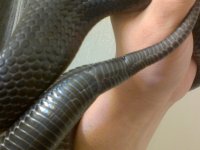
Here's one for ya! Sorry not the best quality
 

Attachments

  • IMG-20120109-00011.jpg
    IMG-20120109-00011.jpg
    238.4 KB · Views: 451
Indigo split scales

Thank you Markus for posting the pic. I take it is an Eastern Indigo. How old is it? Do you have more Indigos? If you do , do they have split scales. The quality of the pic is good. And a great size also. Thanks for sharing. Can anybody else share there experience or pics of split scales on Indigos? Stan Ordonez
 
Back
Top