SirenSanJose
aka: dheideman
Sorry, folks. I know these "OMG I bought this animal at Petco and it's TOTALLY NOT A NORMAL tell me how rare and valuable it is" threads drive everyone crazy, and I'm sorry to be creating one. But this guys is really puzzling me.
So, I picked up several normal balls locally on Craigslist last week. Among them was an adult male, deep in shed.

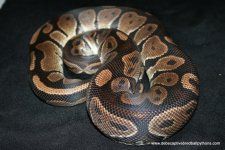
I didn't think anything of it, until yesterday when I went to feed everyone, and saw he'd shed. Once he showed me his new skin, something looked "off". So I picked him up, and took a good close look at him ... and he doesn't appear to have a drop of yellow, anywhere on his body. He's brown, and white, and that's it -- which is the technical definition of axanthic, no yellow (or red) pigment. Back me up? Tell me I'm crazy? (All these photos were taken in natural sunlight, no flash, no correction.)


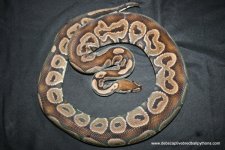
Here he is next to a normal female:


(that's her head, not his)
Now, what I don't know is if he'll prove to be a *genetic* axanthic -- but the good news there is that I have 4 of his 3-year-old daughters, who are all a bit undersized but well may make breeding week by spring. (Their mother, who I saw but do not own, was an everyday normal.)
If any or all of them do reach breeding weight on time, I should be able to prove or disprove him this season. This doesn't appear to be a co-dom gene like the "het red axanthic" gene, as all of his kids are visually (mostly) normal, with visible yellow. So if it's genetic, it's recessive, but they should carry it.
His original owner bought him at a pet store about 5, 6 years ago, as a normal, so nothing is known about his lineage or if he actually is an existing strain of axanthic or something new.
Here he is with the oddest looking of his daughters, she's got some weird patchy color. One other girl is patchy like her, the other two look completely normal.


From left to right: Normal female, "axanthic" male, "het axanthic" daughter

So, I picked up several normal balls locally on Craigslist last week. Among them was an adult male, deep in shed.
I didn't think anything of it, until yesterday when I went to feed everyone, and saw he'd shed. Once he showed me his new skin, something looked "off". So I picked him up, and took a good close look at him ... and he doesn't appear to have a drop of yellow, anywhere on his body. He's brown, and white, and that's it -- which is the technical definition of axanthic, no yellow (or red) pigment. Back me up? Tell me I'm crazy? (All these photos were taken in natural sunlight, no flash, no correction.)
Here he is next to a normal female:
(that's her head, not his)
Now, what I don't know is if he'll prove to be a *genetic* axanthic -- but the good news there is that I have 4 of his 3-year-old daughters, who are all a bit undersized but well may make breeding week by spring. (Their mother, who I saw but do not own, was an everyday normal.)
If any or all of them do reach breeding weight on time, I should be able to prove or disprove him this season. This doesn't appear to be a co-dom gene like the "het red axanthic" gene, as all of his kids are visually (mostly) normal, with visible yellow. So if it's genetic, it's recessive, but they should carry it.
His original owner bought him at a pet store about 5, 6 years ago, as a normal, so nothing is known about his lineage or if he actually is an existing strain of axanthic or something new.
Here he is with the oddest looking of his daughters, she's got some weird patchy color. One other girl is patchy like her, the other two look completely normal.
From left to right: Normal female, "axanthic" male, "het axanthic" daughter