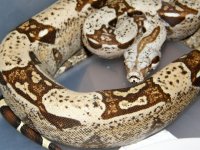
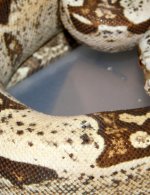
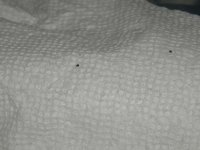
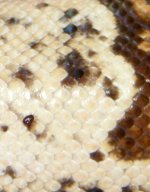
As far as me saying the boa was sick or diseased, when they have mites they are sick. So for those of you who are not aware of what mites can do to your animals, here is a little reading material for you.
Snake mites cause discomfort from their feeding on the blood of the snake. They can transmit bacteria (such as aeromonas hydrophillia) and blood parasites to the snake. They have been implicated as a source of transmission for the boa encephalitis virus.
Also The snake mite (Ophionyssus natricis) is suspected to be a vector, passing the virus from one snake to another. Often, with an outbreak of IBD, the snakes also have concurrent mite problems.
Mites are not a simple thing that go away with no possibility of causing disease or infection.
Dan/Katy,
Your getting blowback over this because your associating the fact that since snake mites are possible vectors that the snake must be sick since it has mites. Using your argument as an analogy, if I got bit by a tick, then I must have Lyme's disease or if I got bit by a mosquito, then I must have malaria, dengue fever, Eastern Equine Encephalitus and West Nile. This is simply not true.
As for being a vector for bacteria like Aeromonus hydrophilia, you are aware that this bacteria is a very common part of the bacterial flora of snakes? (see for example Reptile Medicine and Surgery 2nd edition Saunders Press). The risk that the mites can transmit Aeromonus hydrophilia as a major issue has to be looked at with some suspicion because, the bacteria are normally found in snakes.
With respect to IBD, there are multiple other potential vectors to consider such as contact with materials contaminated with secretions or even small particulates of fecal material. It can be transmitted through a collection by the simple fact of not washing your hands between enclosures when cleaning or changing water bowls. Again Reptile Medicine and Surgery
With respect to quarantine, the reason your seeing so many comments on it is because it is an important control measure. You are aware that some diseases like ophidian paramyxovirus can be transmitted from infected animals (which may or may not be showing symptoms at that time) via airborn particles? Anytime you place a new animal in close proximity to an established collection you have the risk of an outbreak. I quarantine everything regardless of who I get it from and that includes prophylactically treating it for mites. I would do this even if I got the snake from a world renowned breeder. After an unfortunate incident a number of years ago where I ordered some amphibians and received some mites as well, I now also unpack in the quarantine room, and the box and all the materials are treated with PAM.. and placed in a garbage bag which is then tied shut and placed outside.
As for experience, I've been personally keeping snakes since I was 7 with is close to 39 years now and I also spent close to 19 years working in a well known zoological institution.....
With respect to the mites, it only takes one adult female to cause an outbreak and you can't be 100% sure that the mites actually originated from the seller's collection as opposed to picking it up along the way. Possible additional sources are from the packing material or box if it is reused, or even where it was packed. A petstore no matter how carefully cleaned is going to run some risk simply due to the nature of the business.. animals are always coming and going and people are coming and going. Mites can come in with reptiles or from people who handled a infested reptile elsewhere and then handle one of the stores animals or touch the cages.
The argument that the snake must be sick because it has/had mites is simply not valid at this point.
Some comments
Ed