hmmmm....
Christina said:
Genes don't need to be "attached," they just need to be there...the issue with giant blazing blizzards would be that combining 3 different recessive traits is very difficult.
The issue about 3 genes all being expressed at the same time is true, that is IF giant is even a recessive. But I digress, I think it's time for another LONG genetics lesson. I'll be quoting my book the whole way...
<u><b>Chapter 8: Linkage, Crossing over, and Chromosome Mapping in Eukaryotes.</b></u>
<b>Linkage, Recombination, and Crossing Over</b>
Sturtevant based his mapping procedure on the principle that genes on the same chromosome should be inherited together. Because such genes are physically attached to the same structure, they should travel as a unit through meiosis. This phenomenon is called <b>linkage</b>. The early geneticists were unsure about the nature of linkage, but some of them, including Morgan and his students, thought that genes were attached to one another much link beads on a string. Thus, these researchers clearly had a linear model of chromosome organization in mind.
The early geneticists also knew that linkage was not absolute. Their experimental data demonstrated that genes on the same chromosome could be separated as they went through meiosis and that new combinations of genes could be formed. However, this phenomenon, called <b>recombination</b>, was difficult to explain by simple genetic theory.
One hypothesis was that during meiosis, when homologous chromosomes paired, a physical exchange of material separated and recombined genes. This idea was inspired by the cytological observation that chromosomes could be seen in pairing configurations that suggested they had switched pieces with each other. At the switch points, the two homologs were crossed over, as if each had been broken and then reattached to its partner. A crossover point was called a <b>chiasma</b> (plural, chiasmata), from the Greek word meaning "cross." Geneticists began to use the term <i>crossing over</i> to describe the process that created the chiasmata--that is, the actual process of exchange between paired chromosomes. They considered recombination--the separation of linked genes and the formation of new gene combinations--to be a result of the physical even of crossing over.
<b>Exceptions to the Mendelian Principle of Independent Assortment</b>
The phenomenon of linkage and recombination were first described by W. Bateson and R. C. Punnett (aka, Punnett's Square) shortly after the rediscovery of Mendel's work at the beginning of the twentieth century. Initially, this linkage was viewed as an exception to Mendel's Principle on Independent Assortment.
Some of the first evidence for linkage--and against independent assortment--came from experiments with sweet peas (figure, which I don't have a photo of). Bateson and Punnett crossed varieties that differed in two traits, flower color and pollen length. They crossed plants with red flowers and long pollen grains to plants with white flowers and short pollen grains. All the F<sub>1</sub> plants had red flowers and long pollen grains, thus indicating that the alleles for these two phenotypes were dominant (my note, and also making double hets in the process). When the F<sub>1</sub> plants were self-fertilized (my note, crossing the double hets to themselves via their own gametes), Bateson and Punnett observed a peculiar distribution of phenotypes among the offspring. Instead of the 9:3:3:1 ratio expected for two independently assorting genes, they obtained a ratio of 23.3:1:1:6.8. Obviously, the two parental classes were significantly overrepresented in the progeny. This departure from the expected Mendelian results was due to linkage between the gene for flower color and that for pollen length.
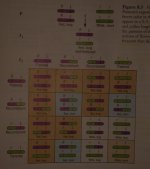
Although Bateson and Punnett devised a complicated explanation for their results, it turned out to be wrong. The correct explanation is that the genes for flower color and pollen length are located on the same chromosome; consequently, they tend to travel through meiosis together. This explanation is diagrammed in Figure 8.3 (I'll get a photo of this shortly after I post and will edit it in). The alleles of the flower color gene are R (red) and r (white), and the alleles for the pollen length gene are L (long) and l (short); the R and L alleles are dominant. (Note here that for historical reasons, the alleles symbols are derived from the dominant rather than the recessive phenotypes.) Because the flower color and pollen length genes are linked, the parental combinations of alleles (R and L, and r and l) are more prevalent than the nonparental combinations (R and l. and r and L) in the gametes of the F<sub>1</sub> plants. Self-fertilization of the F<sub>1</sub> therefore produces a preponderance of parental phenotypes in the F<sub>2</sub>. However, the genes for flower color and pollen length are not inextricably linked. Some nonparental progeny do appear, although at low frequency. Because these progeny indicate that the alleles of the two genes were recombined in the F<sub>1</sub>, they are called <b>recombinants</b>.
Sign, rubbing hands, long post, ouch...
The frequency of recombinants can be calculated too.
You take a heterozygote for the 2 linked genes and testcross (cross the het to a homozygous recessive) it. The frequency is calculated by observing the recombinants (usually the smaller observed offspring) divided by the total (recombinants + observed parentals).
Attached below is Figure 8.3