• Responding to email notices you receive.
    **************************************************
    In short, DON'T! Email notices are to ONLY alert you of a reply to your private message or your ad on this site. Replying to the email just wastes your time as it goes NOWHERE, and probably pisses off the person you thought you replied to when they think you just ignored them. So instead of complaining to me about your messages not being replied to from this site via email, please READ that email notice that plainly states what you need to do in order to reply to who you are trying to converse with.

  • IMPORTANT! PLEASE READ!! About the Google Adsense ads being displayed

    =====================
    Posted 08/15/2025
    =====================


    Yeah, I know. They are a pain in the butt. But they pay the bills to keep my server running. Just a fact of life, I am afraid.

    Want to get rid of them? Simple. Just become a Contributor level member or above and they will be gone. -> Please click HERE."

    Is that too much for me to ask of you to keep this site running? Well, sorry about that. I too wish I could get everything for free. But alas.....

    =====================
    Addendum: 01/10/2026
    =====================


    Google Adsense ad revenue for December, 2025 was just $30 over the cost of the lease for the server running this site. So, in effect, the money providing the incentive for me to continue running this site is coming SOLELY from the paid memberships and sponsorships here. Which honestly ain't much....

Who is working on blazing projects????

Joined
Jun 2, 2002
Messages
928
Reaction score
0
Points
0
Location
Fort Worth, TX
I'm interested in talking to other breeders this year working on Blazing projects, perhaps exchanging notes on hatch rates, etc. So who on here is working with them? Any strain will do.
 
Well as you know I am working on a Bell Blazing blizzard project with Steve Beckerman, hopefully something really good will come of it!

And then of course, the Tremper Blazing project that we have together.

What I really want to see is a picture of an adult or even a subadult blazing blizz. They must not be that cool looking because no one ever posts pictures of older ones. Oh well, I guess i will have to wait and see for myself;)
 
kelli
see if you can email VMS or mark and see if they can email you or post a pic or something

when i saw that one at marks table in daytona it looked like a white blizz but had redish eyes (i couldnt tell realy well) pink tail,feet,belly ,head and all and i would imagine they dont get dark like regular blizzs do
i wonder if they have that same gentle nature the regular blizz's do lmao
 
robin d. said:
kelli
see if you can email VMS or mark and see if they can email you or post a pic or something

when i saw that one at marks table in daytona it looked like a white blizz but had redish eyes (i couldnt tell realy well) pink tail,feet,belly ,head and all and i would imagine they dont get dark like regular blizzs do
i wonder if they have that same gentle nature the regular blizz's do lmao

hmm I'd expect them to not be dark at all? It sure would be nice to see some adults VMS as 2.2 group he told me himself via e-mail. Anyone have any idea just how many there are?
 
they are not dark, they are or at least the one i saw pink and white.......
VMS did hatch out a few this season, it would be interesting to see what an adult or subadult looks like
 
hi all.:D
i am working on this project here in the uk(england!!)as we dont have them yet.i have last years double hets to work from.
i emailed vms and they DONT have an adult pic of a blazzing blizzard yet would be nice to see one tho!!!!!
simmo.
 
we only have one albino strain here :( ;) ;) ;) ;)
the tremper.
hopefully in a few years time the bells,las vegas one will be here
they take there time to find there way here lol
things move very very slowly here!!!!
simmo.
 
go to VMS's website...they have a picture of an adult.

ive talked with Sean Nilland about blazing blizzards and he says they are MORE sensitive to light and slower starters on eating. they still look cool tho.

id really like to see a giant blazing blizzard.
 
the infamousBLAYZEE-ING BLEEZARD

im wondering if they are ugly or just not so special since you really havent seen the few people that have them post any updated adult pics.... maybe they were a flop?
 
tremper says the blizzard cannot become a giant. Something about the giant gene will not attach itself to the blizzard genes. whatever Im no bioligist
 
turtlebuyer

Genes don't need to be "attached," they just need to be there...the issue with giant blazing blizzards would be that combining 3 different recessive traits is very difficult. It doesn't help that actually having blazing blizzards in a pain. I think the issue there is that not all albinos have red eyes...and the blazing blizzards are only blazing blizzards if they have red eyes... I think that's the problem...though I could be wrong. As far as the genetics side of it though...to my understanding, the only reason it would be difficult to combine 2 recessive traits in an animal would be is if there is some sort of lethality to the combination.
 
Hi Simon!!! Welcome to Fauna!

Don't you think it's a little strange that they don't post pictures?....hmmmmmmmmm
[size=-12]maybe there cameras broken? hmmmmmmm?[/size]
 
hmmmm....

Christina said:

Genes don't need to be "attached," they just need to be there...the issue with giant blazing blizzards would be that combining 3 different recessive traits is very difficult.

The issue about 3 genes all being expressed at the same time is true, that is IF giant is even a recessive. But I digress, I think it's time for another LONG genetics lesson. I'll be quoting my book the whole way...

<u><b>Chapter 8: Linkage, Crossing over, and Chromosome Mapping in Eukaryotes.</b></u>

<b>Linkage, Recombination, and Crossing Over</b>

Sturtevant based his mapping procedure on the principle that genes on the same chromosome should be inherited together. Because such genes are physically attached to the same structure, they should travel as a unit through meiosis. This phenomenon is called <b>linkage</b>. The early geneticists were unsure about the nature of linkage, but some of them, including Morgan and his students, thought that genes were attached to one another much link beads on a string. Thus, these researchers clearly had a linear model of chromosome organization in mind.

The early geneticists also knew that linkage was not absolute. Their experimental data demonstrated that genes on the same chromosome could be separated as they went through meiosis and that new combinations of genes could be formed. However, this phenomenon, called <b>recombination</b>, was difficult to explain by simple genetic theory.

One hypothesis was that during meiosis, when homologous chromosomes paired, a physical exchange of material separated and recombined genes. This idea was inspired by the cytological observation that chromosomes could be seen in pairing configurations that suggested they had switched pieces with each other. At the switch points, the two homologs were crossed over, as if each had been broken and then reattached to its partner. A crossover point was called a <b>chiasma</b> (plural, chiasmata), from the Greek word meaning "cross." Geneticists began to use the term <i>crossing over</i> to describe the process that created the chiasmata--that is, the actual process of exchange between paired chromosomes. They considered recombination--the separation of linked genes and the formation of new gene combinations--to be a result of the physical even of crossing over.

<b>Exceptions to the Mendelian Principle of Independent Assortment</b>

The phenomenon of linkage and recombination were first described by W. Bateson and R. C. Punnett (aka, Punnett's Square) shortly after the rediscovery of Mendel's work at the beginning of the twentieth century. Initially, this linkage was viewed as an exception to Mendel's Principle on Independent Assortment.

Some of the first evidence for linkage--and against independent assortment--came from experiments with sweet peas (figure, which I don't have a photo of). Bateson and Punnett crossed varieties that differed in two traits, flower color and pollen length. They crossed plants with red flowers and long pollen grains to plants with white flowers and short pollen grains. All the F<sub>1</sub> plants had red flowers and long pollen grains, thus indicating that the alleles for these two phenotypes were dominant (my note, and also making double hets in the process). When the F<sub>1</sub> plants were self-fertilized (my note, crossing the double hets to themselves via their own gametes), Bateson and Punnett observed a peculiar distribution of phenotypes among the offspring. Instead of the 9:3:3:1 ratio expected for two independently assorting genes, they obtained a ratio of 23.3:1:1:6.8. Obviously, the two parental classes were significantly overrepresented in the progeny. This departure from the expected Mendelian results was due to linkage between the gene for flower color and that for pollen length.

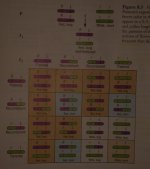
Although Bateson and Punnett devised a complicated explanation for their results, it turned out to be wrong. The correct explanation is that the genes for flower color and pollen length are located on the same chromosome; consequently, they tend to travel through meiosis together. This explanation is diagrammed in Figure 8.3 (I'll get a photo of this shortly after I post and will edit it in). The alleles of the flower color gene are R (red) and r (white), and the alleles for the pollen length gene are L (long) and l (short); the R and L alleles are dominant. (Note here that for historical reasons, the alleles symbols are derived from the dominant rather than the recessive phenotypes.) Because the flower color and pollen length genes are linked, the parental combinations of alleles (R and L, and r and l) are more prevalent than the nonparental combinations (R and l. and r and L) in the gametes of the F<sub>1</sub> plants. Self-fertilization of the F<sub>1</sub> therefore produces a preponderance of parental phenotypes in the F<sub>2</sub>. However, the genes for flower color and pollen length are not inextricably linked. Some nonparental progeny do appear, although at low frequency. Because these progeny indicate that the alleles of the two genes were recombined in the F<sub>1</sub>, they are called <b>recombinants</b>.

Sign, rubbing hands, long post, ouch...

The frequency of recombinants can be calculated too.

You take a heterozygote for the 2 linked genes and testcross (cross the het to a homozygous recessive) it. The frequency is calculated by observing the recombinants (usually the smaller observed offspring) divided by the total (recombinants + observed parentals).

Attached below is Figure 8.3

 

Attachments

  • figure8.3.jpg
    figure8.3.jpg
    70.4 KB · Views: 99
That's basically what I was trying to explain!...lol I just didn't use a lot of the fancy words or get into the calculation of recombination rates or anything like that.

One thing I know is that linkage is not required between different genes to have them expressed in two animals offspring. There is no rhyme or reason to what half of a parent's genetics the offpring will get...and the DNA from one parent has no effect on the DNA of the other parent. So if an offspring was to get DNA from one parent that includes an albino and blizzard allele, and DNA from the other parent that includes the giant allele (assuming it is recessive), the offspring will be triple het for the 3 traits. Now if linkage was involved and two triple hets were bred together....the likelyhood of getting giant blazing blizzards would increase from 1/64 offspring. However this number is decreased greatly because not all albino blizzards are blazing blizzards (again that's why I think it's like that...but I'm really not sure). It shouldn't be impossible to create giant blazing blizzards (again assuming that giant is recessive), however it would be VERY VERY difficult!
 
not all albino blizzards are blazing blizzards (again that's why I think it's like that...but I'm really not sure).

All a blazing blizzard is is an albino blizzard. Whether the eyes are red or not doesn't matter. As you stated earlier, (I believe you did anyhow) you don't have to have red eyes to be albino.

From What Eye Problems Result from Albinism

Iris color is usually blue/gray or light brown (Diagram 1). It is a common notion that people with albinism must have red eyes, but in fact the color of the iris varies from a dull gray to blue to brown. (A brown iris is common in ethnic groups with darker pigmentation.) Under certain lighting conditions, there is a reddish or violet hue reflected through the iris, which has very little pigment. This reddish reflection comes from the retina, which is the surface lining the inside of the eye. This reddish reflection is similar to that which occurs when a flash photograph is taken of a person looking directly at the camera, and the eyes appear red. With some types of albinism the red color can reflect back through the iris as well as through the pupil.

For those reading, I suggest reading up about albinism at International Albinism Center at the University of Minnesota and The National Organization for Albinism and Hypopigmentation. I recommend following some of the links.

Chris
 
Ok, one reason why giant blazing would be very diffucult to do is that perhaps both the gaint and blizzard gene are both located on the same chromosome, but not on the exact same one (I know, I could not think of an easier way to express it). This would make it impossible for both traits to express themselves unless one of the traits crosses over onto another chromosome. If this is true it appears that the Bell albino, Tremper albino, blizzard, and patternless are all found on the same chromosome (again, but not that exact chromosome in a certain animal, but the same chromosome in different animals).

One thing I am wondering is if we could test this theory. If in fact one of the genes did in fact cross over onto another chromosome to allow both both traits to be expressed at the same time, would it still bred true to an animal with the old gene location? Example: I buy a Tremper blazing blizzard, would I be able to breed it to a Tremper albino/blizzard and produce all albinos/blizzards. Sorry I made it so confusing, it is much easier to talk about this in person then via a forum.
 
Back
Top