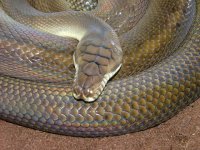
Just to add to the flood of similar comments; while i'm against euthanasia for any animal not in clear physical distress, there is no way I could support an animal with a clear physical such as this breeding.
Ultimately, however, I don't think it matters all that much. Yes, it's somewhat unethical. However, it's highly unlikely to become an issue, since the market isn't that big; and the deformity is not such as to render the animal unviable without special care -- normal pet care should be adequate. Eyesight in snakes is at most a co-primary sense, more often a secondary one; and more important to avoiding predators than it is for finding food. Nor is this animal likely to pollute the gene pool since it is 1) not likely to be released into the wild and 2) will not survive long if it is.
Highly specialized breeding and hybridization has been going on in numerous species throughout history. Nearly all dogs are the result of this sort of breeding, and many have serious health problems because of it. Unfortunate, but not likely to change anytime soon. And since almost none of the more extreme variants will survive in the wild, there is no real danger of contamination of wild species (less extreme variants will interbreed and eventually achieve a set of median forms which will encompass the better traits of the various sub-groups).
Regarding the differences between morphs and more severe traits like the eyelessness; I agree that the differences is one of kind, not of degree. Colour morphs are an environmental adaptation -- while albinoism/anerythrism/leucicism/etc. often results in a less survivable animal, this is due exclusively to the environment, the fact that the animal no longer blends in well with it's surroundings. This is why regional variations exist -- a colour that may make the snake highly visible in one location, may make it almost invisible in another. (There is a study on this phenomenon involving a species of moth, which I'm too lazy to look up right now.) So the morph can actually confer benefits to the animal. Eyelessness, however, is a true disability that can only negatively impact the animal's survivability. It has no benefits whatsoever. There are no naturally-occuring blind reptile species that I'm aware of (the misnamed "Blind-worm" snakes notwithstanding, since they do have eyes and are able to differentiate light and dark patterns at the very least); and deep caves are not environments where herps are capable of surviving, due to the cold temperatures.
Mostly, I just see a lot of over-reacting and demonization from both sides. No, I don't think Glen is acting ethically, but I hardly think that he's likely to destroy the herp world either. There are far worse sellers and breeders out there to worry about. My biggest gripe with him is not the snake so much as it is the possible misrepresentation involved in his advertising of it and possible offspring, should the trait prove genetic.
A couple other notes, sort of pet peeves. Once a trait is bred out, chances are not good that it can be bred back in, unless external bloodlines displaying that trait are added to the gene pool. This is particularly true with traits on the dominant end of the spectrum -- once they are bred out, then the only traits that are left are recessive (with recessive traits, it's far more difficult to tell if they've been completely bred out or not).
A bigger pet peeve is the whole "heightened senses compensating for disabilities" thing. As the term has been used in this thread, it is pretty much a misconception and scientific fallacy. The existence of a disabled sense does not automatically confer superiority to any of the other senses. The reason that it appears to be the case is that those other senses are more relied upon, and therefore is better trained to use those senses as primary.
Incidentally, the only time I have ever seen this claimed is for blind people, never for the deaf, or those with disabled olfactory or taste senses. Humans are predominantly a visual animal, and rely primarily on their eyesight. Sound and touch are secondary senses, as are taste and smell (though the last two are rarely depended upon, and can even be relegated to tertiary senses for most people).
The loss of a primary sense results in the individual being more dependent upon secondary senses, thus training them to a much higher degree than is commonly done. This is not something that is unique to the disabled, however; and it is perfectly possible for non-disabled individuals to train secondary senses to a similar, or even greater, degree. Just talk to any professional classical musician, or even better, Navy sonar operator (actually, I've never known a blind person who had a sense of hearing as highly trained as a sonar jock).
For snakes, eyesight is not a primary sense, or not their only primary sense. And it's unlikely that animals have the capacity to train their senses, since even for disabled humans, it requires a certain amount of conscious effort to do so. And disable animals do not survive long in the wild.
Just for the record, I also tend to oppose inter-species hybridization; with the caveat that we don't really know enough in many cases to accurately determine whether a particular differences is an example of true speciation, or simply a regional variant. (However, I am something of a purist, regardless, so I tend to prefer keeping regional bloodlines, such as my Crawl Caye Boa, pure.) I don't have a problem with the various morphs, even those not normally occuring in nature (like Super-Tiger Retics).